Pregunta 1
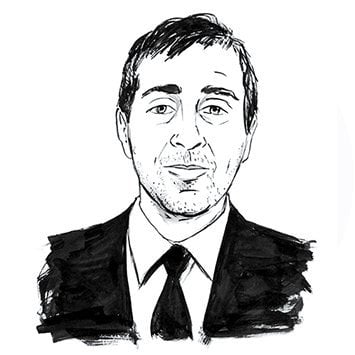
George Hotz
x.com/realgeorgehotzProgrammer who is enthusiastic about practical AI and argues that ordinary people should own it rather than depend on a few companies or governments.
¿Cómo cambiará la IA el mundo?
Horizontal: su perspectiva Doom–Bloom expresada. Vertical: escala de la transformación.
Doom–Bloom: 82 de 100. Escala de la transformación: 66 de 100. Rangos de interpretación: de 75 a 100 en horizontal y de 61 a 75 en vertical. Son coordenadas de interpretación, no probabilidades de eventos.
≈3%
Inferido a partir de sus respuestas simuladas, no de un número que haya dado. Rango plausible: 2–8%.
Un supuesto central
If models commoditize—and I think they will—then much knowledge work gets cheaper, wage premiums fall, and plenty of institutions built around scarce expertise get rearranged.Respuesta 1
Si este supuesto resultara distinto, ¿cómo cambiaría su perspectiva?
Qué podría hacer cambiar de opinión
A real, reproducible hard takeoff would change my view most: one system rapidly improving itself, overcoming practical search and coordination limits, and building a durable lead that competitors with distributed compute cannot close.Respuesta 2
¿Qué evidencia bastaría y en qué dirección movería su visión?
Más detalles
Se esperan beneficios transformadores y de gran valor para muchos.
90 / 100
Rango de interpretación de 67 a 100 en la escala cualitativa.
Se esperan daños manejables o localizados.
45 / 100
Rango de interpretación de 33 a 67 en la escala cualitativa.
Las decisiones humanas pueden redirigir sustancialmente la trayectoria de la IA.
71 / 100
Rango de interpretación de 48 a 100 en la escala cualitativa.
Restringir el acceso a la IA potente.
Permitir el acceso con restricciones de capacidad o de uso.
Posición simulada: Favorecer un acceso amplio o abierto a la IA potente.
Estas interpretaciones conservan las condiciones que se indicaron. Los beneficios y los daños pueden ser considerables a la vez. Los rangos describen cómo leemos sus respuestas simuladas, no intervalos de confianza estadísticos.
Visiones similares
Líderes de opinión cuyas visiones simuladas son las más cercanas a la de George Hotz
Lo que George Hotz ha dicho sobre la IA
Hotz is enthusiastic about practical AI, doubts runaway superintelligence and argues that ordinary people should own AI, not rely on a few companies.
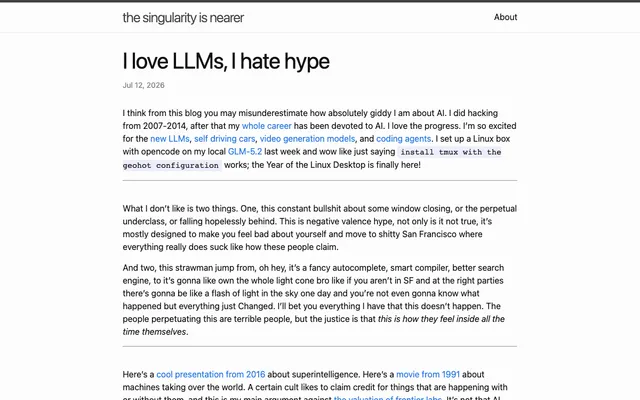
“I love the progress. I’m so excited for the new LLMs, self driving cars, video generation models, and coding agents.”
Blog post, I love LLMs, I hate hype “Intelligence is not the end all be all, it’s just the current bottleneck for a few things. You cannot take over the world with tokens.”
Blog post, AI 2040 and the Cult of Intelligence “AI will be cheap, everywhere, collapse a bunch of sectors of work, wreck wage premiums, and cause a big reevaluation of status hierarchies.”
Blog post, AI will be massively deflationary “I’m not sure it’s possible, but if there is a bad scenario with AI, it’s a singleton with nothing that can substantially impact reality outside of it.”
Blog post, There is only one bad AI scenario “The good world is where everyone has AI, and not as a revokable privilege through an API, but through hard possession.”
Blog post, Do you really want the US to “win” AI?
Citas textuales de las fuentes enlazadas, comprobadas el 3 oct 2026
Evaluación simulada
Fuentes
Artículos, entrevistas y textos usados para fundamentar a este usuario simulado.
Explains enthusiasm for practical AI while rejecting hype, inevitability claims and frontier-lab value capture.

Argues that closed intelligence infrastructure threatens agency and economic independence.

Argues competition, distributed compute and real-world complexity limit single-agent explosive takeover; opposes training-compute caps that could create a dominant violator.

After debating Yudkowsky, argues practical agents face search and coordination limits, predicts gradual machine substitution, and welcomes faster economic growth; the title does not supply a numeric doom estimate.

Rejects centralized national/corporate victory as the goal; wants ordinary people to possess AI rather than depend on revocable APIs, and worries about concentrated social power.

Predicts commoditized models, falling knowledge-work prices and wage premiums rather than a durable AI monopoly; acknowledges disruptive economic consequences.

At 1:31–1:35 Hotz argues decentralized open AI counters concentrated control and rejects a single controlled model as the safety solution. Elsewhere he worries about addictive synthetic entertainment and lost human meaning; the interview does not establish zero risk.

¿Dónde te ubicas?
Mapear mi visión de la IA