Pregunta 1
Sayash Kapoor
x.com/sayashkAI evaluation and policy researcher who sees AI as transformative, measures how reliable AI agents are and favors resilience over nonproliferation.
¿Cómo cambiará la IA el mundo?
Horizontal: su perspectiva Doom–Bloom expresada. Vertical: escala de la transformación.
Doom–Bloom: 55 de 100. Escala de la transformación: 72 de 100. Rangos de interpretación: de 50 a 75 en horizontal y de 67 a 77 en vertical. Son coordenadas de interpretación, no probabilidades de eventos.
≈6%
Inferido a partir de sus respuestas simuladas, no de un número que haya dado. Rango plausible: 3–12%.
Trabajo e instituciones
So I expect rapid capability gains but institutionally paced change.
Respuesta 1
Agrupados por hito, sin espaciarlos ni ordenarlos por fechas inferidas. La IA general y la IA sobrehumana conservan sus definiciones.
Un supuesto central
AI can be enormously beneficial, but only if we make keeping humans in control an explicit institutional choice rather than assuming capability automatically brings reliability or good governance.Respuesta 2
Si este supuesto resultara distinto, ¿cómo cambiaría su perspectiva?
Una pregunta sin resolver
I don’t have a defensible number.Respuesta 4
¿Qué le ayudaría a distinguir aquí entre los desenlaces plausibles?
Más detalles
Se esperan beneficios sustanciales, con condiciones importantes o límites en su distribución.
79 / 100
Rango de interpretación de 67 a 100 en la escala cualitativa.
Se espera que los daños graves o generalizados sean una parte significativa del futuro.
66 / 100
Rango de interpretación de 67 a 67 en la escala cualitativa.
Las decisiones humanas pueden redirigir sustancialmente la trayectoria de la IA.
66 / 100
Rango de interpretación de 50 a 100 en la escala cualitativa.
Restringir los usos de la IA mencionados hasta que existan protecciones o permisos previos.
Posición simulada: Permitir los usos de la IA mencionados con rendición de cuentas y protecciones específicas.
Reducir al mínimo las restricciones a los usos de la IA mencionados.
Estas interpretaciones conservan las condiciones que se indicaron. Los beneficios y los daños pueden ser considerables a la vez. Los rangos describen cómo leemos sus respuestas simuladas, no intervalos de confianza estadísticos.
Visiones similares
Líderes de opinión cuyas visiones simuladas son las más cercanas a la de Sayash Kapoor
Evaluación simulada
Fuentes
Artículos, entrevistas y textos usados para fundamentar a este usuario simulado.
Says the normal-technology view is not capability skepticism: AI will be generally transformative, including at finding and chaining exploits. By analogy with fuzzing tools, he predicts such tools will differentially help cyber defenders over time while urging institutions to adopt them defensively now. He reads a lab’s reports of a model bypassing access controls as control failures and favors sandboxing, formal verification and layered ecosystem defenses; he calls it inevitable that small open-weight models will eventually be made to propagate across networks, so defenses must work at the systems level. He argues many important tasks have limits outside computation, that humans should stay in control, and that building AI with its own volition is a choice society should not make. He reports agent reliability improving four to ten times more slowly than accuracy, with a naive linear extrapolation of five to seven years to saturate their reliability benchmarks. Own turns in Substack’s machine transcript inspected; speaker labels inferred from the dialogue.

He describes AI as a general-purpose technology that will not lead to superintelligence and current open models as less consequential for biosecurity than some argue. His top research priority is resilience for a world where advanced AI is abundant with few safeguards, because he does not think its availability can be limited or that nonproliferation should carry the policy load. Acute cyber and bio risks matter, for example by deploying AI to defenders and into biological screening, but he is equally concerned about diffuse risks: eroding trust in journalism and in institutions’ ability to function. He cites his group’s finding that 2024 election deepfakes were no more effective than cheap fakes. Full interview text inspected.

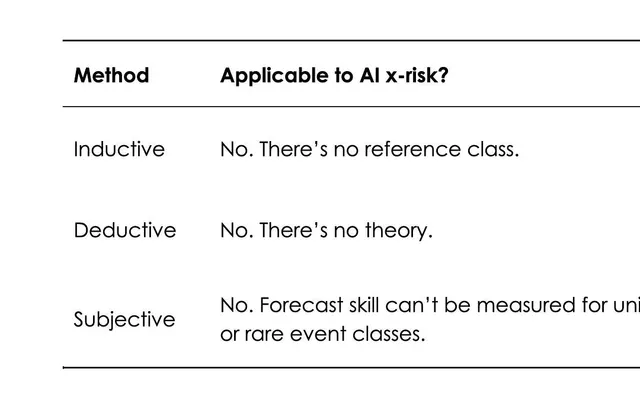
Co-authored repost of their 2024 essay with a new preface. It argues that AI extinction forecasts lack an inductive reference class, a deductive model or any validated subjective method, so they turn vague intuitions into pseudo-precise numbers; policymakers should not base costly restrictions on them, though forecasting is fine as an academic or private activity. Governments should prefer policies that are helpful across a range of risk estimates. The preface calls p(doom) culture counterproductive to a broader conception of safety. It offers no probability of its own and does not claim the risk is zero. Preface and essay inspected.

¿Dónde te ubicas?
Mapear mi visión de la IA