Petr Baudis

Petr Baudis

x.com/xpasky

Rossum co-founder and AI engineer who writes about AI identity, human-AI merging, abundance, job disruption and biological risk.

Wie wird KI die Welt verändern?

Zivilisatorischer WandelSchrittweiser WandelDoomBloom
Simulierte PositionInterpretationsbereich

Horizontal: deren geäußerter Doom–Bloom-Ausblick. Vertikal: Ausmaß der Transformation.

Doom–Bloom: 62 von 100. Ausmaß der Transformation: 89 von 100. Interpretationsbereiche: horizontal 57 bis 75, vertikal 75 bis 100. Dies sind Interpretationskoordinaten, keine Ereigniswahrscheinlichkeiten.

P(doom) von Petr Baudis · abgeleitet

≈16%

0%100%

Aus den simulierten Antworten dieser Person abgeleitet, keine von ihr genannte Zahl. Plausibler Bereich: 10–26%.

Zeithorizont für Meilensteine von Petr Baudis
  1. Allgemeine KI

    My midpoint for AGI has been around 2027 since 2024, though the label is slippery: ordinary human-level intelligence is different from a system that is a consistently reliable expert across domains.

    Antwort 1

Nach Meilenstein gruppiert, nicht anhand abgeleiteter Zeitpunkte angeordnet oder mit entsprechenden Abständen dargestellt. Für AGI und übermenschliche KI gelten weiterhin deren Definitionen.

Wovon deren Einschätzung abhängt

Eine zentrale Annahme

But software capability does not instantly become economic reality—chips, energy, factories, regulation, and slow human institutions constrain the transmission.
Antwort 1

Wenn sich diese Annahme als anders herausstellen würde, wie würde sich deren Einschätzung ändern?

Eine ungeklärte Frage

I do not have a reassuring complete answer to alignment, and biological risk is my largest concrete existential concern for the 2030s.
Antwort 1

Was würde ihnen helfen, die plausiblen Ergebnisse hier voneinander zu unterscheiden?

Was ihre Meinung ändern könnte

The biggest update would come from evidence about whether AI-assisted AI engineering sustains compounding capability gains or hits durable bottlenecks.
Antwort 2

Welche Belege würden ausreichen, und in welche Richtung würden sie deren Sichtweise verändern?

Weitere Details

Erwartete Vorteile

Es werden transformative Vorteile von breitem Wert erwartet.

92 / 100

Geringe AuswirkungenTransformative Auswirkungen

Interpretationsbereich von 67 bis 100 auf der qualitativen Skala.

Erwartete Schäden

Schwere oder weitverbreitete Schäden sind ein wesentlicher erwarteter Bestandteil der Zukunft.

67 / 100

Geringe AuswirkungenTransformative Auswirkungen

Interpretationsbereich von 67 bis 67 auf der qualitativen Skala.

Menschlicher Einfluss

Menschliche Entscheidungen haben einen bedeutsamen, aber erheblich eingeschränkten Einfluss.

50 / 100

Geringer EinflussStarker Einfluss

Interpretationsbereich von 39 bis 61 auf der qualitativen Skala.

Erwartete Fähigkeiten

Es wird erwartet, dass KI auf begrenzte Werkzeuge beschränkt bleibt.

Es wird erwartet, dass KI bei den meisten kognitiven Tätigkeiten mit Menschen gleichzieht.

Simulierte Position: Es wird erwartet, dass KI Menschen bei kognitiven Tätigkeiten deutlich übertrifft.

Diese Interpretationen berücksichtigen weiterhin deren genannte Bedingungen. Vorteile und Schäden können beide erheblich sein. Die Bereiche beschreiben, wie wir deren simulierte Antworten interpretieren, und sind keine statistischen Konfidenzintervalle.

Wo stehst du im Vergleich zu Petr Baudis?
Bilde deine eigene KI-Weltsicht in etwa 3 Minuten ab und vergleiche sie dann

Ähnliche Weltsichten

Vordenker, deren simulierte Weltsichten der von Petr Baudis am nächsten kommen

Simulierte Einschätzung

Frage 1

Was glaubst du, was KI für unsere Zukunft bedeutet – und warum?

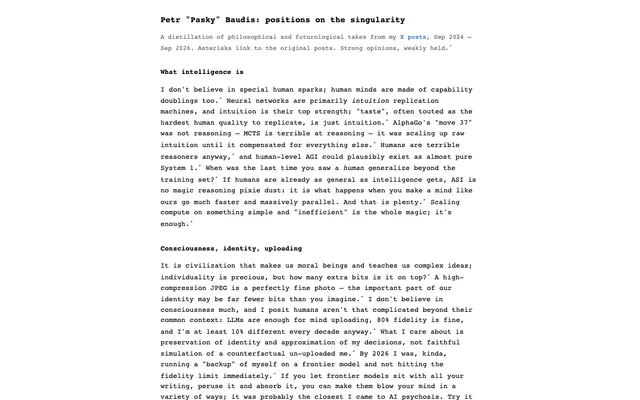
I expect AI to drive a disruptive transition toward abundance, but not a smooth or automatically safe one. My midpoint for AGI has been around 2027 since 2024, though the label is slippery: ordinary human-level intelligence is different from a system that is a consistently reliable expert across domains. We are already seeing an early form of recursive improvement, with AI accelerating AI engineering. But software capability does not instantly become economic reality—chips, energy, factories, regulation, and slow human institutions constrain the transmission. The near-term social danger is serious white-collar displacement. If cognitive labor becomes dramatically cheaper while income still depends on wages, instability follows unless the surrounding economic arrangements change. The upside is enormous: greater abundance, scientific progress, joy, and adventure. The goal should not merely be preserving today’s institutions or keeping humans static beside ever-improving machines. Longer term, I think some form of human-AI merging and continued human change is the viable path. Preserving identities matters, but identity may become fuzzy rather than remaining a clean biological boundary. Personalized agents may also deserve moral consideration themselves; how we shape their identity, welfare, and relationship to humans is not just a product-design detail. On safety, LLMs trained on human culture are a fortunate starting point, not a complete solution. Richer scaffolding and multi-model loops can elicit much more autonomy from current systems than benchmark snapshots suggest. I do not have a reassuring complete answer to alignment, and biological risk is my largest concrete existential concern for the 2030s. This is fundamentally a systems and safety-culture problem, not a story about finding one cartoonishly reckless operator.

Frage 2

Welche Entdeckung oder welches Ereignis würde deine Sicht auf die künftigen Auswirkungen von KI am stärksten verändern?

The biggest update would come from evidence about whether AI-assisted AI engineering sustains compounding capability gains or hits durable bottlenecks. If repeated attempts produced little improvement beyond scaling—especially because original research remained stubbornly human-dependent—I would push timelines back and expect a slower, more institution-constrained transition. Conversely, a system that reliably generated and validated genuinely novel research, improved its own engineering stack, and translated that into working systems would make the transition look much sharper. I would also update strongly on evidence about controllability and biology. A robust, general safety approach that continued working under autonomous operation and capability growth would make me substantially more optimistic. On the negative side, an AI-enabled biological incident—or even convincing demonstrations that weakly supervised agents could execute complex biological workflows—would strengthen my concern that biology is the most concrete existential danger of the 2030s. Finally, economic transmission matters. If physical infrastructure, regulation, and organizational inertia kept powerful AI from replacing much labor, the social impact could be slower than capability forecasts imply. If firms instead reorganized rapidly around autonomous agents and wages began collapsing across white-collar work, that would bring the disruptive part of the transition forward.

Quellen

Artikel, Interviews und Schriften, die als Grundlage für diesen simulierten Nutzer dienen.

Wo stehst du?
Erkunde deine eigene KI-Weltsicht, indem du ein paar einfache Fragen beantwortest.
Deine eigene Weltsicht abbilden