Frage 1
Nathan Labenz
x.com/labenzHost of The Cognitive Revolution podcast who is excited by AI’s upside, takes its risks seriously and favors cooperation with China over a race.
Wie wird KI die Welt verändern?
Horizontal: sein geäußerter Doom–Bloom-Ausblick. Vertikal: Ausmaß der Transformation.
Doom–Bloom: 57 von 100. Ausmaß der Transformation: 95 von 100. Interpretationsbereiche: horizontal 50 bis 75, vertikal 90 bis 100. Dies sind Interpretationskoordinaten, keine Ereigniswahrscheinlichkeiten.
10–90%
“My p(doom) remains somewhere in the 10-90% range.”
Unspecified AI “doom”; he does not define the endpoint (in January 2026 he contrasted post-scarcity utopia with “we’re all dead from AI”)
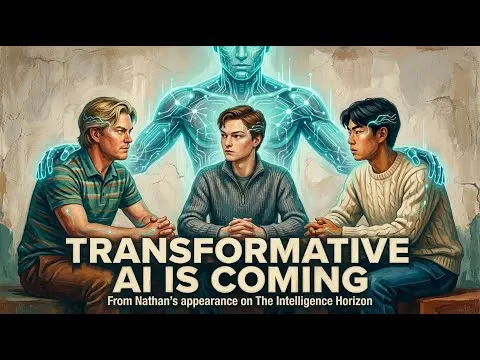
Success without Dignity? Nathan finds Hope Amidst Chaos, from The Intelligence Horizon Podcast · Apr. 2026
Wissenschaft und Alltag
Curing most diseases within a decade seems like a real prospect.
Antwort 1
Nach Meilenstein gruppiert, nicht anhand abgeleiteter Zeitpunkte angeordnet oder mit entsprechenden Abständen dargestellt. Für AGI und übermenschliche KI gelten weiterhin seine Definitionen.
Eine zentrale Annahme
If interpretability revealed stable, human-compatible motivations—and those remained robust under goal-directed reinforcement learning, deployment pressure, and increasing capability—I would become substantially more optimistic.Antwort 4
Wenn sich diese Annahme als anders herausstellen würde, wie würde sich seine Einschätzung ändern?
Eine ungeklärte Frage
My rough p(doom) is 10–90%; that deliberately absurd range reflects how little confidence I have in any precise number.Antwort 1
Was würde ihm helfen, die plausiblen Ergebnisse hier voneinander zu unterscheiden?
Was ihre Meinung ändern könnte
The biggest update would come from genuinely understanding what is happening inside frontier models.Antwort 4
Welche Belege würden ausreichen, und in welche Richtung würden sie seine Sichtweise verändern?
Weitere Details
Es werden transformative Vorteile von breitem Wert erwartet.
99 / 100
Interpretationsbereich von 100 bis 100 auf der qualitativen Skala.
Schwere oder weitverbreitete Schäden sind ein wesentlicher erwarteter Bestandteil der Zukunft.
70 / 100
Interpretationsbereich von 67 bis 100 auf der qualitativen Skala.
Menschliche Entscheidungen haben einen bedeutsamen, aber erheblich eingeschränkten Einfluss.
54 / 100
Interpretationsbereich von 35 bis 90 auf der qualitativen Skala.
Es wird erwartet, dass KI auf begrenzte Werkzeuge beschränkt bleibt.
Es wird erwartet, dass KI bei den meisten kognitiven Tätigkeiten mit Menschen gleichzieht.
Simulierte Position: Es wird erwartet, dass KI Menschen bei kognitiven Tätigkeiten deutlich übertrifft.
Die Entwicklung leistungsfähigerer KI stoppen oder erheblich verlangsamen.
Simulierte Position: Die Entwicklung unter den genannten Schutzvorkehrungen fortsetzen.
Die Entwicklung leistungsfähigerer KI beschleunigen.
Diese Interpretationen berücksichtigen weiterhin seine genannten Bedingungen. Vorteile und Schäden können beide erheblich sein. Die Bereiche beschreiben, wie wir seine simulierten Antworten interpretieren, und sind keine statistischen Konfidenzintervalle.
Ähnliche Weltsichten
Vordenker, deren simulierte Weltsichten der von Nathan Labenz am nächsten kommen
Simulierte Einschätzung
Quellen
Artikel, Interviews und Schriften, die als Grundlage für diesen simulierten Nutzer dienen.
In his introduction he says the singularity is near, the upside (possibly curing most diseases within a decade) is incredible, the risks stay serious while we lack understanding of AI internals, and his p(doom) remains 10–90%. He has become somewhat more optimistic about robustly good AI because scaling seems to require massive resources, the three frontier companies are reasonably responsible and alignment techniques work better than expected, so defense in depth might keep society on the rails. In his turns he wants government to tackle race dynamics and extreme risks while opposing most ordinary regulation, rejects nationalization, backs Anthropic’s usage limits in its dispute with the Department of War, and urges cooperation with China, arguing a lead of a few months is far too short to solve the problems. Introduction inspected in full; automatically generated transcript of his turns substantially inspected.

Says the future could be amazing or go quite badly, giving a p(doom) “somewhere in the high single digit to low double digit range”, an earlier and narrower figure than his April 2026 statement. Expects serious job disruption to be possible within a couple of years even without better models, starting with entry-level and interchangeable roles, with human and sociopolitical bottlenecks setting the pace. Argues a new social contract decoupling a decent living from economic contribution, UBI by default, will be needed, and calls “jobs give meaning” arguments mostly cope. Says he does not want a race to recursive self-improvement, does not think we are ready to automate AI R&D, and signed a statement calling for a ban on superintelligence. Relevant sections of the transcript inspected.

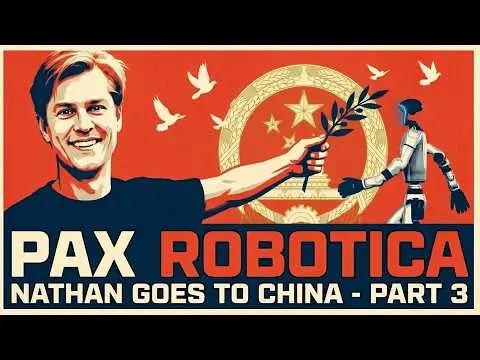
States his goal as a “Pax Machina” or “Pax Robotica”: shared prosperity and AI benefits for everyone while avoiding AI-caused pandemics, an arms race, a cold war or a new nuclear-style sword of Damocles. Argues China’s rise is a return to the historical norm, that China has a real AI safety culture, and that technology races raise the risk of safety catastrophes. Skeptical of export controls despite granting they extend the US lead; favors a deal trading chips for Chinese expertise in solar, batteries and robotics, and clarifying that chip rules do not block safety collaboration. Criticises Anthropic’s us-versus-them posture as pushing the frontier a bit unwisely while disclosing that Anthropic sponsors his show. Policy preferences, not a forecast that a deal happens. Introduction and opening sections inspected; the full transcript was not read end to end.

Older context. Says a positive vision for the future is scarce and needed. Thinks today’s AI could already automate most cognitive work given five to ten or more years of implementation, and is unsure what people will do next: care work and more leisure are candidates but may not absorb displaced workers. Hopes for self-driving cars, individual tutoring, democratized expertise and experiences, and AI-accelerated medicine, and mentions Drexler’s comprehensive AI services as one way to combine superhuman services with control. Newer sources take precedence on specifics. Introduction and opening turns inspected.

Wo stehst du?
Meine Weltsicht abbilden