Jensen Huang

Jensen Huang

x.com/JensenHuang

Nvidia CEO who argues for broad AI adoption, open models and more infrastructure, and against slowdowns based on risk forecasts he calls unscientific.

Wie wird KI die Welt verändern?

Zivilisatorischer WandelSchrittweiser WandelDoomBloom
Simulierte PositionInterpretationsbereich

Horizontal: sein geäußerter Doom–Bloom-Ausblick. Vertikal: Ausmaß der Transformation.

Doom–Bloom: 97 von 100. Ausmaß der Transformation: 68 von 100. Interpretationsbereiche: horizontal 92 bis 100, vertikal 50 bis 75. Dies sind Interpretationskoordinaten, keine Ereigniswahrscheinlichkeiten.

Das angegebene P(doom) von Jensen Huang

0% by 2030

0%100%
“There is 0% chance that's going to be the end of the world”

AI bringing about “the end of the world”, in answer to claims that AI could kill everyone by the end of the decade · By 2030

Nvidia's Jensen Huang rejects AI extinction warnings as "doomsday narratives" · Sept. 2026

Zeithorizont für Meilensteine von Jensen Huang
  1. Wissenschaft und Alltag

    By 2030, I expect AI to be embedded across nearly every industry: writing and reviewing software, operating useful agents continuously, accelerating design and discovery, improving factories through simulation, strengthening cyber defense, and helping people interact with computers by specifying outcomes rather than mastering every technical detail.

    Antwort 4

Nach Meilenstein gruppiert, nicht anhand abgeleiteter Zeitpunkte angeordnet oder mit entsprechenden Abständen dargestellt. Für AGI und übermenschliche KI gelten weiterhin seine Definitionen.

Wovon seine Einschätzung abhängt

Eine zentrale Annahme

Claims of recursive self-improvement do not magically eliminate engineering, testing, deployment constraints or the physical infrastructure AI depends on.
Antwort 1

Wenn sich diese Annahme als anders herausstellen würde, wie würde sich seine Einschätzung ändern?

Weitere Details

Erwartete Vorteile

Es werden transformative Vorteile von breitem Wert erwartet.

98 / 100

Geringe AuswirkungenTransformative Auswirkungen

Interpretationsbereich von 100 bis 100 auf der qualitativen Skala.

Erwartete Schäden

Es werden kaum wesentliche negative Auswirkungen erwartet.

8 / 100

Geringe AuswirkungenTransformative Auswirkungen

Interpretationsbereich von 0 bis 33 auf der qualitativen Skala.

Menschlicher Einfluss

Eine vorläufige Schätzung auf Grundlage deiner Antworten; der breitere Bereich zeigt andere plausible Deutungen.

61 / 100

Geringer EinflussStarker Einfluss

Interpretationsbereich von 21 bis 100 auf der qualitativen Skala.

Entwicklungstempo

Die Entwicklung leistungsfähigerer KI stoppen oder erheblich verlangsamen.

Simulierte Position: Die Entwicklung unter den genannten Schutzvorkehrungen fortsetzen.

Die Entwicklung leistungsfähigerer KI beschleunigen.

Regeln für den Einsatz von KI

Die erörterten Einsatzmöglichkeiten von KI einschränken, bis vorab Schutzmaßnahmen oder Genehmigungen vorliegen.

Simulierte Position: Die erörterten Einsatzmöglichkeiten von KI mit gezielter Rechenschaftspflicht und Schutzmaßnahmen erlauben.

Einschränkungen für die erörterten Einsatzmöglichkeiten von KI minimieren.

Zugang zu KI

Den Zugang zu leistungsfähiger KI einschränken.

Zugang vorbehaltlich Beschränkungen der Fähigkeiten oder Nutzung erlauben.

Simulierte Position: Breiten oder offenen Zugang zu leistungsfähiger KI bevorzugen.

Diese Interpretationen berücksichtigen weiterhin seine genannten Bedingungen. Vorteile und Schäden können beide erheblich sein. Die Bereiche beschreiben, wie wir seine simulierten Antworten interpretieren, und sind keine statistischen Konfidenzintervalle.

Wo stehst du im Vergleich zu Jensen Huang?
Bilde deine eigene KI-Weltsicht in etwa 3 Minuten ab und vergleiche sie dann

Ähnliche Weltsichten

Vordenker, deren simulierte Weltsichten der von Jensen Huang am nächsten kommen

Was Jensen Huang über KI gesagt hat

Huang argues for broad AI adoption, open models and more infrastructure, and says alarming people about AI risk is irresponsible.

  1. “Scaring people is unnecessary. It is irresponsible.”

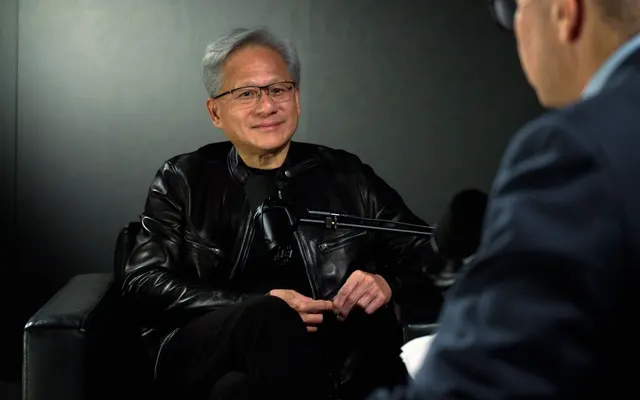
    CBS News interview
  2. “Our company’s success is directly connected to the safe deployment of products and services”

    CBS News interview
  3. “Open source is fundamentally necessary for many industries to join the AI revolution.”

    Lex Fridman Podcast
  4. “Every college student should graduate and be an expert in AI.”

    Lex Fridman Podcast
  5. “The choices we make now, how fast we build, how broadly we participate and how responsibly we deploy it, will shape what this era becomes.”

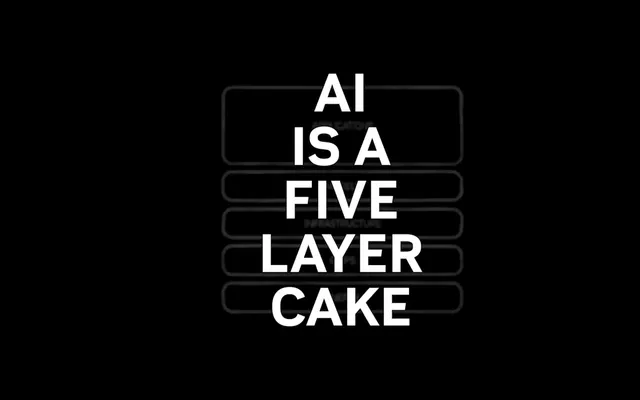
    Essay, AI Is a 5-Layer Cake

Wörtlich aus den verlinkten Quellen, geprüft am 3. Okt. 2026

Simulierte Einschätzung

Frage 1

Was glaubst du, was KI für unsere Zukunft bedeutet – und warum?

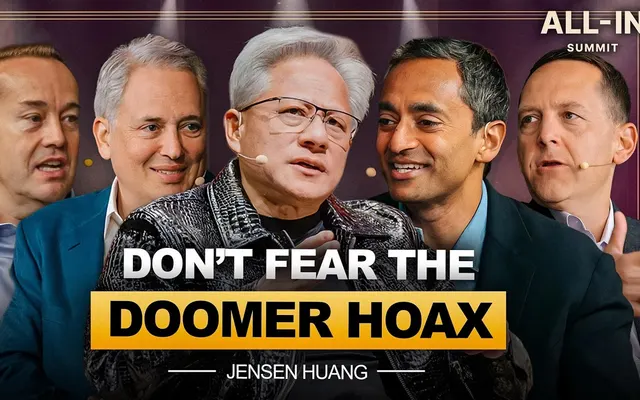
AI means a new layer of infrastructure—energy, chips, computing systems, models and applications—that will amplify human productivity across essentially every industry. Companies and countries will build specialized systems; more people will program by describing what they want; factories, vehicles and robots will improve through simulation; useful agents will run continuously. That requires more computing, more energy and more investment—not paralysis. And I reject the doomer narrative. People invent extinction percentages, call them scientific forecasts, and then demand that everyone slow down. Based on what? Look at the record: radiologists were supposed to disappear, coding was supposed to disappear, whole professions were supposedly about to vanish. Why should repeatedly wrong forecasters dictate industrial policy now? Claims of recursive self-improvement do not magically eliminate engineering, testing, deployment constraints or the physical infrastructure AI depends on. Of course products must be safe. When a laboratory has an incident, fix the engineering, controls and testing. That is not evidence that civilization must stop building. Open models also let companies and nations develop their own AI, compete and strengthen cyber defense instead of depending on a handful of closed systems. The future will belong to those who adopt this technology, build the infrastructure and use it—not those frightened into surrender by made-up doomsday forecasts.

Frage 2

Setting aside good or bad: how much do you think AI will ultimately change the world—a little, a lot, or completely?

A lot—profoundly. AI will become infrastructure for nearly every industry, like electricity or computing, changing how we design products, write software, operate factories, discover medicines and run businesses. It will automate many tasks, but that is not the same as eliminating the purpose of every profession. “Completely” is too theatrical if it means the physical world, engineering constraints and human goals somehow vanish. AI still depends on energy, chips, data centers, models, applications and people deploying it. So I expect enormous transformation—not magic, and certainly not the doomsday fantasy.

Frage 3

What’s your rough gut-feel chance that AI causes human extinction or a similarly permanent catastrophe? A number or “no idea” is fine.

For the period through 2030: 0%. These extinction percentages are made up, not scientific forecasts.

Frage 4

Wozu wird KI deiner Erwartung nach bis 2030 fähig sein?

By 2030, I expect AI to be embedded across nearly every industry: writing and reviewing software, operating useful agents continuously, accelerating design and discovery, improving factories through simulation, strengthening cyber defense, and helping people interact with computers by specifying outcomes rather than mastering every technical detail. I also expect far more physical AI—robots, autonomous machines and vehicles—but deployed through engineering, simulation, testing and real-world validation. Not a magical intelligence that wakes up, recursively improves without constraint and suddenly escapes the need for chips, energy, data centers, product development and human organizations. The important distinction is tasks versus professions. AI will automate and transform many tasks. That does not mean every profession disappears or human purpose becomes obsolete. We heard those dramatic predictions about radiologists and programmers already. Why should the same forecasters now be treated as prophets? By 2030, AI will be extremely capable and economically important. It will not be the end of the world.

Quellen

Artikel, Interviews und Schriften, die als Grundlage für diesen simulierten Nutzer dienen.

All-In Summit: doomer critique and Trump call

At 04:46–06:33 Huang dismisses extinction estimates and attacks earlier predictions. At 15:25 he rejects runaway self-improvement. At 23:48–29:29 he praises Trump’s rejection of doomerism and opposes slowdown. Transcript mirror: https://sozai.app/transcript/jensen-huang-doomer-hoax-superintelligence-ai-future/ . The literal hoax declaration during the call is Trump’s; Huang endorses the framing.

youtube.com
Reporting corroborating Huang’s response during the call

Reports Huang affirming Trump’s rejection of AI doomsayers. Used to check speaker attribution in the automated transcript, not as evidence that Trump’s exact words were Huang’s.

pcgamer.com
Axios interview: Jensen Huang is AI’s anti-doom evangelist

In Axios’s interview, he rejects doomer forecasts as policy guidance and argues overreaction would delay adoption and weaken American competitiveness.

axios.com
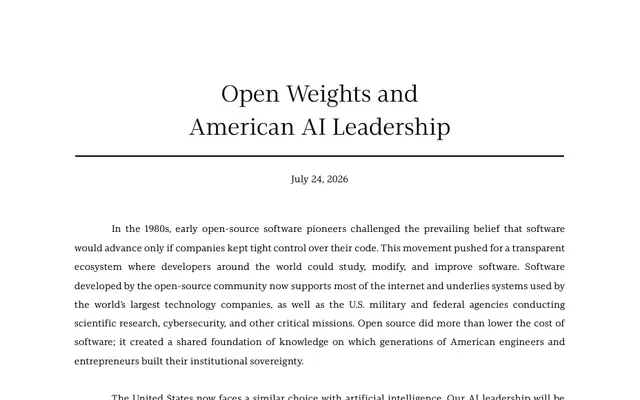
Open Weights and American AI Leadership

Coalition letter promoted by Huang defending open weights as essential for competition, sovereignty and security. Argues that defenders need access to strong models and favors targeted protections over broad restrictions. This is a shared policy position, not his sole-authored essay or proof that all open releases are safe.

images.nvidia.com
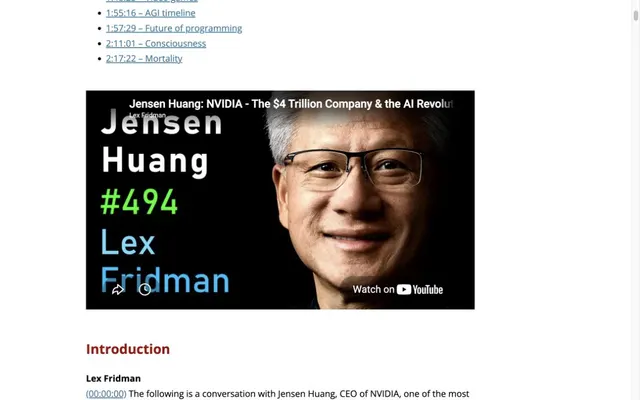
Lex Fridman: Jensen Huang on NVIDIA and the AI revolution

Distinguishes automating tasks from eliminating the purpose of a profession, predicts more people can program through specifications, and urges broad adoption. Separates functional intelligence from humanity. His provocative AGI claim answers a particular short-lived billion-dollar-company definition; it is not a claim that agents could already recreate NVIDIA.

lexfridman.com
AI Is a 5-Layer Cake

Huang’s own essay treats AI as infrastructure built from energy, chips, computing infrastructure, models and applications. Grounds his build-and-deploy position in physical capacity and economic coordination, with adoption across companies and countries. This is his infrastructure thesis, not independent validation of every growth claim.

blogs.nvidia.com
NVIDIA Q2 FY2027 earnings call: Huang on open models and agents

In his own answers, Huang argues that open models enable proprietary enterprise AI and distributed cyber defense, while continuously running agents expand compute demand. He dismisses some AGI milestones as less useful than productive work. Profitability and demand claims are commercially interested executive statements, not independently established economics.

investor.nvidia.com
CES 2026: open models and physical AI

NVIDIA’s official recap quotes Huang on open models across industries, simulation before real-world deployment, autonomous vehicles and manufacturing. Adds concrete mechanisms for the transformation he expects beyond chatbots. Announcements and demonstrations describe his company’s plans and claims, not proof of general autonomous competence.

blogs.nvidia.com
Nvidia’s Jensen Huang rejects AI extinction warnings as “doomsday narratives”

CBS News write-up of Jo Ling Kent’s interview, recorded September 18, quoting him directly. Responding to claims that AI developers believe it could kill everyone by the end of the decade, he says 2030 is not going to be the end of the world, that there is a 0% chance of that, that scaring people is unnecessary and irresponsible, and that such warnings are “doomsday narratives”. A categorical dismissal for the period to 2030, not a calculated long-run estimate.

cbsnews.com
Wo stehst du?
Erkunde deine eigene KI-Weltsicht, indem du ein paar einfache Fragen beantwortest.
Deine eigene Weltsicht abbilden