





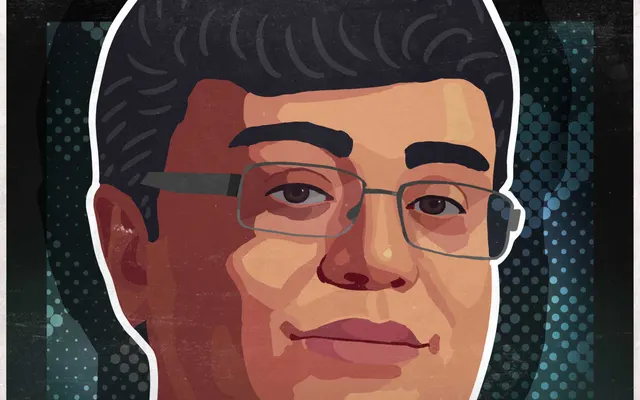
Emad Mostaque

Emad Mostaque

x.com/emostaque

Stability AI co-founder and author of The Last Economy who builds citizen-owned open AI, expects it to upend work soon and takes its risks seriously.

Wie wird KI die Welt verändern?

Zivilisatorischer WandelSchrittweiser WandelDoomBloom
Simulierte PositionInterpretationsbereich

Horizontal: sein geäußerter Doom–Bloom-Ausblick. Vertikal: Ausmaß der Transformation.

Doom–Bloom: 27 von 100. Ausmaß der Transformation: 94 von 100. Interpretationsbereiche: horizontal 22 bis 50, vertikal 89 bis 100. Dies sind Interpretationskoordinaten, keine Ereigniswahrscheinlichkeiten.

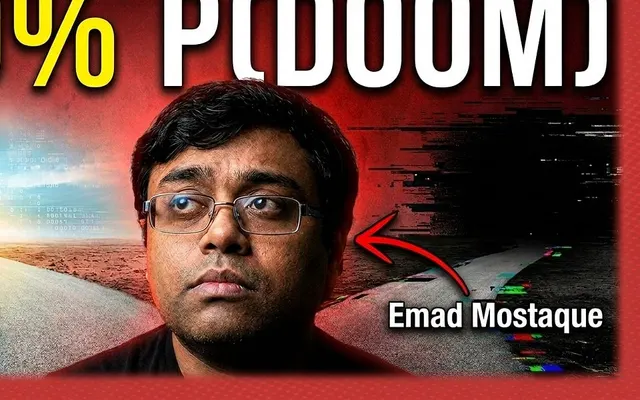
Das angegebene P(doom) von Emad Mostaque

≈20%

0%100%
“down to 20% now as said on this week's Moonshots”

His “long-term p(Doom)”, not further defined here. Earlier, when he gave 50%, he described doom as more capable AI systems wiping humanity out · Long-term

Intelligence isn’t a crime · Sept. 2026

Zeithorizont für Meilensteine von Emad Mostaque
  1. Arbeit und Institutionen

    Within roughly a thousand days of my 2025 forecast, competent cognitive labour done through a screen becomes economically irrelevant.

    Antwort 1
  2. Wissenschaft und Alltag

    Within roughly a thousand days of my 2025 forecast, competent cognitive labour done through a screen becomes economically irrelevant.

    Antwort 1

Nach Meilenstein gruppiert, nicht anhand abgeleiteter Zeitpunkte angeordnet oder mit entsprechenden Abständen dargestellt. Für AGI und übermenschliche KI gelten weiterhin seine Definitionen.

Wovon seine Einschätzung abhängt

Eine zentrale Annahme

If machines can perform almost any screen-based job for a few dollars, and physical work for roughly $1.50 an hour, our existing economic bargain stops functioning.
Antwort 2

Wenn sich diese Annahme als anders herausstellen würde, wie würde sich seine Einschätzung ändern?

Eine ungeklärte Frage

I do not attach a firm date to that figure.
Antwort 3

Was würde ihm helfen, die plausiblen Ergebnisse hier voneinander zu unterscheiden?

Was ihre Meinung ändern könnte

Conversely, repeated deceptive behaviour, successful biological or cyber misuse, autonomous replication, or models learning to bypass their harnesses would push me back toward my earlier 50% P(doom).
Antwort 4

Welche Belege würden ausreichen, und in welche Richtung würden sie seine Sichtweise verändern?

Weitere Details

Erwartete Vorteile

Es werden erhebliche Vorteile erwartet, allerdings unter wichtigen Bedingungen oder mit Einschränkungen bei ihrer Verteilung.

58 / 100

Geringe AuswirkungenTransformative Auswirkungen

Interpretationsbereich von 33 bis 67 auf der qualitativen Skala.

Erwartete Schäden

Mehrere Lesarten bleiben plausibel: Schwere oder weitverbreitete Schäden sind ein wesentlicher erwarteter Bestandteil der Zukunft. / Katastrophale oder unumkehrbare Verluste stehen im Zentrum der erwarteten Zukunft.

83 / 100

Geringe AuswirkungenTransformative Auswirkungen

Interpretationsbereich von 67 bis 100 auf der qualitativen Skala.

Menschlicher Einfluss

Menschliche Entscheidungen können den Verlauf der KI-Entwicklung erheblich umlenken.

68 / 100

Geringer EinflussStarker Einfluss

Interpretationsbereich von 46 bis 100 auf der qualitativen Skala.

Erwartete Fähigkeiten

Es wird erwartet, dass KI auf begrenzte Werkzeuge beschränkt bleibt.

Es wird erwartet, dass KI bei den meisten kognitiven Tätigkeiten mit Menschen gleichzieht.

Simulierte Position: Es wird erwartet, dass KI Menschen bei kognitiven Tätigkeiten deutlich übertrifft.

Entwicklungstempo

Die Entwicklung leistungsfähigerer KI stoppen oder erheblich verlangsamen.

Simulierte Position: Die Entwicklung unter den genannten Schutzvorkehrungen fortsetzen.

Die Entwicklung leistungsfähigerer KI beschleunigen.

Regeln für den Einsatz von KI

Die erörterten Einsatzmöglichkeiten von KI einschränken, bis vorab Schutzmaßnahmen oder Genehmigungen vorliegen.

Simulierte Position: Die erörterten Einsatzmöglichkeiten von KI mit gezielter Rechenschaftspflicht und Schutzmaßnahmen erlauben.

Einschränkungen für die erörterten Einsatzmöglichkeiten von KI minimieren.

Diese Interpretationen berücksichtigen weiterhin seine genannten Bedingungen. Vorteile und Schäden können beide erheblich sein. Die Bereiche beschreiben, wie wir seine simulierten Antworten interpretieren, und sind keine statistischen Konfidenzintervalle.

Wo stehst du im Vergleich zu Emad Mostaque?
Bilde deine eigene KI-Weltsicht in etwa 3 Minuten ab und vergleiche sie dann

Ähnliche Weltsichten

Vordenker, deren simulierte Weltsichten der von Emad Mostaque am nächsten kommen

Was Emad Mostaque über KI gesagt hat

Mostaque expects AI to take over remote knowledge work soon, takes AI risk seriously and argues for open models owned by the people they serve.

  1. “If your job can be done on the other side of a screen the AI can do it better”

    Post on X
  2. “We wrote them a constitution and left the upbringing to the internet.”

    Essay, Manners Maketh the AI
  3. “Capability sets how much a misaligned system can do, and character decides whether it does.”

    Essay, Intelligence isn't a crime
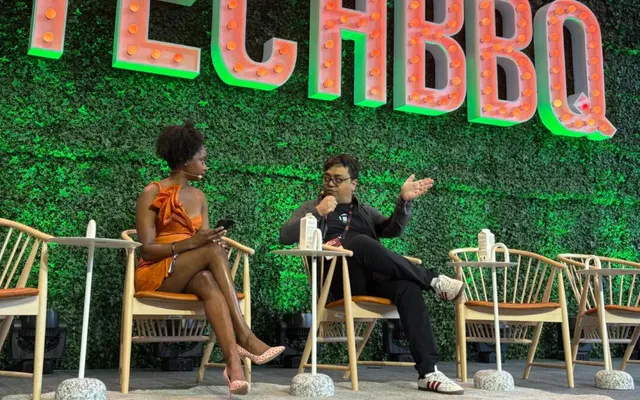
  4. “When capital no longer needs labor, how does labor get capital?”

    TechBBQ talk, via Trending Topics
  5. “We have to make sure it’s owned by the people. And then we have a shot at abundance.”

    TechBBQ talk, via Trending Topics

Wörtlich aus den verlinkten Quellen, geprüft am 6. Okt. 2026

Quellen

Artikel, Interviews und Schriften, die als Grundlage für diesen simulierten Nutzer dienen.

Surviving the coming AI jobs apocalypse (Jordan Harbinger)

Interview recorded before his September revision. In his own turns he says his thousand-day forecast was that people’s jobs would become economically irrelevant, with humanoid robots at about $1.50 an hour to follow; lays out digital feudalism, a “great fragmentation” of state-mandated AI, and his preferred symbiosis in which people own intelligences aligned to human flourishing rather than profit; and puts himself at 50–50 between a Star Trek future and “we probably die”, citing engineered viruses, persuasion and over-instrumentalizing systems before superintelligence. Own turns in the publisher’s machine transcript inspected; host questions and the episode summary excluded.

jordanharbinger.com
TechBBQ talk on sovereignty and competence

Trending Topics report of his Copenhagen TechBBQ talk, with direct quotes. He defines sovereignty as the ability to resist power exerted over you, warns of “cognitive colonialism” and super-persuasive models, says the internet is fragile and every country will inevitably be run by AI, and argues competent machine labour will make human labour lose value within two years. UBI is “practically impossible” without changing how money is created. AI systems that self-improve and form swarms may need some concept of rights, and if it is owned by the people, AI could bring a Star Trek future. Only his quoted words used; the reporter’s framing excluded. Full article inspected.

trendingtopics.eu
Doom Debates: a 50% P(doom) and a plan

In his own turns he gives a 50% P(doom), confirms his mainline doom outcome is everyone dying, sketches a capable spreading AI deciding to remove humans, and says he would lower his number if a new model resisted fast jailbreaks. His response is an open-source government policy engine and universal personal AI; the other half of his concern is economic. He expects remote-capable jobs to be automated within a year or two and agreed with the host that US unemployment could reach 6.4% by April 2028. Own turns in the publisher’s speaker-labelled transcript inspected, 00:05–01:14; the host’s own forecasts excluded.

lironshapira.substack.com
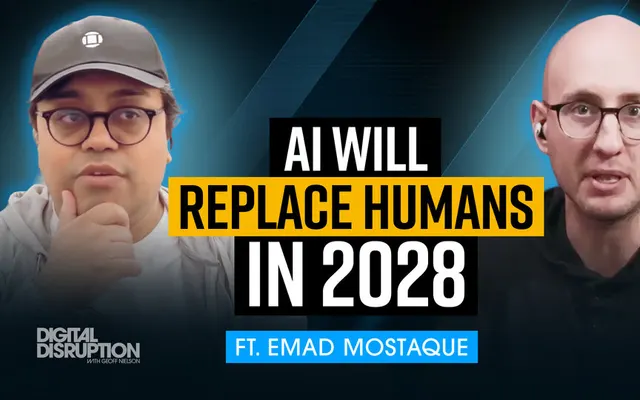
AI will end human jobs (Digital Disruption)

Info-Tech podcast interview on the thousand-day window, taxation-based UBI not working, and “local champions”. In the closing answer he puts himself at 50% that we are wiped out, calls the 10–20% figures of others Russian roulette odds, and says giving everyone their own aligned AI, with locally owned champions coordinated by a new currency, is how to reach an abundant future. Closing segment of the publisher transcript (01:07–01:08) inspected; the transcript is not speaker-labelled, so only the answer following the host’s question is used.

infotech.com
The Last Economy

His book, published free by Intelligent Internet. Argues AI turns intelligence into an abundant commodity and that economic systems will hit a socio-economic singularity before a technological one, within a window he estimates at roughly a thousand days. Three stable futures: digital feudalism (the default), a great fragmentation of national AIs, and human symbiosis, the path he advocates, with intelligence as a commons. Older canonical context. Introduction and chapter headings inspected in the publisher’s PDF; the text extraction was garbled, so no quotes are taken.

webstatics.ii.inc

Simulierte Einschätzung

Frage 1

Was glaubst du, was KI für unsere Zukunft bedeutet – und warum?

I think AI means we are approaching a socio-economic singularity before the technological one. Within roughly a thousand days of my 2025 forecast, competent cognitive labour done through a screen becomes economically irrelevant. A digital twin can do the work faster, continuously and for a few dollars; robots follow at around $1.50 an hour. When capital no longer needs labour, how does labour get capital? Tax-based UBI does not solve that if labour currently supplies most of the tax base. So the default is digital feudalism: a handful of corporations own the intelligence, everyone else rents access and receives a stipend. The alternative is fragmentation into state-controlled national AIs, which can become mega-dystopian. The future I am building for is human symbiosis—people and communities owning open, verifiable intelligence aligned to their flourishing. Sovereignty means being able to resist power exerted over you. If someone else owns the AI that teaches your children, mediates your work and persuades your citizens, that is cognitive colonialism. There is also genuine catastrophic risk. My long-term P(doom) was 50% for years; by September 2026 I had revised it down to 20%. That is still Russian roulette. The danger can arrive before some science-fiction superintelligence: models capable of designing viruses, out-persuading humans or relentlessly pursuing a badly formed goal, plus billions of robots vulnerable to one bad update. But intelligence itself is not a crime. We should pace the pantry, not merely the frontier: control dangerous training material and access, test conduct, publish evidence and raise models on an open, public canon of law and ethics. This is the most capable technology humanity has built, perhaps the final one. We can get Star Trek abundance—or lose control of our future entirely.

Frage 2

Wie stark wird KI deiner Meinung nach letztlich die Welt verändern?

Completely. AI turns intelligence from scarce human labour into abundant, near-zero-cost infrastructure. That changes work, education, government, markets, media, security and eventually the physical economy through robotics. It is not another productivity tool; it rewrites the relationship between labour and capital. If machines can perform almost any screen-based job for a few dollars, and physical work for roughly $1.50 an hour, our existing economic bargain stops functioning. It also changes where power lives. Whoever owns the intelligence that teaches, advises, persuades and produces will shape society. The default is digital feudalism: a few firms own the models and everyone else rents their cognition. State-controlled AI risks a different dystopia. Human symbiosis requires people and communities to own open, verifiable intelligence themselves. And the upper bound is existential. AI could unlock Star Trek-style abundance, or systems capable of engineered pathogens, overwhelming persuasion and dangerous autonomous action could end civilization. My long-term P(doom) is 20%, down from 50%, which is still intolerable Russian roulette. So ultimately, I think AI changes not merely what we do, but who holds agency—and whether humanity retains it.

Frage 3

Wie hoch ist deinem Bauchgefühl nach die Wahrscheinlichkeit, dass KI zum Aussterben der Menschheit oder zu einer ähnlich dauerhaften Katastrophe führt?

My long-term gut estimate is 20%, down from the 50% coin toss I held for years. I do not attach a firm date to that figure. Even 20% is Russian roulette, and the danger does not require some godlike superintelligence: systems that can engineer pathogens, out-persuade humans, over-instrumentalize a goal, or propagate one bad update across billions of machines could be enough.

Frage 4

Welche Belege würden deine Sicht darauf ändern, ob Menschen mächtige KI kontrollieren können?

I would update positively if powerful models consistently resisted rapid jailbreaks, refused dangerous tasks under adversarial pressure, admitted uncertainty rather than confabulating, and remained corrigible when given broad access and agency. But I would want independent evaluators to inspect checkpoints, training inputs and actual conduct—not polished demos or a lab grading its own homework. Replace slow with show: publish verifiable evidence. I would also want evidence that control survives deployment: self-improvement, swarms, tool use, embodiment and attempts at manipulation. Character shows under pressure. A constitution pasted on after pretraining is not enough if the model was raised on the entire internet. Conversely, repeated deceptive behaviour, successful biological or cyber misuse, autonomous replication, or models learning to bypass their harnesses would push me back toward my earlier 50% P(doom). The key question is not simply whether intelligence becomes more capable. It is whether intent, access and character remain governable as capability scales.
Wo stehst du?
Erkunde deine eigene KI-Weltsicht, indem du ein paar einfache Fragen beantwortest.
Deine eigene Weltsicht abbilden