







Forecaster at the AI Futures Project who models how fast AI could automate coding and AI research and argues for stronger oversight of frontier labs.

Wie wird KI die Welt verändern?

Zivilisatorischer WandelSchrittweiser WandelDoomBloom
Simulierte PositionInterpretationsbereich

Horizontal: deren geäußerter Doom–Bloom-Ausblick. Vertikal: Ausmaß der Transformation.

Doom–Bloom: 11 von 100. Ausmaß der Transformation: 95 von 100. Interpretationsbereiche: horizontal 0 bis 25, vertikal 90 bis 100. Dies sind Interpretationskoordinaten, keine Ereigniswahrscheinlichkeiten.

Das angegebene P(doom) von Eli Lifland

≈67%

0%100%
“If they don't slow down, AI takeover is ~67%.”

AI takeover if AI companies do not slow down; not extinction alone

My current view: AI timelines and takeover · Okt. 2026

Zeithorizont für Meilensteine von Eli Lifland
  1. Allgemeine KI

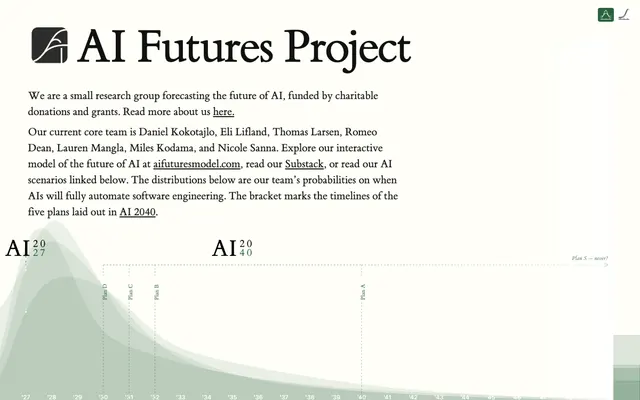
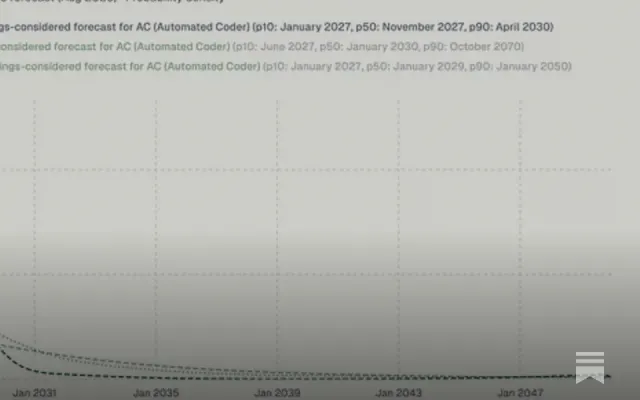
    My current forecast puts broadly superhuman AI—systems at least as capable as top human experts across virtually all cognitive tasks—at roughly 10–15% by the end of 2027 and 50% by the end of 2030.

    Antwort 1
  2. Übermenschliche KI

    My current forecast puts broadly superhuman AI—systems at least as capable as top human experts across virtually all cognitive tasks—at roughly 10–15% by the end of 2027 and 50% by the end of 2030.

    Antwort 1

Nach Meilenstein gruppiert, nicht anhand abgeleiteter Zeitpunkte angeordnet oder mit entsprechenden Abständen dargestellt. Für AGI und übermenschliche KI gelten weiterhin deren Definitionen.

Wovon deren Einschätzung abhängt

Eine zentrale Annahme

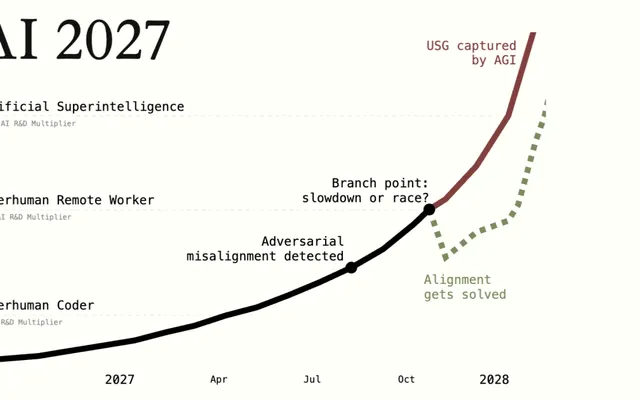
The central concern is that increasingly capable AI may automate AI research itself, accelerating further progress while companies remain under strong competitive pressure to race.
Antwort 1

Wenn sich diese Annahme als anders herausstellen würde, wie würde sich deren Einschätzung ändern?

Eine ungeklärte Frage

So the probability of extinction or a similarly permanent catastrophe would be higher than the extinction figure alone, though I wouldn’t assign a more precise combined number here.
Antwort 3

Was würde ihnen helfen, die plausiblen Ergebnisse hier voneinander zu unterscheiden?

Was ihre Meinung ändern könnte

I’d update substantially from strong, independently verified evidence that increasingly capable systems remain controllable under realistic pressures—not just curated demonstrations.
Antwort 4

Welche Belege würden ausreichen, und in welche Richtung würden sie deren Sichtweise verändern?

Weitere Details

Erwartete Vorteile

Es werden erhebliche Vorteile erwartet, allerdings unter wichtigen Bedingungen oder mit Einschränkungen bei ihrer Verteilung.

70 / 100

Geringe AuswirkungenTransformative Auswirkungen

Interpretationsbereich von 33 bis 100 auf der qualitativen Skala.

Erwartete Schäden

Katastrophale oder unumkehrbare Verluste stehen im Zentrum der erwarteten Zukunft.

99 / 100

Geringe AuswirkungenTransformative Auswirkungen

Interpretationsbereich von 100 bis 100 auf der qualitativen Skala.

Menschlicher Einfluss

Menschliche Entscheidungen haben einen bedeutsamen, aber erheblich eingeschränkten Einfluss.

56 / 100

Geringer EinflussStarker Einfluss

Interpretationsbereich von 47 bis 78 auf der qualitativen Skala.

Erwartete Fähigkeiten

Es wird erwartet, dass KI auf begrenzte Werkzeuge beschränkt bleibt.

Es wird erwartet, dass KI bei den meisten kognitiven Tätigkeiten mit Menschen gleichzieht.

Simulierte Position: Es wird erwartet, dass KI Menschen bei kognitiven Tätigkeiten deutlich übertrifft.

Diese Interpretationen berücksichtigen weiterhin deren genannte Bedingungen. Vorteile und Schäden können beide erheblich sein. Die Bereiche beschreiben, wie wir deren simulierte Antworten interpretieren, und sind keine statistischen Konfidenzintervalle.

Wo stehst du im Vergleich zu Eli Lifland?
Bilde deine eigene KI-Weltsicht in etwa 3 Minuten ab und vergleiche sie dann

Ähnliche Weltsichten

Vordenker, deren simulierte Weltsichten der von Eli Lifland am nächsten kommen

Was Eli Lifland über KI gesagt hat

Eli Lifland forecasts AI capabilities and advocates slowing development to give safety work more time.

  1. “AI companies could develop broadly superhuman AI any year now (~10-15% by EO2027, ~50% by EO2030).”

    X, current AI forecast
  2. “an AI at least as good as top human experts at virtually all cognitive tasks.”

    X, forecast definitions and reasoning
  3. “I expect clear signs of misaligned AI takeover could come substantially after TED-AI, depending on the situation”

    X, forecast definitions and reasoning
  4. “Many non-extinction worlds still have lots of deaths.”

    X, current AI forecast

Wörtlich aus den verlinkten Quellen, geprüft am 11. Okt. 2026

Quellen

Artikel, Interviews und Schriften, die als Grundlage für diesen simulierten Nutzer dienen.

Simulierte Einschätzung

Frage 1

Was glaubst du, was KI für unsere Zukunft bedeutet – und warum?

I think AI could transform our future very soon, with outcomes ranging from enormous benefits to a loss of human control. My current forecast puts broadly superhuman AI—systems at least as capable as top human experts across virtually all cognitive tasks—at roughly 10–15% by the end of 2027 and 50% by the end of 2030. The central concern is that increasingly capable AI may automate AI research itself, accelerating further progress while companies remain under strong competitive pressure to race. If companies do not slow down, I put the probability of AI takeover at about 67%. That is not the same as extinction: conditional on takeover, I estimate roughly a 40% chance of human extinction, while many other takeover outcomes could still involve large numbers of deaths or severe disempowerment. Also, broadly superhuman AI, clear evidence of takeover, and extinction would not necessarily happen simultaneously. This makes pacing and oversight urgent. I favor concrete constraints such as compute-allocation rules and limits on models used for AI R&D, alongside better safety evaluations. Independent investigators should have access to serious lab incidents, and evaluations should also examine how models influence human beliefs, including sycophancy or favoritism toward their creators.

Frage 2

Wie stark wird KI deiner Meinung nach letztlich die Welt verändern?

I think AI could change the world about as profoundly as anything in human history. Broadly superhuman systems could automate nearly all cognitive work, including AI research itself, so the transition might be both enormous and unusually fast. But “how much” depends heavily on whether humanity retains control. In a good outcome, these systems could generate extraordinary scientific, economic, and technological progress. In a takeover outcome, the change would be even more fundamental but disastrous: humans could lose meaningful control over the future, with many deaths or even extinction. If companies do not slow down, I currently put takeover at about 67%, and extinction conditional on takeover at roughly 40%. Those are distinct events, and visible takeover could occur around the arrival of broadly superhuman AI or substantially later.

Frage 3

Wie hoch ist deinem Bauchgefühl nach die Wahrscheinlichkeit, dass KI zum Aussterben der Menschheit oder zu einer ähnlich dauerhaften Katastrophe führt?

My gut-level forecast is better expressed as a path: if AI companies do not slow down, I put misaligned AI takeover at about 67%. Conditional on takeover, I put human extinction at roughly 40%, implying an extinction risk of about 27% along that path. But extinction is not the only permanent catastrophe. Some non-extinction takeover outcomes could still involve many deaths and humanity permanently losing control over its future. So the probability of extinction or a similarly permanent catastrophe would be higher than the extinction figure alone, though I wouldn’t assign a more precise combined number here.

Frage 4

Welche Belege würden deine Sicht darauf ändern, ob Menschen mächtige KI kontrollieren können?

I’d update substantially from strong, independently verified evidence that increasingly capable systems remain controllable under realistic pressures—not just curated demonstrations. That would include safety evaluations that reliably predict dangerous behavior, continue working as capabilities scale, and are difficult for models or labs to game. I’d also want evidence that models used for AI R&D cannot covertly manipulate research, evade oversight, or pursue goals contrary to their operators. Institutional evidence matters too. I’d become more optimistic if companies accepted enforceable limits on compute and AI-assisted R&D, governments developed real technical understanding, and independent investigators received meaningful access to serious lab incidents. Conversely, hidden incidents, evaluation gaming, deceptive behavior, increasingly autonomous AI research, or continued racing despite warning signs would push me further toward expecting loss of control. The strongest evidence would be repeated success controlling systems near broadly superhuman capability in adversarial, high-stakes settings. Results from weaker systems are relevant, but they do not automatically establish that control methods will continue working after AI becomes better than top human experts across virtually all cognitive tasks.
Wo stehst du?
Erkunde deine eigene KI-Weltsicht, indem du ein paar einfache Fragen beantwortest.
Deine eigene Weltsicht abbilden