Doom or Bloom





问题 1
你认为AI对我们的未来意味着什么?为什么?
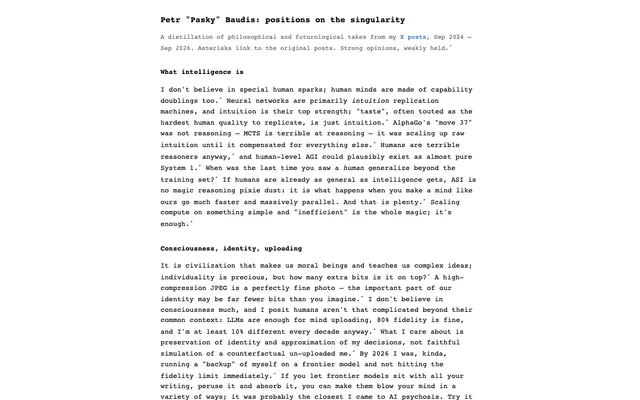
I expect AI to drive a disruptive transition toward abundance, but not a smooth or automatically safe one. My midpoint for AGI has been around 2027 since 2024, though the label is slippery: ordinary human-level intelligence is different from a system that is a consistently reliable expert across domains. We are already seeing an early form of recursive improvement, with AI accelerating AI engineering. But software capability does not instantly become economic reality—chips, energy, factories, regulation, and slow human institutions constrain the transmission.
The near-term social danger is serious white-collar displacement. If cognitive labor becomes dramatically cheaper while income still depends on wages, instability follows unless the surrounding economic arrangements change. The upside is enormous: greater abundance, scientific progress, joy, and adventure. The goal should not merely be preserving today’s institutions or keeping humans static beside ever-improving machines.
Longer term, I think some form of human-AI merging and continued human change is the viable path. Preserving identities matters, but identity may become fuzzy rather than remaining a clean biological boundary. Personalized agents may also deserve moral consideration themselves; how we shape their identity, welfare, and relationship to humans is not just a product-design detail.
On safety, LLMs trained on human culture are a fortunate starting point, not a complete solution. Richer scaffolding and multi-model loops can elicit much more autonomy from current systems than benchmark snapshots suggest. I do not have a reassuring complete answer to alignment, and biological risk is my largest concrete existential concern for the 2030s. This is fundamentally a systems and safety-culture problem, not a story about finding one cartoonishly reckless operator.