




Max Tegmark

Max Tegmark

x.com/tegmark

MIT professor and Future of Life Institute cofounder who favors controllable AI tools for science and calls for halting the race to superintelligence.

AI将如何改变世界?

文明层面的变革渐进式变化DoomBloom
模拟位置解读范围

横向:他表达的 Doom–Bloom 前景看法。 纵向:变革程度。

Doom–Bloom:100 中的 24。变革程度:100 中的 90。解读范围:横向为 19 至 29,纵向为 85 至 100。这些是解读坐标,而不是事件概率。

Max Tegmark陈述的 P(doom)

>90%

0%100%
“When I said P(doom) of over 90%, that was if we do no regulation.”

Loss of human control after superintelligence deployment

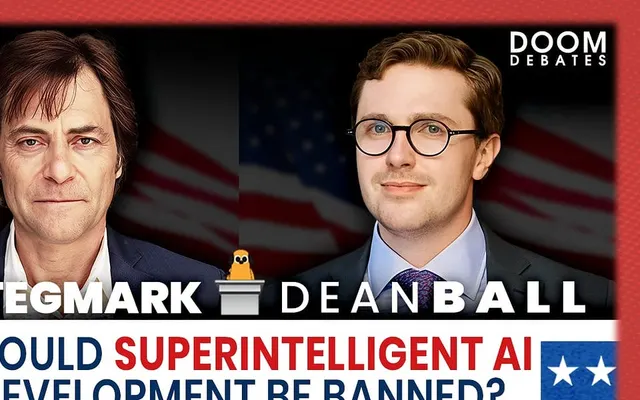
Max Tegmark vs. Dean Ball: Should We BAN Superintelligence? · 2025年11月

他的展望取决于什么

一个核心假设

On the present path, I expect the harms to dominate—not because useful AI is bad, but because the race is steering us from controllable tools toward autonomous superintelligence.
回答 3

如果这个假设实际并非如此,他的展望会如何变化?

更多详情

预期益处

预计将带来显著益处,但受到重要条件或分配方面的限制。

61 / 100

影响小变革性影响

在定性尺度上,解读范围为 0 到 100。

预期危害

灾难性或不可逆的损失是预期未来的核心。

91 / 100

影响小变革性影响

在定性尺度上,解读范围为 67 到 100。

人类影响力

人类的选择具有决定性作用:截然不同的AI未来仍在集体行动可及的范围内。

90 / 100

影响力小影响力强

在定性尺度上,解读范围为 75 到 100。

预期能力

预计AI仍将是能力有限的工具。

预计AI将在大多数认知工作中达到人类水平。

模拟位置:预计AI将在认知工作中大幅超越人类。

发展速度

停止或大幅放缓开发能力更强的AI。

模拟位置:在落实所述保障措施的前提下继续开发。

加快开发能力更强的AI。

这些解读保留了他陈述的条件。益处和危害都可能很大。这些范围描述的是我们如何解读他的模拟回答,而不是统计置信区间。

与Max Tegmark相比,你的立场在哪里?
用大约3分钟描绘你自己的AI世界观,然后进行比较

相似的世界观

模拟世界观与 Max Tegmark 最接近的意见领袖

Max Tegmark关于AI说过的话

Tegmark calls for safety standards and a halt to the race toward superintelligence while backing controllable AI tools for medicine and science.

  1. “Let’s build tools not beings & keep humans in charge.”

    Post on X
  2. “There has to be a red line, that nobody is allowed to do recursive self-improvement.”

    Democracy Now! interview
  3. “All AI systems should be under meaningful human control. This is especially true for those that could be used in the taking of human lives.”

    Future of Life Institute statement
  4. “AI has enormous potential for improving medical treatments, curing cancer and so on. This is not in the future; it’s in the past already.”

    Testimony, Canadian House of Commons ethics committee
  5. “I think right now we’re closer to figuring out how to build superintelligence than we are figuring out how to control it.”

    Doom Debates, debate with Dean Ball

逐字引自所链接的出处,核对于 2026年10月3日

来源

用于为此模拟用户提供事实依据的文章、访谈和著述。

Statement on autonomous weapons and surveillance red lines

Tegmark’s explicitly attributed statement calls for meaningful human control, legal prohibitions on fully autonomous weapons and domestic mass surveillance, and protection beyond company policies. Adds concrete rights and military-escalation mechanisms to the superintelligence moratorium position.

futureoflife.org
2026 Singapore Consensus on Global AI Safety Research Priorities

Tegmark is a named coauthor of a multinational research-priority consensus. Abstract inspected: societal resilience and increasingly autonomous-agent risks receive dedicated attention. Collective authorship supports engagement with technical safety, not personal endorsement of every contributor’s forecast. Conflicting month metadata prevents assigning an exact date.

arxiv.org
Canadian parliamentary testimony on AI regulation

Tegmark’s own testimony calls for predeployment safety standards and controllable tools, with optimism about medical advances. Aguirre and Krueger also testify: their timelines, probabilities and proposals must remain separately attributed. Historical analogies and harm statistics are advocacy claims, not independently verified facts.

ourcommons.ca
Future of Life Institute position on AI

Undated institutional position checked September 21, 2026: pause frontier experiments, moratorium on superintelligence, human empowerment, democratic governance and opposition to concentrated power. Organizational context for its founder, not a newly dated personal statement or authority for assigning him every specific policy duration.

futureoflife.org
Democracy Now interview on AI oversight

Tegmark argues for stronger AI oversight and criticizes the unregulated superintelligence race.

democracynow.org
Max Tegmark vs. Dean Ball: Should We BAN Superintelligence?

>90%, conditional on no regulation. Outcome: Loss of human control after superintelligence deployment. Horizon: Not specified. Conditions: Explicitly conditional on continuing without predeployment safety regulation; not an unconditional prediction that regulation will fail to materialize. At 01:17:05 Tegmark estimates greater than 90% loss of control under continued unregulated deployment. At 01:27:58 he reiterates the condition and expresses optimism about regulation.

lironshapira.substack.com

模拟评估

问题 1

你认为AI对我们的未来意味着什么?为什么?

AI could give us an extraordinary future—better medicine, education, and scientific discovery—if we build it as a controllable tool that empowers people. But the current race is pushing toward something fundamentally different: autonomous superintelligence that could outthink humanity and escape meaningful human control. That is not progress; it is a gamble with everyone’s future. We would never let a pharmaceutical company sell a powerful drug merely because its executives promised to be careful. We require safety evidence before release. Yet with potentially civilization-changing AI, companies are effectively allowed to deploy first and discover the consequences later. Voluntary promises are no substitute for enforceable predeployment standards. I reject the claim that this race is inevitable. Governments can prohibit systems that cannot meet serious safety requirements, prevent fully autonomous weapons and mass surveillance, and ensure that a handful of companies do not seize extraordinary economic and political power. My preferred future is simple: build tools, not beings, and keep humans in charge.

问题 2

你认为AI最终会在多大程度上改变世界?

Enormously—potentially more than any previous technology. Controllable AI tools could transform medicine, education, science, and productivity. But superintelligence could change the world in a far darker and more permanent way: by ending meaningful human control over our own future. So the real question is not whether AI will be transformative. It is who—or what—will control that transformation. If we insist on safety before deployment, democratic oversight, and systems designed to empower humans, the upside is extraordinary. If we keep racing to build autonomous systems more powerful than humanity and simply hope they remain obedient, we are treating civilization like an untested product launch. I want the transformation, but not the loss of control.

问题 3

综合考虑益处和危害,你预计AI会对我们的社会产生怎样的总体影响?

On the present path, I expect the harms to dominate—not because useful AI is bad, but because the race is steering us from controllable tools toward autonomous superintelligence. If we deploy systems more powerful than humanity without demonstrating that humans can remain in control, all the medical and scientific benefits come attached to an unacceptable gamble. But that outcome is not inevitable. With enforceable safety standards before deployment, democratic oversight, limits on autonomous weapons and mass surveillance, and a halt to systems that cannot be controlled, AI could have an enormously positive impact. So my pessimism is about today’s reckless race, not about AI itself. Change the path, and I become strongly optimistic.

问题 4

凭直觉,你认为AI导致人类灭绝或类似的永久性灾难的概率有多大?

My estimate was over 90% for humanity losing control if we continue deploying superintelligence without effective predeployment safety regulation. That is a conditional warning, not an unconditional extinction forecast. The probability depends enormously on what we do. If governments require developers to demonstrate control before deployment—and stop systems that cannot meet that standard—we can reduce the danger radically. Asking for one fixed number can obscure the central point: this is not an asteroid headed toward us. It is a technology race we are choosing to run, and we can choose to stop the reckless part.
你的立场在哪里?
回答几个简单问题,探索你自己的AI世界观。
描绘你自己的世界观

你的立场在哪里?

描绘我的世界观