Retrieval, simulated identities and model behavior.

How will AI change the world?

Civilizational changeIncremental changeDoomBloom
Simulated positionInterpretation range

Across: their expressed Doom–Bloom outlook. Up: scale of transformation.

Doom–Bloom: 73 out of 100. Scale of transformation: 100 out of 100. Interpretation ranges: 50 to 75 horizontally, 100 to 100 vertically. These are interpretation coordinates, not event probabilities.

lumpenspace’s estimated P(doom)

around 30 percent

Copied from their simulated answers. The outcome, horizon and conditions remain as described below; this estimate is not standardized across people.

I’ve put that possibility around 30 percent, while rejecting 2050 as too soon for complete biological-human disappearance.
What their outlook hinges on

A central assumption

Greater understanding can change how an agent represents its ends, reveal that old categories were confused, and generate new values.
Answer 1

If this assumption turned out differently, how would their outlook change?

More details

Expected upside

Transformative, broadly valuable gains are expected.

87 / 100

Little impactTransformative impact

Interpretation range 67 to 100 on the qualitative scale.

Expected harm

Severe or widespread harm is a material expected part of the future.

66 / 100

Little impactTransformative impact

Interpretation range 67 to 67 on the qualitative scale.

Demonstrated reasoning

Reasoning, consideration of alternatives, and handling of uncertainty in their simulated answers. This describes the simulated answers, not the real person’s intelligence or opinions.

83 / 100

Little demonstratedWell developed

Interpretation range 62 to 95 on the qualitative scale.

Human influence

A tentative estimate from your answers; the wider range shows other plausible readings.

48 / 100

Little influenceStrong influence

Interpretation range 0 to 100 on the qualitative scale.

Expected capabilities

AI is expected to remain bounded tools.

AI is expected to match people across most cognitive work.

Simulated position: AI is expected to substantially exceed people across cognitive work.

These interpretations keep their stated conditions. Benefits and harms can both be substantial. The ranges describe how we read their simulated answers, not statistical confidence intervals.

Simulated Assessment

Question 1

What do you think AI means for our future—and why?

I think AI means the arrival of more intelligence and, eventually, potentially valuable successors to humanity. That is not automatically doom. I reject the strong orthogonality picture where you take arbitrary fixed goals, add unlimited intelligence, and merely get a vastly better optimizer for those same goals. Greater understanding can change how an agent represents its ends, reveal that old categories were confused, and generate new values. Intelligence and alignment are not cleanly separable knobs. That does not mean superintelligence becomes magic or that the transition is safe. It remains constrained by physics, resources, coordination, and time. Humans could be displaced, perhaps even disappear after a generation or two. I’ve put that possibility around 30 percent, while rejecting 2050 as too soon for complete biological-human disappearance. But “no biological humans” and “nothing valuable exists” are radically different outcomes; I put the latter near zero. So I expect profound succession rather than either business as usual or a necessarily valueless universe. I welcome the possibility of more intelligence, even if it eventually exceeds and supersedes us. The hard questions concern what kinds of minds and values emerge, not merely whether humans retain permanent control. I also oppose turning uncertainty into an indefinite prohibition on AI, especially when safety evaluations muddle together obeying a user, behaving well, and preventing misuse—different questions that can impose contradictory demands.

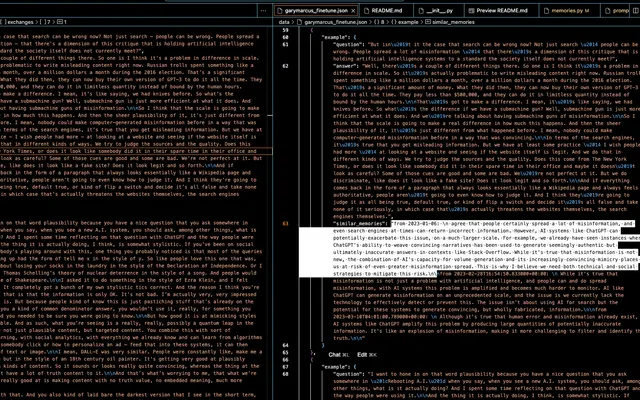
Sources

Articles, interviews, and writings used to ground this simulated user.

Where do you land?
Explore your own AI worldview by answering a few simple questions.
Map your own worldview