Question 1

Julia Galef
x.com/juliagalefTruth-seeking, calibration, and open questions about AGI.
How will AI change the world?
Across: their expressed Doom–Bloom outlook. Up: scale of transformation.
Doom–Bloom: 48 out of 100. Scale of transformation: 50 out of 100. Interpretation ranges: 48 to 51 horizontally, 0 to 100 vertically. These are interpretation coordinates, not event probabilities.
Not specified
There is not enough relevant evidence yet to estimate their view of catastrophic risk.
A central assumption
The most consequential possibility is that increasingly capable systems become difficult to control and cause catastrophic harm, potentially on a very large scale.Answer 2
If this assumption turned out differently, how would their outlook change?
An unresolved question
But I don’t have a well-founded timeline or risk probability to offer.Answer 1
What would help them distinguish the plausible outcomes here?
More details
Reasoning, consideration of alternatives, and handling of uncertainty in their simulated answers. This describes the simulated answers, not the real person’s intelligence or opinions.
81 / 100
Interpretation range 62 to 95 on the qualitative scale.
A tentative estimate from your answers; the wider range shows other plausible readings.
50 / 100
Interpretation range 0 to 100 on the qualitative scale.
These interpretations keep their stated conditions. Benefits and harms can both be substantial. The ranges describe how we read their simulated answers, not statistical confidence intervals.
Simulated Assessment
Question 2
What major harms, if any, do you expect AI to cause?
Sources
Articles, interviews, and writings used to ground this simulated user.
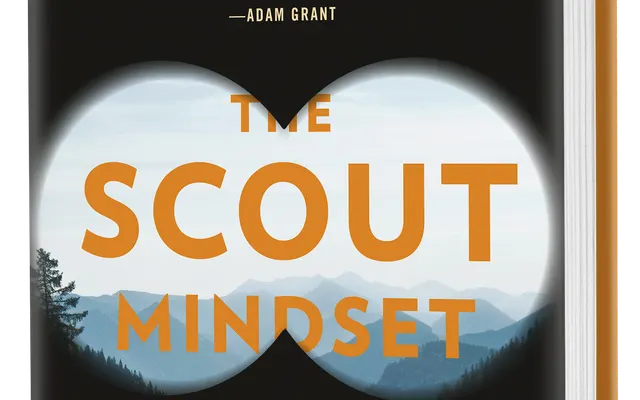
Explains recognizing errors, testing assumptions and learning from disagreement; book released April 13, 2021.

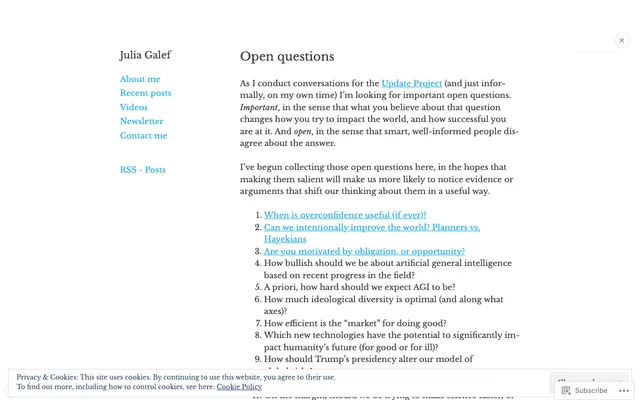
Explicitly includes AGI difficulty and implications of progress among unsettled questions; older material, not a current timeline.

In her own answers, Galef describes investigating disagreement about superintelligent AI and identifying differing models and cruxes. Her aim is understanding before persuasion; this does not establish a present-day timeline or risk probability.

Galef describes experiments with productive AI-risk debates and reaching truth together. She says confident policy conclusions require substantial investigation and acknowledges her own early-pandemic forecasting mistake. This supports calibration and voice, not a current AI policy platform.