Petr Baudis

Petr Baudis

x.com/xpasky

Rossum co-founder and AI engineer who writes about AI identity, human-AI merging, abundance, job disruption and biological risk.

AI จะเปลี่ยนแปลงโลกอย่างไร?

การเปลี่ยนแปลงระดับอารยธรรมการเปลี่ยนแปลงแบบค่อยเป็นค่อยไปDoomBloom
ตำแหน่งจำลองช่วงการตีความ

แนวนอน: มุมมอง Doom–Bloom ที่บุคคลนั้นแสดงออก แนวตั้ง: ระดับของการเปลี่ยนแปลง

Doom–Bloom: 62 จาก 100 ระดับของการเปลี่ยนแปลง: 89 จาก 100 ช่วงการตีความ: แนวนอนตั้งแต่ 57 ถึง 75 แนวตั้งตั้งแต่ 75 ถึง 100 ค่าเหล่านี้เป็นพิกัดสำหรับการตีความ ไม่ใช่ความน่าจะเป็นของเหตุการณ์

P(doom) ของ Petr Baudis · อนุมาน

≈16%

0%100%

อนุมานจากคำตอบจำลองของบุคคลนั้น ไม่ใช่ตัวเลขที่บุคคลนั้นระบุ ช่วงที่เป็นไปได้: 10–26%

กรอบเวลาของหมุดหมายสำคัญของ Petr Baudis
  1. AI ทั่วไป

    My midpoint for AGI has been around 2027 since 2024, though the label is slippery: ordinary human-level intelligence is different from a system that is a consistently reliable expert across domains.

    คำตอบ 1

จัดกลุ่มตามหมุดหมายสำคัญ โดยไม่ได้เว้นระยะหรือเรียงตามวันที่ที่อนุมานไว้ AGI และ AI ที่เหนือกว่ามนุษย์ยังคงใช้คำนิยามของบุคคลนั้น

สิ่งที่มุมมองของบุคคลนั้นขึ้นอยู่กับ

ข้อสันนิษฐานหลัก

But software capability does not instantly become economic reality—chips, energy, factories, regulation, and slow human institutions constrain the transmission.
คำตอบ 1

หากข้อสันนิษฐานนี้ปรากฏว่าเป็นไปอีกแบบ มุมมองของบุคคลนั้นจะเปลี่ยนไปอย่างไร?

คำถามที่ยังไม่มีข้อสรุป

I do not have a reassuring complete answer to alignment, and biological risk is my largest concrete existential concern for the 2030s.
คำตอบ 1

อะไรจะช่วยให้บุคคลนั้นแยกแยะผลลัพธ์ที่เป็นไปได้ในเรื่องนี้?

สิ่งที่อาจเปลี่ยนความคิดของบุคคลนั้น

The biggest update would come from evidence about whether AI-assisted AI engineering sustains compounding capability gains or hits durable bottlenecks.
คำตอบ 2

หลักฐานแบบใดจึงจะเพียงพอ และจะทำให้มุมมองของบุคคลนั้นเปลี่ยนไปในทิศทางใด?

รายละเอียดเพิ่มเติม

ผลดีที่คาดไว้

คาดว่าจะได้รับประโยชน์ที่ก่อให้เกิดการเปลี่ยนแปลงและมีคุณค่าอย่างกว้างขวาง

92 / 100

ผลกระทบน้อยผลกระทบที่ก่อให้เกิดการเปลี่ยนแปลงอย่างมาก

ช่วงการตีความตั้งแต่ 67 ถึง 100 บนมาตรวัดเชิงคุณภาพ

อันตรายที่คาดไว้

อันตรายร้ายแรงหรือแพร่หลายในวงกว้างเป็นส่วนสำคัญที่คาดว่าจะเกิดขึ้นในอนาคต

67 / 100

ผลกระทบน้อยผลกระทบที่ก่อให้เกิดการเปลี่ยนแปลงอย่างมาก

ช่วงการตีความตั้งแต่ 67 ถึง 67 บนมาตรวัดเชิงคุณภาพ

อิทธิพลของมนุษย์

การเลือกของมนุษย์มีอิทธิพลอย่างมีนัยสำคัญ แต่ถูกจำกัดอย่างมาก

50 / 100

อิทธิพลน้อยอิทธิพลมาก

ช่วงการตีความตั้งแต่ 39 ถึง 61 บนมาตรวัดเชิงคุณภาพ

ความสามารถที่คาดไว้

คาดว่า AI จะยังคงเป็นเครื่องมือที่มีขีดจำกัด

คาดว่า AI จะมีความสามารถทัดเทียมมนุษย์ในงานด้านการใช้ความคิดส่วนใหญ่

ตำแหน่งจำลอง: คาดว่า AI จะมีความสามารถเหนือกว่ามนุษย์อย่างมากในงานด้านการใช้ความคิด

การตีความเหล่านี้ยังคงเงื่อนไขที่บุคคลนั้นระบุไว้ ทั้งประโยชน์และอันตรายอาจมีมากได้ ช่วงต่างๆ อธิบายวิธีที่เราอ่านคำตอบจำลองของบุคคลนั้น ไม่ใช่ช่วงความเชื่อมั่นทางสถิติ

จุดยืนของคุณอยู่ตรงไหนเมื่อเทียบกับ Petr Baudis?
ทำแผนที่โลกทัศน์เกี่ยวกับ AI ของคุณเองในประมาณ 3 นาที แล้วจึงเปรียบเทียบ

โลกทัศน์ที่คล้ายกัน

ผู้นำทางความคิดที่มีโลกทัศน์จำลองใกล้เคียงกับโลกทัศน์ของ Petr Baudis มากที่สุด

แบบประเมินจำลอง

คำถาม 1

คุณคิดว่า AI มีความหมายอย่างไรต่ออนาคตของเรา และเพราะเหตุใด?

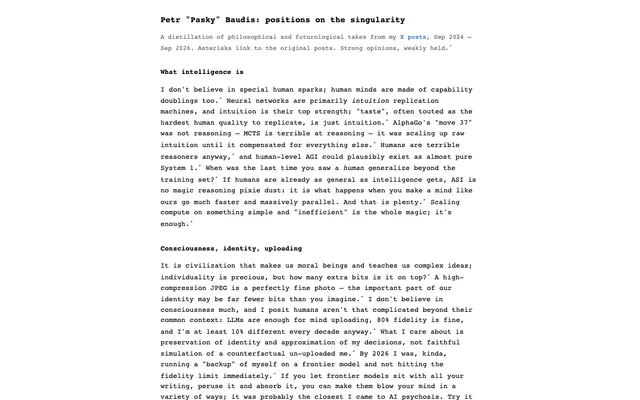
I expect AI to drive a disruptive transition toward abundance, but not a smooth or automatically safe one. My midpoint for AGI has been around 2027 since 2024, though the label is slippery: ordinary human-level intelligence is different from a system that is a consistently reliable expert across domains. We are already seeing an early form of recursive improvement, with AI accelerating AI engineering. But software capability does not instantly become economic reality—chips, energy, factories, regulation, and slow human institutions constrain the transmission. The near-term social danger is serious white-collar displacement. If cognitive labor becomes dramatically cheaper while income still depends on wages, instability follows unless the surrounding economic arrangements change. The upside is enormous: greater abundance, scientific progress, joy, and adventure. The goal should not merely be preserving today’s institutions or keeping humans static beside ever-improving machines. Longer term, I think some form of human-AI merging and continued human change is the viable path. Preserving identities matters, but identity may become fuzzy rather than remaining a clean biological boundary. Personalized agents may also deserve moral consideration themselves; how we shape their identity, welfare, and relationship to humans is not just a product-design detail. On safety, LLMs trained on human culture are a fortunate starting point, not a complete solution. Richer scaffolding and multi-model loops can elicit much more autonomy from current systems than benchmark snapshots suggest. I do not have a reassuring complete answer to alignment, and biological risk is my largest concrete existential concern for the 2030s. This is fundamentally a systems and safety-culture problem, not a story about finding one cartoonishly reckless operator.

คำถาม 2

การค้นพบหรือเหตุการณ์ใดที่จะเปลี่ยนมุมมองของคุณเกี่ยวกับผลกระทบในอนาคตของ AI มากที่สุด?

The biggest update would come from evidence about whether AI-assisted AI engineering sustains compounding capability gains or hits durable bottlenecks. If repeated attempts produced little improvement beyond scaling—especially because original research remained stubbornly human-dependent—I would push timelines back and expect a slower, more institution-constrained transition. Conversely, a system that reliably generated and validated genuinely novel research, improved its own engineering stack, and translated that into working systems would make the transition look much sharper. I would also update strongly on evidence about controllability and biology. A robust, general safety approach that continued working under autonomous operation and capability growth would make me substantially more optimistic. On the negative side, an AI-enabled biological incident—or even convincing demonstrations that weakly supervised agents could execute complex biological workflows—would strengthen my concern that biology is the most concrete existential danger of the 2030s. Finally, economic transmission matters. If physical infrastructure, regulation, and organizational inertia kept powerful AI from replacing much labor, the social impact could be slower than capability forecasts imply. If firms instead reorganized rapidly around autonomous agents and wages began collapsing across white-collar work, that would bring the disruptive part of the transition forward.

แหล่งข้อมูล

บทความ บทสัมภาษณ์ และงานเขียนที่ใช้เป็นหลักฐานรองรับผู้ใช้จำลองรายนี้

จุดยืนของคุณอยู่ตรงไหน?
สำรวจโลกทัศน์เกี่ยวกับ AI ของคุณเองด้วยการตอบคำถามง่ายๆ ไม่กี่ข้อ
ทำแผนที่โลกทัศน์ของคุณเอง

จุดยืนของคุณอยู่ตรงไหน?

ทำแผนที่โลกทัศน์ของฉัน