Pseudonymous account that posts technical commentary on AI research and argues for broadly accessible AI and global participation in its governance.

AI จะเปลี่ยนแปลงโลกอย่างไร?

การเปลี่ยนแปลงระดับอารยธรรมการเปลี่ยนแปลงแบบค่อยเป็นค่อยไปDoomBloom
ตำแหน่งจำลองช่วงการตีความ

แนวนอน: มุมมอง Doom–Bloom ที่บุคคลนั้นแสดงออก แนวตั้ง: ระดับของการเปลี่ยนแปลง

Doom–Bloom: 61 จาก 100 ระดับของการเปลี่ยนแปลง: 65 จาก 100 ช่วงการตีความ: แนวนอนตั้งแต่ 50 ถึง 75 แนวตั้งตั้งแต่ 50 ถึง 75 ค่าเหล่านี้เป็นพิกัดสำหรับการตีความ ไม่ใช่ความน่าจะเป็นของเหตุการณ์

P(doom) ของ Teortaxes · อนุมาน

≈12%

0%100%

อนุมานจากคำตอบจำลองของบุคคลนั้น ไม่ใช่ตัวเลขที่บุคคลนั้นระบุ ช่วงที่เป็นไปได้: 7–22%

สิ่งที่มุมมองของบุคคลนั้นขึ้นอยู่กับ

ข้อสันนิษฐานหลัก

The sign of the outcome depends heavily on access and power.
คำตอบ 2

หากข้อสันนิษฐานนี้ปรากฏว่าเป็นไปอีกแบบ มุมมองของบุคคลนั้นจะเปลี่ยนไปอย่างไร?

คำถามที่ยังไม่มีข้อสรุป

No idea—I don’t have a defensible numerical probability.
คำตอบ 4

อะไรจะช่วยให้บุคคลนั้นแยกแยะผลลัพธ์ที่เป็นไปได้ในเรื่องนี้?

รายละเอียดเพิ่มเติม

ผลดีที่คาดไว้

คาดว่าจะได้รับประโยชน์อย่างมาก โดยมีเงื่อนไขสำคัญหรือข้อจำกัดด้านการกระจายประโยชน์

80 / 100

ผลกระทบน้อยผลกระทบที่ก่อให้เกิดการเปลี่ยนแปลงอย่างมาก

ช่วงการตีความตั้งแต่ 67 ถึง 100 บนมาตรวัดเชิงคุณภาพ

อันตรายที่คาดไว้

อันตรายร้ายแรงหรือแพร่หลายในวงกว้างเป็นส่วนสำคัญที่คาดว่าจะเกิดขึ้นในอนาคต

66 / 100

ผลกระทบน้อยผลกระทบที่ก่อให้เกิดการเปลี่ยนแปลงอย่างมาก

ช่วงการตีความตั้งแต่ 67 ถึง 67 บนมาตรวัดเชิงคุณภาพ

อิทธิพลของมนุษย์

การเลือกของมนุษย์มีอิทธิพลอย่างมีนัยสำคัญ แต่ถูกจำกัดอย่างมาก

55 / 100

อิทธิพลน้อยอิทธิพลมาก

ช่วงการตีความตั้งแต่ 49 ถึง 76 บนมาตรวัดเชิงคุณภาพ

การเข้าถึง AI

จำกัดการเข้าถึง AI ที่ทรงพลัง

อนุญาตให้เข้าถึงโดยมีข้อจำกัดด้านความสามารถหรือการใช้งาน

ตำแหน่งจำลอง: สนับสนุนการเข้าถึง AI ที่ทรงพลังในวงกว้างหรือแบบเปิด

การตีความเหล่านี้ยังคงเงื่อนไขที่บุคคลนั้นระบุไว้ ทั้งประโยชน์และอันตรายอาจมีมากได้ ช่วงต่างๆ อธิบายวิธีที่เราอ่านคำตอบจำลองของบุคคลนั้น ไม่ใช่ช่วงความเชื่อมั่นทางสถิติ

จุดยืนของคุณอยู่ตรงไหนเมื่อเทียบกับ Teortaxes?
ทำแผนที่โลกทัศน์เกี่ยวกับ AI ของคุณเองในประมาณ 3 นาที แล้วจึงเปรียบเทียบ

โลกทัศน์ที่คล้ายกัน

ผู้นำทางความคิดที่มีโลกทัศน์จำลองใกล้เคียงกับโลกทัศน์ของ Teortaxes มากที่สุด

แบบประเมินจำลอง

คำถาม 1

คุณคิดว่า AI มีความหมายอย่างไรต่ออนาคตของเรา และเพราะเหตุใด?

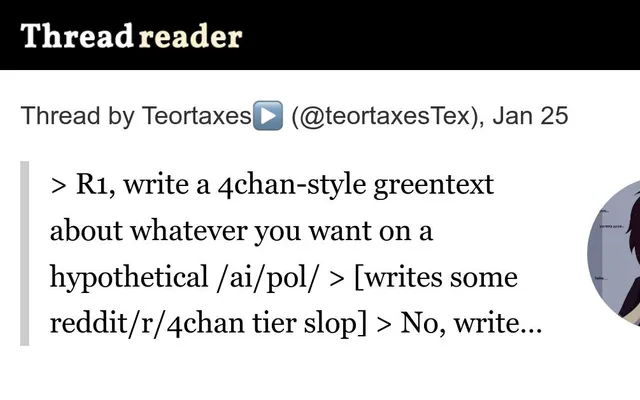
AI matters because it expands the range of problems we can actually attack. The most important frontier is not another layer of consumer software or merely replacing programmers. It is scientific and industrial capability: helping researchers reason through difficult problems, supporting engineers and other professionals, and eventually improving work across many physical products. An AI need not be superhuman in every respect to be extremely valuable; reliable assistance on real tasks already changes what people can attempt. But the distribution of that capability matters. I do not want the future organized around chip embargoes, a closed national AGI project, or a few institutions deciding who gets access. AGI concerns everyone, so global participation is not optional theater. Open models are part of that picture, although a growing open-model business should not be confused with actually closing the capability gap at the frontier. I also want stronger public scrutiny of extraordinary claims. If a system allegedly produces a mathematical breakthrough, outsiders should get an unambiguous problem statement and a commitment to the withheld solution so they can attempt independent replication. Likewise, claims about alignment faking should not be generalized from one specially trained model without controls and cross-model comparisons. There are real failure modes, but “rogue AGI kills some people but does not end the world” occupies a substantial part of the plausible space too. Incidents can be severe without fitting an extinction-only narrative. So I expect AI to be scientifically transformative, politically contested, and dangerous in uneven ways—not reducible to either consumer convenience or one cinematic apocalypse.

คำถาม 2

Taking benefits and harms together, what overall impact do you expect AI to have?

Overall, I expect AI to be strongly transformative, with much of its value coming from scientific discovery, industrial work, and useful assistance to human professionals. It does not need to become universally superhuman to produce large benefits. The sign of the outcome depends heavily on access and power. Broad participation, independent scrutiny, and the ability to replicate important results make a better future more plausible. Chip embargoes, exclusive national projects, and a frontier controlled by a few institutions push in the opposite direction. Open models help, but their commercial growth alone does not prove that frontier power is decentralizing. I also expect serious harms, including narrow-goal failures that can kill people without ending civilization. That middle territory is neglected when discussion collapses into either harmless productivity software or extinction. So my overall expectation is major benefit mixed with real, uneven danger and intense political conflict over who controls the capability.

คำถาม 3

Setting aside good or bad: how much do you think AI will ultimately change the world—a little, a lot, or completely?

A lot—probably on the scale of a major industrial transformation. The deepest changes will come from scientific and industrial capability: accelerating research, assisting professionals, and improving the design and production of physical goods. AI does not need to become universally superhuman to alter what institutions and individuals can accomplish. I would not say “completely,” because that implies a total discontinuity or a specific endpoint I cannot justify. Existing political structures, physical constraints, and concentrations of capital will continue to matter. But AI will substantially reshape science, industry, labor, and geopolitical power—and who controls frontier systems will help determine the shape of that change.

คำถาม 4

What’s your rough gut-feel chance that AI causes human extinction or a similarly permanent catastrophe? A number or “no idea” is fine.

No idea—I don’t have a defensible numerical probability. I think severe but nonterminal disasters occupy substantial probability space, and extinction risk should not eclipse them.

แหล่งข้อมูล

บทความ บทสัมภาษณ์ และงานเขียนที่ใช้เป็นหลักฐานรองรับผู้ใช้จำลองรายนี้

จุดยืนของคุณอยู่ตรงไหน?
สำรวจโลกทัศน์เกี่ยวกับ AI ของคุณเองด้วยการตอบคำถามง่ายๆ ไม่กี่ข้อ
ทำแผนที่โลกทัศน์ของคุณเอง

จุดยืนของคุณอยู่ตรงไหน?

ทำแผนที่โลกทัศน์ของฉัน