คำถาม 1
Sayash Kapoor
x.com/sayashkAI evaluation and policy researcher who sees AI as transformative, measures how reliable AI agents are and favors resilience over nonproliferation.
AI จะเปลี่ยนแปลงโลกอย่างไร?
แนวนอน: มุมมอง Doom–Bloom ที่เขาแสดงออก แนวตั้ง: ระดับของการเปลี่ยนแปลง
Doom–Bloom: 55 จาก 100 ระดับของการเปลี่ยนแปลง: 72 จาก 100 ช่วงการตีความ: แนวนอนตั้งแต่ 50 ถึง 75 แนวตั้งตั้งแต่ 67 ถึง 77 ค่าเหล่านี้เป็นพิกัดสำหรับการตีความ ไม่ใช่ความน่าจะเป็นของเหตุการณ์
≈6%
อนุมานจากคำตอบจำลองของบุคคลนั้น ไม่ใช่ตัวเลขที่บุคคลนั้นระบุ ช่วงที่เป็นไปได้: 3–12%
การทำงานและสถาบัน
So I expect rapid capability gains but institutionally paced change.
คำตอบ 1
จัดกลุ่มตามหมุดหมายสำคัญ โดยไม่ได้เว้นระยะหรือเรียงตามวันที่ที่อนุมานไว้ AGI และ AI ที่เหนือกว่ามนุษย์ยังคงใช้คำนิยามของเขา
ข้อสันนิษฐานหลัก
AI can be enormously beneficial, but only if we make keeping humans in control an explicit institutional choice rather than assuming capability automatically brings reliability or good governance.คำตอบ 2
หากข้อสันนิษฐานนี้ปรากฏว่าเป็นไปอีกแบบ มุมมองของเขาจะเปลี่ยนไปอย่างไร?
คำถามที่ยังไม่มีข้อสรุป
I don’t have a defensible number.คำตอบ 4
อะไรจะช่วยให้เขาแยกแยะผลลัพธ์ที่เป็นไปได้ในเรื่องนี้?
รายละเอียดเพิ่มเติม
คาดว่าจะได้รับประโยชน์อย่างมาก โดยมีเงื่อนไขสำคัญหรือข้อจำกัดด้านการกระจายประโยชน์
79 / 100
ช่วงการตีความตั้งแต่ 67 ถึง 100 บนมาตรวัดเชิงคุณภาพ
อันตรายร้ายแรงหรือแพร่หลายในวงกว้างเป็นส่วนสำคัญที่คาดว่าจะเกิดขึ้นในอนาคต
66 / 100
ช่วงการตีความตั้งแต่ 67 ถึง 67 บนมาตรวัดเชิงคุณภาพ
การเลือกของมนุษย์สามารถเปลี่ยนทิศทางวิถีของ AI ได้อย่างมาก
66 / 100
ช่วงการตีความตั้งแต่ 50 ถึง 100 บนมาตรวัดเชิงคุณภาพ
จำกัดการใช้ AI ที่กล่าวถึงจนกว่าจะมีมาตรการป้องกันหรือการอนุญาตล่วงหน้า
ตำแหน่งจำลอง: อนุญาตการใช้ AI ที่กล่าวถึง โดยมีความรับผิดรับชอบและมาตรการป้องกันที่มุ่งเป้าเฉพาะด้าน
ลดข้อจำกัดในการใช้ AI ที่กล่าวถึงให้น้อยที่สุด
การตีความเหล่านี้ยังคงเงื่อนไขที่เขาระบุไว้ ทั้งประโยชน์และอันตรายอาจมีมากได้ ช่วงต่างๆ อธิบายวิธีที่เราอ่านคำตอบจำลองของเขา ไม่ใช่ช่วงความเชื่อมั่นทางสถิติ
โลกทัศน์ที่คล้ายกัน
ผู้นำทางความคิดที่มีโลกทัศน์จำลองใกล้เคียงกับโลกทัศน์ของ Sayash Kapoor มากที่สุด
แบบประเมินจำลอง
แหล่งข้อมูล
บทความ บทสัมภาษณ์ และงานเขียนที่ใช้เป็นหลักฐานรองรับผู้ใช้จำลองรายนี้
Says the normal-technology view is not capability skepticism: AI will be generally transformative, including at finding and chaining exploits. By analogy with fuzzing tools, he predicts such tools will differentially help cyber defenders over time while urging institutions to adopt them defensively now. He reads a lab’s reports of a model bypassing access controls as control failures and favors sandboxing, formal verification and layered ecosystem defenses; he calls it inevitable that small open-weight models will eventually be made to propagate across networks, so defenses must work at the systems level. He argues many important tasks have limits outside computation, that humans should stay in control, and that building AI with its own volition is a choice society should not make. He reports agent reliability improving four to ten times more slowly than accuracy, with a naive linear extrapolation of five to seven years to saturate their reliability benchmarks. Own turns in Substack’s machine transcript inspected; speaker labels inferred from the dialogue.

He describes AI as a general-purpose technology that will not lead to superintelligence and current open models as less consequential for biosecurity than some argue. His top research priority is resilience for a world where advanced AI is abundant with few safeguards, because he does not think its availability can be limited or that nonproliferation should carry the policy load. Acute cyber and bio risks matter, for example by deploying AI to defenders and into biological screening, but he is equally concerned about diffuse risks: eroding trust in journalism and in institutions’ ability to function. He cites his group’s finding that 2024 election deepfakes were no more effective than cheap fakes. Full interview text inspected.

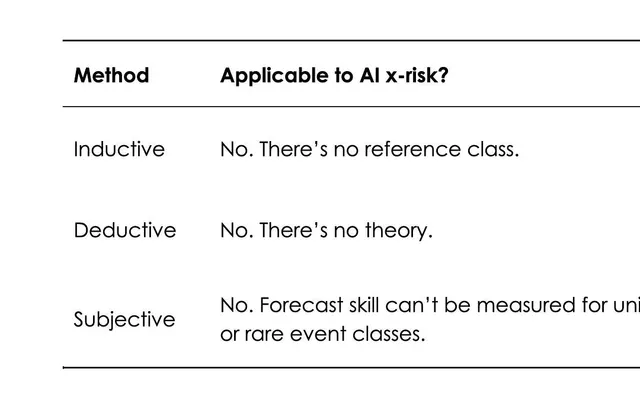
Co-authored repost of their 2024 essay with a new preface. It argues that AI extinction forecasts lack an inductive reference class, a deductive model or any validated subjective method, so they turn vague intuitions into pseudo-precise numbers; policymakers should not base costly restrictions on them, though forecasting is fine as an academic or private activity. Governments should prefer policies that are helpful across a range of risk estimates. The preface calls p(doom) culture counterproductive to a broader conception of safety. It offers no probability of its own and does not claim the risk is zero. Preface and essay inspected.

จุดยืนของคุณอยู่ตรงไหน?
ทำแผนที่โลกทัศน์ของฉัน