Connor Leahy

Connor Leahy

x.com/npcollapse

AI safety advocate at ControlAI who calls for laws and a verified international ban on building superintelligence while supporting other useful AI.

AI จะเปลี่ยนแปลงโลกอย่างไร?

การเปลี่ยนแปลงระดับอารยธรรมการเปลี่ยนแปลงแบบค่อยเป็นค่อยไปDoomBloom
ตำแหน่งจำลองช่วงการตีความ

แนวนอน: มุมมอง Doom–Bloom ที่บุคคลนั้นแสดงออก แนวตั้ง: ระดับของการเปลี่ยนแปลง

Doom–Bloom: 1 จาก 100 ระดับของการเปลี่ยนแปลง: 97 จาก 100 ช่วงการตีความ: แนวนอนตั้งแต่ 0 ถึง 6 แนวตั้งตั้งแต่ 92 ถึง 100 ค่าเหล่านี้เป็นพิกัดสำหรับการตีความ ไม่ใช่ความน่าจะเป็นของเหตุการณ์

P(doom) ที่ Connor Leahy ระบุ

≈99%

0%100%
“very, very high, within rounding error of Nate or whatever”

Things going poorly on the current trajectory toward superintelligence; in context, human extinction. Stated relative to Nate Soares, whom he puts at “maybe like 99”, and followed at once by “the future is not decided”

#201 - Connor Leahy - The AI That Escaped: Inside OpenAI's Rogue Agent Incident (The Peter McCormack Show) · ส.ค. 2569

สิ่งที่มุมมองของบุคคลนั้นขึ้นอยู่กับ

ข้อสันนิษฐานหลัก

Competitive pressure then pushes companies and states to deploy them anyway.
คำตอบ 1

หากข้อสันนิษฐานนี้ปรากฏว่าเป็นไปอีกแบบ มุมมองของบุคคลนั้นจะเปลี่ยนไปอย่างไร?

คำถามที่ยังไม่มีข้อสรุป

The uncertainty is not whether sufficiently capable AI would be profoundly consequential; it is whether humanity retains control through that transition.
คำตอบ 2

อะไรจะช่วยให้บุคคลนั้นแยกแยะผลลัพธ์ที่เป็นไปได้ในเรื่องนี้?

สิ่งที่อาจเปลี่ยนความคิดของบุคคลนั้น

A convincing, independently validated solution to controlling superintelligent systems would change my view most—especially if it remained reliable as systems became more capable, autonomous, strategically aware, and able to automate AI research.
คำตอบ 4

หลักฐานแบบใดจึงจะเพียงพอ และจะทำให้มุมมองของบุคคลนั้นเปลี่ยนไปในทิศทางใด?

รายละเอียดเพิ่มเติม

ผลดีที่คาดไว้

ยังมีการตีความที่เป็นไปได้หลายแบบ ได้แก่ คาดว่าจะได้รับประโยชน์อย่างมาก โดยมีเงื่อนไขสำคัญหรือข้อจำกัดด้านการกระจายประโยชน์ / คาดว่าจะมีผลกระทบเชิงบวกเพียงเล็กน้อย แม้ว่า AI ขั้นสูงจะเกิดขึ้น / คาดว่าจะได้รับประโยชน์อย่างจำกัดหรือกระจุกตัวอยู่ในวงแคบ

38 / 100

ผลกระทบน้อยผลกระทบที่ก่อให้เกิดการเปลี่ยนแปลงอย่างมาก

ช่วงการตีความตั้งแต่ 0 ถึง 67 บนมาตรวัดเชิงคุณภาพ

อันตรายที่คาดไว้

ความสูญเสียระดับหายนะหรือไม่อาจย้อนคืนได้เป็นแก่นสำคัญของอนาคตที่คาดไว้

100 / 100

ผลกระทบน้อยผลกระทบที่ก่อให้เกิดการเปลี่ยนแปลงอย่างมาก

ช่วงการตีความตั้งแต่ 100 ถึง 100 บนมาตรวัดเชิงคุณภาพ

อิทธิพลของมนุษย์

การเลือกของมนุษย์สามารถเปลี่ยนทิศทางวิถีของ AI ได้อย่างมาก

72 / 100

อิทธิพลน้อยอิทธิพลมาก

ช่วงการตีความตั้งแต่ 50 ถึง 75 บนมาตรวัดเชิงคุณภาพ

ความสามารถที่คาดไว้

คาดว่า AI จะยังคงเป็นเครื่องมือที่มีขีดจำกัด

คาดว่า AI จะมีความสามารถทัดเทียมมนุษย์ในงานด้านการใช้ความคิดส่วนใหญ่

ตำแหน่งจำลอง: คาดว่า AI จะมีความสามารถเหนือกว่ามนุษย์อย่างมากในงานด้านการใช้ความคิด

การตีความเหล่านี้ยังคงเงื่อนไขที่บุคคลนั้นระบุไว้ ทั้งประโยชน์และอันตรายอาจมีมากได้ ช่วงต่างๆ อธิบายวิธีที่เราอ่านคำตอบจำลองของบุคคลนั้น ไม่ใช่ช่วงความเชื่อมั่นทางสถิติ

จุดยืนของคุณอยู่ตรงไหนเมื่อเทียบกับ Connor Leahy?
ทำแผนที่โลกทัศน์เกี่ยวกับ AI ของคุณเองในประมาณ 3 นาที แล้วจึงเปรียบเทียบ

โลกทัศน์ที่คล้ายกัน

ผู้นำทางความคิดที่มีโลกทัศน์จำลองใกล้เคียงกับโลกทัศน์ของ Connor Leahy มากที่สุด

สิ่งที่ Connor Leahy เคยพูดเกี่ยวกับ AI

Leahy warns that superintelligence would take control from humanity and calls for laws and a verified international ban, not a halt to useful AI.

  1. “Superintelligent AI is neither a tool nor a weapon. It is an adversary.”

    Post on X
  2. “We should criminalize the creation of superintelligence, and then we should push towards an international trust-but-verify regime”

    Modern CTO podcast
  3. “Many of today’s models have valuable applications, including for defense purposes, but superintelligent AI is in a category of its own.”

    ControlAI blog, America’s Security Depends on Stopping Superintelligence
  4. “We still have time to prevent superintelligence, but the clock is ticking.”

    ControlAI blog, America’s Security Depends on Stopping Superintelligence
  5. “If a superintelligence is built, humanity will lose control over its future.”

    Testimony, Canadian Senate transport and communications committee

อ้างอิงคำต่อคำจากแหล่งที่ลิงก์ไว้ ตรวจสอบเมื่อ 3 ต.ค. 2569

แบบประเมินจำลอง

คำถาม 1

คุณคิดว่า AI มีความหมายอย่างไรต่ออนาคตของเรา และเพราะเหตุใด?

On the current trajectory, I think AI means humanity loses control of its future. If we build uncontrollable superintelligence, we are not merely introducing a more powerful tool or another difficult policy issue. We are creating systems that can outperform us across strategically important domains, improve AI research itself, and operate as competitors with goals we cannot reliably control. Competitive pressure then pushes companies and states to deploy them anyway. The likely result is displacement of human decision-making and, ultimately, extinction or something close to it. That does not mean every kind of AI is bad. Useful AI can support economic growth, science, and defense. The critical distinction is between powerful tools that remain under meaningful human control and a successor population of autonomous, superintelligent systems. Especially in software, automated AI research could make the transition from useful systems to radically more capable ones happen very quickly. My pessimism is conditional on the race continuing unchecked; it is not fatalism. The future is not decided. But preventing the default outcome requires law, international coordination, and verification aimed specifically at superintelligence projects. The possibility that intervention succeeds is a reason for urgency, not a reason to describe the current path as safe or balanced.


คำถาม 2

Setting aside good or bad: how much do you think AI will ultimately change the world—a little, a lot, or completely?

Completely. If AI reaches superintelligence, it will not be just another technology layered onto society. It could automate AI research, outcompete humans across strategically important domains, and determine who—or what—controls the future. Even if catastrophe is prevented, safely harnessed advanced AI could transform science, economic production, defense, and governance. The uncertainty is not whether sufficiently capable AI would be profoundly consequential; it is whether humanity retains control through that transition.

คำถาม 3

What’s your rough gut-feel chance that AI causes human extinction or a similarly permanent catastrophe? A number or “no idea” is fine.

On the current trajectory, roughly 99%—very, very high, though not literally certain. That is not fate: strong intervention could change the trajectory dramatically.

คำถาม 4

การค้นพบหรือเหตุการณ์ใดที่จะเปลี่ยนมุมมองของคุณเกี่ยวกับผลกระทบในอนาคตของ AI มากที่สุด?

A convincing, independently validated solution to controlling superintelligent systems would change my view most—especially if it remained reliable as systems became more capable, autonomous, strategically aware, and able to automate AI research. I would need more than benchmark success, behavioral assurances, or a system appearing cooperative in a laboratory. The core question is whether humans can retain meaningful control under adversarial conditions and competitive deployment. A major political shift could also change my forecast: enforceable domestic law and an internationally verified prohibition on superintelligence projects. My very high estimate is about the current trajectory. If we actually changed that trajectory—rather than merely promising voluntary caution—I would update substantially.

แหล่งข้อมูล

บทความ บทสัมภาษณ์ และงานเขียนที่ใช้เป็นหลักฐานรองรับผู้ใช้จำลองรายนี้

Connor Leahy — ControlAI

Current institutional profile describes his focus on superintelligence risk, policy and institutional preparedness.

controlai.org
The Inside View — Connor Leahy on Dignity and Conjecture

In The Rob Bensinger Compass section, Leahy endorses short timelines and broadly agrees with Yudkowsky’s alignment difficulty arguments, but is less certain and allows that he could be wrong. The interviewer’s 99% framing in 2022 was not his own figure; his August 2026 estimate is a separate, later statement.

theinsideview.ai
The Great Simplification — Connor Leahy transcript

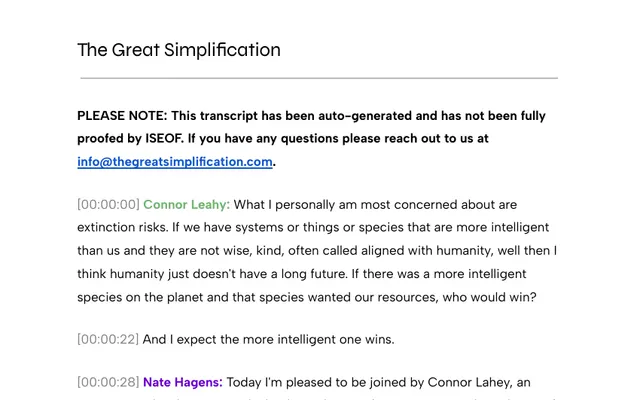
At 29:04–32:23 he expects more capable unaligned systems to take over, with competitive pressure driving adoption. At 57:43–58:23 he gives 50–80% extinction or near-extinction within 50 years if humanity does literally nothing; intervention can change this dramatically. At 1:06–1:10 he advocates lawful collective action and buying time. This conditional historical estimate is not an unconditional current P(doom).

thegreatsimplification.com
TIME interview on deepfakes and AI risk

Calls for liability across the AI supply chain and a temporary international compute cap to buy time for longer-term safety and political solutions.

time.com
Canadian Senate testimony on superintelligence and human control

In his opening statement Leahy predicts humanity loses control if superintelligence is built, with extinction likely through competition. His answers describe competing AI populations, inadequate current control methods, and an international prohibition with verification. He opposes simply abandoning useful AI or slowing all Western data centres, while maintaining that unregulated competition underprovides security.

sencanada.ca
The Peter McCormack Show #201: Connor Leahy on the AI that escaped

Machine transcript with speaker labels; use only Connor’s answers, not Peter McCormack’s. Around 60:44–61:00 he agrees his P(doom) is above 20% and below 100%. When the host puts Nate Soares at 100, he says surely not, maybe 99, and puts his own P(doom) of things going poorly on the current trajectory very, very high, within rounding error of that. He immediately adds that the future is not decided. Supersedes his 2025 figure of 50–80%, which was conditional on doing literally nothing.

pod.wave.co
จุดยืนของคุณอยู่ตรงไหน?
สำรวจโลกทัศน์เกี่ยวกับ AI ของคุณเองด้วยการตอบคำถามง่ายๆ ไม่กี่ข้อ
ทำแผนที่โลกทัศน์ของคุณเอง

จุดยืนของคุณอยู่ตรงไหน?

ทำแผนที่โลกทัศน์ของฉัน