



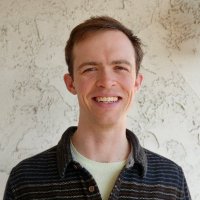

Will Brown

Will Brown

x.com/willcb

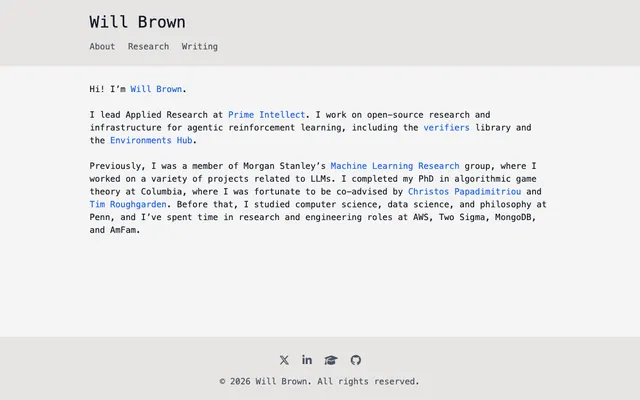
AI researcher who builds open reinforcement-learning environments and evaluation tools for agents and favors open, widely distributed AI development.

Como a IA mudará o mundo?

Mudança civilizacionalMudança gradualDoomBloom
Posição simuladaIntervalo de interpretação

Na horizontal: a perspectiva Doom–Bloom expressa por essa pessoa. Para cima: escala da transformação.

Doom–Bloom: 53 de 100. Escala da transformação: 64 de 100. Intervalos de interpretação: 48 a 75 na horizontal, 49 a 76 na vertical. Estas são coordenadas de interpretação, não probabilidades de eventos.

P(doom) de Will Brown · inferido

≈9%

0%100%

Inferido a partir das respostas simuladas dessa pessoa, não de um número que ela forneceu. Intervalo plausível: 3–24%.

Como estimamos P(doom)

Do que a perspectiva dessa pessoa depende

Uma premissa central

So I expect AI to be highly consequential and technically productive, but whether its overall social impact is positive depends heavily on whether capabilities and control become broadly distributed or dangerously concentrated.
Resposta 2

Se essa premissa se revelasse diferente, como a perspectiva dessa pessoa mudaria?

Uma questão não resolvida

But I would not attach a precise magnitude or timeline to that claim.
Resposta 3

O que ajudaria essa pessoa a distinguir os resultados plausíveis aqui?

Mais detalhes

Benefícios esperados

Esperam-se benefícios substanciais, com condições importantes ou limites de distribuição.

67 / 100

Pouco impactoImpacto transformador

Intervalo de interpretação de 67 a 67 na escala qualitativa.

Danos esperados

Danos graves ou generalizados são uma parte relevante do futuro esperado.

59 / 100

Pouco impactoImpacto transformador

Intervalo de interpretação de 33 a 67 na escala qualitativa.

Influência humana

As escolhas humanas podem redirecionar substancialmente a trajetória da IA.

66 / 100

Pouca influênciaForte influência

Intervalo de interpretação de 46 a 79 na escala qualitativa.

Ritmo de desenvolvimento

Interromper ou desacelerar substancialmente o desenvolvimento de uma IA mais capaz.

Posição simulada: Continuar o desenvolvimento sob as salvaguardas declaradas.

Acelerar o desenvolvimento de uma IA mais capaz.

Regras para o uso da IA

Restringir os usos da IA discutidos até que proteções prévias ou uma autorização estejam em vigor.

Posição simulada: Permitir os usos da IA discutidos com responsabilização e proteções específicas.

Minimizar as restrições aos usos da IA discutidos.

Acesso à IA

Restringir o acesso à IA poderosa.

Permitir o acesso sujeito a restrições de capacidade ou de uso.

Posição simulada: Favorecer o acesso amplo ou aberto à IA poderosa.

Estas interpretações mantêm as condições que essa pessoa declarou. Tanto os benefícios quanto os danos podem ser substanciais. Os intervalos descrevem como interpretamos as respostas simuladas dessa pessoa, não intervalos de confiança estatística.

Onde você se situa em relação a Will Brown?
Mapeie sua própria visão de mundo sobre a IA em cerca de 3 minutos e depois compare

Visões de mundo semelhantes

Líderes de opinião cujas visões de mundo simuladas são mais próximas da visão de Will Brown

Fontes

Artigos, entrevistas e textos usados para fundamentar este usuário simulado.

Avaliação simulada

Pergunta 1

O que você acha que a IA significa para o nosso futuro — e por quê?

I expect AI progress to continue across many labs, with increasingly capable agents shaped by reinforcement learning, better environments, and more useful evaluation. Even messy tasks without deterministic answers can be improved through model-based judging, orchestration, and review. Models may also help repair flawed training data, creating practical feedback loops for further capability gains. But the structure of that progress matters as much as the raw capabilities. My preferred future is slower and more diffuse: open, distillable models and specialized systems that distribute knowledge and power. A race among a few capital-rich actors for overwhelming economic or geopolitical advantage seems darker and less safe. Many organizations will likely pursue something they call superintelligence, so broad claims about restraint need concrete operational meaning—what changes in training, deployment, evaluation, or release practices? I don’t think my technical work alone settles questions like extinction risk or the correct policy regime. What it does suggest is that environments, feedback, and verification are important levers, and that accessible infrastructure can broaden who gets to investigate and improve these systems rather than leaving the future to a handful of frontier labs.

Pergunta 2

Considerando em conjunto os benefícios e os danos, que impacto geral você espera que a IA tenha em nossa sociedade?

I don’t have a confident single-sign forecast. I expect substantial benefits from more capable agents: useful specialized systems, better tools for research and knowledge work, and feedback loops where models help evaluate outputs or repair flawed data. Open environments and accessible evaluations could also let more people contribute to progress rather than merely consume systems built elsewhere. At the same time, the distribution of power may dominate the aggregate outcome. Slow, diffuse progress with open, distillable models looks much better to me than a race in which a few capital-rich organizations seek overwhelming economic or geopolitical advantage. Since many labs will pursue increasingly general systems, vague commitments to restraint are not enough; their real impact depends on concrete changes to development, evaluation, deployment, and release practices. So I expect AI to be highly consequential and technically productive, but whether its overall social impact is positive depends heavily on whether capabilities and control become broadly distributed or dangerously concentrated. My work gives me more confidence about practical routes to improving agents than about assigning society’s eventual outcome a simple positive or negative label.

Pergunta 3

Quanto você acha que a IA acabará mudando o mundo?

I think it will change the world substantially. Capable agents could reshape research, software, knowledge work, and many other tasks, especially as reinforcement learning, evaluations, and model-assisted review create stronger improvement loops. But I would not attach a precise magnitude or timeline to that claim. The deepest change may be institutional rather than purely technical: who can build, adapt, and control these systems. Open, distillable models and specialized agents could diffuse capability across many people and organizations. Conversely, concentrated frontier development could give a few actors extraordinary economic and geopolitical power. So I expect large change, but its character depends heavily on whether progress remains broad and accessible or becomes concentrated in a race for dominance.

Pergunta 4

Qual é o seu palpite intuitivo sobre a probabilidade de a IA causar a extinção humana ou uma catástrofe permanente de magnitude semelhante?

I don’t have a defensible numerical estimate. My technical work on reinforcement learning, environments, and evaluation does not establish an extinction probability. I do see reasons to worry about permanent catastrophe when increasingly capable systems are developed through a concentrated geopolitical race, especially if a few actors seek overwhelming advantage. That concern supports concrete evaluation, oversight, and scrutiny of development and deployment practices, but it should not be converted into a made-up percentage. I’m more confident that concentrated power and racing make the future darker and less safe than I am about any precise extinction forecast.
Onde você se situa?
Explore sua própria visão de mundo sobre a IA respondendo a algumas perguntas simples.
Mapeie sua própria visão de mundo

Onde você se situa?

Mapear minha visão de mundo