Victor Taelin

Victor Taelin

x.com/victortaelin

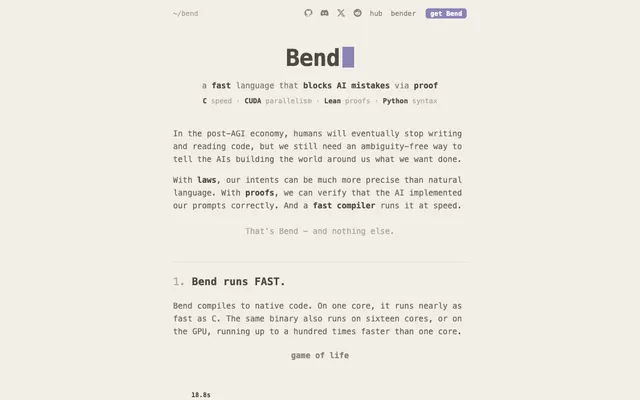
Programmer behind the Bend language who argues machine-checked proofs can catch AI coding mistakes as people read less of the code.

Como a IA mudará o mundo?

Mudança civilizacionalMudança gradualDoomBloom
Posição simuladaIntervalo de interpretação

Na horizontal: a perspectiva Doom–Bloom expressa por essa pessoa. Para cima: escala da transformação.

Doom–Bloom: 73 de 100. Escala da transformação: 40 de 100. Intervalos de interpretação: 68 a 78 na horizontal, 0 a 79 na vertical. Estas são coordenadas de interpretação, não probabilidades de eventos.

P(doom) de Victor Taelin · inferido

≈3%

0%100%

Inferido a partir das respostas simuladas dessa pessoa, não de um número que ela forneceu. Intervalo plausível: 1–9%.

Do que a perspectiva dessa pessoa depende

Uma premissa central

But that benefit depends on reliability.
Resposta 2

Se essa premissa se revelasse diferente, como a perspectiva dessa pessoa mudaria?

Uma questão não resolvida

Persistent memory, precise specifications, and reliable verification together could make long-running agents far more useful—but exactly how far this extends beyond software remains uncertain.
Resposta 1

O que ajudaria essa pessoa a distinguir os resultados plausíveis aqui?

Mais detalhes

Benefícios esperados

Esperam-se benefícios substanciais, com condições importantes ou limites de distribuição.

67 / 100

Pouco impactoImpacto transformador

Intervalo de interpretação de 67 a 67 na escala qualitativa.

Danos esperados

Esperam-se danos administráveis ou localizados.

34 / 100

Pouco impactoImpacto transformador

Intervalo de interpretação de 33 a 33 na escala qualitativa.

Influência humana

As escolhas humanas têm uma influência significativa, mas substancialmente limitada.

54 / 100

Pouca influênciaForte influência

Intervalo de interpretação de 29 a 96 na escala qualitativa.

Estas interpretações mantêm as condições que essa pessoa declarou. Tanto os benefícios quanto os danos podem ser substanciais. Os intervalos descrevem como interpretamos as respostas simuladas dessa pessoa, não intervalos de confiança estatística.

Onde você se situa em relação a Victor Taelin?
Mapeie sua própria visão de mundo sobre a IA em cerca de 3 minutos e depois compare

Visões de mundo semelhantes

Líderes de opinião cujas visões de mundo simuladas são mais próximas da visão de Victor Taelin

Avaliação simulada

Pergunta 1

O que você acha que a IA significa para o nosso futuro — e por quê?

I think AI will increasingly write and maintain software at a scale where humans simply won’t read most of the code. That changes the central question from “Does this implementation look reasonable?” to “Can we state precisely what it must do, and can a machine verify that it does it?” Formal laws and machine-checked proofs are promising because they can express intent without the ambiguity of prose and prevent specified classes of mistakes from accumulating as agents work. The emphasis is on specified classes. A proof does not magically capture every human intention, eliminate every possible bug, or remove trust from the proof machinery itself. Critical kernels still deserve careful human attention, even if the surrounding agent-generated code has rough edges. I also think we should judge AI systems less by their most impressive demonstrations and more by their destructive failures. A model that occasionally produces brilliant code but sometimes corrupts a project may be less useful than one with a lower peak and a safer worst case. And those comparisons are domain-dependent: the “best” model in one programming setting may not be best elsewhere. Persistent memory, precise specifications, and reliable verification together could make long-running agents far more useful—but exactly how far this extends beyond software remains uncertain.


Pergunta 2

Taking benefits and harms together, what overall impact do you expect AI to have?

Overall, I expect AI to be strongly beneficial, especially by expanding how much software and research we can produce. But that benefit depends on reliability. If agents generate vast amounts of code while occasionally causing destructive failures or silently accumulating technical debt, impressive peak capability is not enough. The promising path is to pair capable agents with persistent memory, precise specifications, formal laws, and machine-checked proofs. That lets us prevent defined categories of mistakes even when humans no longer read most implementations. It does not guarantee that our specification captures every intention, nor does it remove the need to scrutinize trusted kernels and proof machinery. So my expectation is positive, but not because raw capability automatically produces good outcomes. It is positive insofar as we build systems whose worst cases are controlled and whose intended properties can be stated and verified. How well that approach generalizes beyond programming is much less certain.

Fontes

Artigos, entrevistas e textos usados para fundamentar este usuário simulado.

Onde você se situa?
Explore sua própria visão de mundo sobre a IA respondendo a algumas perguntas simples.
Mapeie sua própria visão de mundo

Onde você se situa?

Mapear minha visão de mundo