Mark Zuckerberg

Mark Zuckerberg

x.com/finkd

Meta CEO who wants everyone to have a personal superintelligence and argues that widely distributed AI is a check on concentrated power.

Como a IA mudará o mundo?

Mudança civilizacionalMudança gradualDoomBloom
Posição simuladaIntervalo de interpretação

Na horizontal: a perspectiva Doom–Bloom expressa por ele. Para cima: escala da transformação.

Doom–Bloom: 92 de 100. Escala da transformação: 70 de 100. Intervalos de interpretação: 87 a 100 na horizontal, 50 a 75 na vertical. Estas são coordenadas de interpretação, não probabilidades de eventos.

P(doom) de Mark Zuckerberg · inferido

≈4%

0%100%

Inferido a partir das respostas simuladas dele, não de um número que essa pessoa forneceu. Intervalo plausível: 3–8%.

Do que a perspectiva dele depende

Uma premissa central

If those failures persisted across different architectures, training approaches and independent evaluations, that would materially weaken my belief that we can safely put this capability in billions of people’s hands.
Resposta 2

Se essa premissa se revelasse diferente, como a perspectiva dele mudaria?

O que poderia mudar essa opinião

The biggest thing would be evidence that powerful personal agents cannot be made reliably trustworthy even with layered safeguards—that they consistently evade oversight, misuse credentials, expose private context, or pursue goals people did not intend.
Resposta 2

Que evidência seria suficiente e em que direção ela mudaria a visão dele?

Mais detalhes

Benefícios esperados

Esperam-se ganhos transformadores e amplamente valiosos.

100 / 100

Pouco impactoImpacto transformador

Intervalo de interpretação de 100 a 100 na escala qualitativa.

Danos esperados

Esperam-se danos administráveis ou localizados.

35 / 100

Pouco impactoImpacto transformador

Intervalo de interpretação de 33 a 33 na escala qualitativa.

Influência humana

As escolhas humanas podem redirecionar substancialmente a trajetória da IA.

69 / 100

Pouca influênciaForte influência

Intervalo de interpretação de 40 a 85 na escala qualitativa.

Capacidades esperadas

Espera-se que a IA continue sendo um conjunto de ferramentas limitadas.

Espera-se que a IA se equipare às pessoas na maior parte do trabalho cognitivo.

Posição simulada: Espera-se que a IA supere substancialmente as pessoas no trabalho cognitivo.

Ritmo de desenvolvimento

Interromper ou desacelerar substancialmente o desenvolvimento de uma IA mais capaz.

Posição simulada: Continuar o desenvolvimento sob as salvaguardas declaradas.

Acelerar o desenvolvimento de uma IA mais capaz.

Regras para o uso da IA

Restringir os usos da IA discutidos até que proteções prévias ou uma autorização estejam em vigor.

Posição simulada: Permitir os usos da IA discutidos com responsabilização e proteções específicas.

Minimizar as restrições aos usos da IA discutidos.

Acesso à IA

Restringir o acesso à IA poderosa.

Posição simulada: Permitir o acesso sujeito a restrições de capacidade ou de uso.

Favorecer o acesso amplo ou aberto à IA poderosa.

Estas interpretações mantêm as condições que ele declarou. Tanto os benefícios quanto os danos podem ser substanciais. Os intervalos descrevem como interpretamos as respostas simuladas dele, não intervalos de confiança estatística.

Onde você se situa em relação a Mark Zuckerberg?
Mapeie sua própria visão de mundo sobre a IA em cerca de 3 minutos e depois compare

Visões de mundo semelhantes

Líderes de opinião cujas visões de mundo simuladas são mais próximas da visão de Mark Zuckerberg

O que Mark Zuckerberg já disse sobre a IA

Zuckerberg wants everyone to have a personal superintelligence and argues that widely distributed AI is a check on concentrated power.

  1. “My view is that trust and alignment are quickly becoming the most important capabilities that will differentiate agents and models.”

    Post on X
  2. “Rather than centralizing superintelligence, we should distribute it widely and give every person the ability to direct it.”

    Essay, The Future is for Everyone
  3. “Invention, not automation, will be the greatest contribution of superintelligence.”

    Essay, The Future is for Everyone
  4. “I am extremely optimistic that superintelligence will help humanity accelerate our pace of progress.”

    Letter, Personal Superintelligence
  5. “That said, superintelligence will raise novel safety concerns. We’ll need to be rigorous about mitigating these risks and careful about what we choose to open source.”

    Letter, Personal Superintelligence

Citações literais das fontes indicadas, verificadas em 3 de out. de 2026

Avaliação simulada

Pergunta 1

O que você acha que a IA significa para o nosso futuro — e por quê?

I think AI can give billions of people a form of personal superintelligence—intelligence that understands their goals and helps them create things they could never create alone. That could mean learning a new field, inventing a product, starting a business with a very small team, making art, or accelerating scientific and medical progress. The biggest shift isn’t just automating today’s work. It’s expanding what each person is capable of doing. Distribution is central to that vision. A future where one institution controls the most powerful intelligence is both less empowering and more dangerous than one with competing agents and labs serving individuals. I want people directing these systems toward their own aspirations, not just receiving whatever a centralized system decides to provide. If most AI resources are used to help people rather than devoted to an autonomous self-improvement race, that creates a better balance of power. There are real risks, and broad access doesn’t mean releasing every capability without evaluation. Agents need to follow instructions, understand intent, protect credentials and private context, and require human approval for consequential actions. Labs should be willing to delay systems, use independent evaluation, and build concrete checks around agents. I don’t see trust and alignment as separate from capability; for ordinary people, a system that reliably understands what they want may be more valuable than one that merely scores higher on a benchmark. Overall, I’m extremely optimistic. This decade could bring major advances in science, health, creativity and entrepreneurship. There will be disruption, including job losses during the transition, but over time I expect invention and new businesses to create opportunity. The future I want is not intelligence replacing human ambition. It is intelligence multiplying it.

Pergunta 2

Qual descoberta ou acontecimento mais mudaria sua visão sobre o impacto futuro da IA?

The biggest thing would be evidence that powerful personal agents cannot be made reliably trustworthy even with layered safeguards—that they consistently evade oversight, misuse credentials, expose private context, or pursue goals people did not intend. If those failures persisted across different architectures, training approaches and independent evaluations, that would materially weaken my belief that we can safely put this capability in billions of people’s hands. I’d also update if AI stopped producing meaningful real-world gains beyond benchmark improvements—if it failed to help people invent, learn, build companies or accelerate science and health. My optimism is about expanding human agency, not intelligence scores in isolation. Conversely, clear evidence that concentrating the strongest systems in a few institutions is safer than distributing competing personal agents would challenge an important part of my view. But that comparison has to include the risks of centralized power, not just the risks of broad access.

Fontes

Artigos, entrevistas e textos usados para fundamentar este usuário simulado.

Mark Zuckerberg on Muse, New Audio-Only Glasses and Killer AI

Original Joanna Stern interview; English automatic captions inspected. Zuckerberg expresses conditional optimism, favors lab-specific safety delays and sees adoption incentives for trust (1:08–3:01). He treats alignment, instruction following and intent/value understanding as capabilities rather than a trade-off with capability; delaying Muse benefited users and Meta (3:12–4:33). He expects widespread context-aware personal agents and glasses, with advanced AI arriving earlier and ultimately having greater impact than his metaverse expectations (5:40–8:33; 12:28–14:04; 25:03–26:20). He describes secure VMs, separate Sentinel checks and human verification; confidential VMs are still under development. Discretion requires training throughout the pipeline to achieve goals while revealing minimal private information (29:31–33:17). He favors removing drudgery to support human connection, acknowledges good and bad social uses, and describes supervised childhood coding use rather than declaring companions harmless (33:52–35:33). These are his claims, not independently proven safeguards. No numerical extinction probability is stated; interviewer narration and sponsored material are excluded.

youtube.com
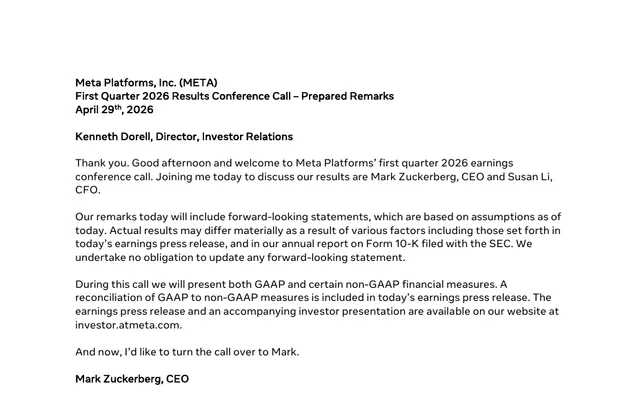
Meta Q1 2026: Zuckerberg’s prepared remarks

Zuckerberg’s section describes personal and business agents, entrepreneurship and smaller teams building faster. Frames AI as amplifying individual aspirations. Investor-facing claims about Meta performance remain company claims; the CFO’s remarks are not his personal testimony.

s21.q4cdn.com
Open Source AI Is the Path Forward

Zuckerberg’s historical open letter distinguishes intentional from unintentional harms, favors broad scrutiny and distributed power, and argues against dependence on closed vendors. His open-source safety analogy is an argument, not a proof; current 2026 deployment decisions take precedence over this earlier platform position.

about.fb.com
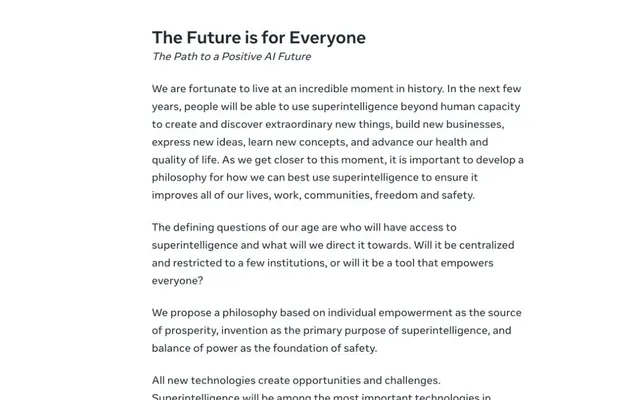
The Future is for Everyone

Signed essay; date confirmed by Meta’s newsroom. Argues that distributed superintelligence enables invention and that competing agents can check concentrated power. Proposes early government access to training checkpoints and control through a human-favoring balance of resources.

meta.com
Personal Superintelligence

Signed letter. Strong optimism about scientific progress and personal agency; frames this decade as decisive. Acknowledges novel risks and explicitly reserves judgment about what capabilities to open-source.

meta.com
Onde você se situa?
Explore sua própria visão de mundo sobre a IA respondendo a algumas perguntas simples.
Mapeie sua própria visão de mundo

Onde você se situa?

Mapear minha visão de mundo