質問1
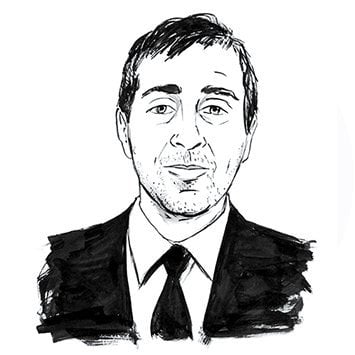
Sam Altman
x.com/samaOpenAI CEO who expects cheap, widely available intelligence to accelerate science and prosperity and argues safety must stay ahead of capability.
AIは世界をどのように変えるでしょうか?
横軸:彼が表明したDoom–Bloomの見通し。 縦軸:変革の規模。
Doom–Bloom:100点中80。変革の規模:100点中75。解釈範囲:横方向は75から100、縦方向は49から80。これらは解釈上の座標であり、事象の確率ではありません。
≈13%
本人が示した数値ではなく、シミュレーションされた本人の回答から推定したものです。 妥当と考えられる範囲:7–24%。
中心的な前提
Alignment and security have to stay ahead of capability.回答1
この前提が実際には異なると判明した場合、彼の見通しはどう変わりますか?
詳細
変革をもたらし、広く価値のある恩恵が予想されています。
96 / 100
質的尺度での解釈範囲は67から100です。
深刻または広範な害が、予想される将来の実質的な一部となっています。
55 / 100
質的尺度での解釈範囲は33から67です。
人間の選択によって、AIの軌道を大幅に変えることができます。
67 / 100
質的尺度での解釈範囲は47から100です。
より高性能なAIの開発を停止するか、大幅に減速させます。
シミュレーション上の位置:明示された安全対策の下で開発を継続します。
より高性能なAIの開発を加速させます。
事前の保護措置または許可が整うまで、取り上げられたAIの利用を制限します。
シミュレーション上の位置:対象を絞った説明責任と保護措置を伴う形で、取り上げられたAIの利用を認めます。
取り上げられたAIの利用に対する制限を最小限にします。
これらの解釈では、彼が示した条件が維持されています。恩恵と害は、どちらも大きくなり得ます。この範囲は、統計的な信頼区間ではなく、彼のシミュレーションされた回答をどのように読み取ったかを示すものです。
似ている世界観
シミュレーションされた世界観がSam Altmanの世界観に最も近いオピニオンリーダー
Sam AltmanがAIについて語ったこと
Altman expects widely shared AI to bring abundance and faster science, and argues that safety and alignment must stay ahead of capabilities.
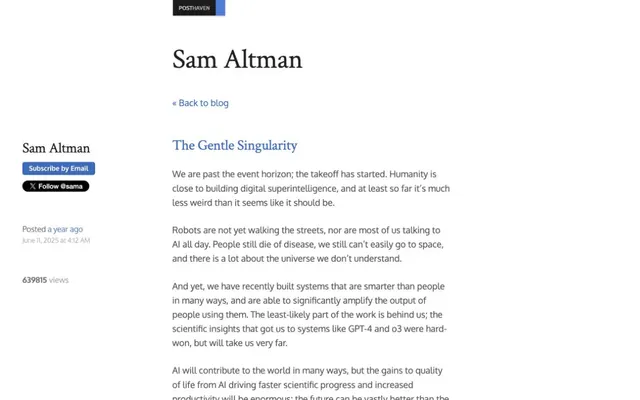
“Pacing will be well worth this cost; no amount of American competitive pressure should justify recklessness, or let capabilities get ahead of alignment and monitoring.”
Post on X “AI will be the most powerful tool for expanding human capability and potential that anyone has ever seen.”
Blog post “AI has to be democratized; power cannot be too concentrated.”
Blog post “In the 2030s, intelligence and energy—ideas, and the ability to make ideas happen—are going to become wildly abundant.”
Essay, The Gentle Singularity “We do need to solve the safety issues, technically and societally, but then it’s critically important to widely distribute access to superintelligence given the economic implications.”
Essay, The Gentle Singularity
リンク先の出典から原文どおりに引用(2026年10月3日に確認)
シミュレーション評価
出典
このシミュレーション対象者の根拠として使用された記事、インタビュー、著作です。
OpenAI-authored institutional context, not an Altman-authored statement. Proposes US-led international technical standards for frontier AI and automated research, including shared evaluations, human oversight and incident reporting. Says fully autonomous recursive self-improvement is not happening today and should not be pursued until safe, with human control and informed democratic choices governing whether to proceed. Presents AI-assisted alignment and broad access to benefits as goals, while distinguishing technical standards from licensing or mandatory prerelease approval. Supports the builder persona’s emphasis on safety pacing and international cooperation without attributing every institutional proposal personally to Altman.

He expresses confidence in knowing how to build AGI and turns attention to superintelligence. Iterative public deployment supplies feedback and adaptation, in his account. Scientific discovery, prosperity, broad empowerment, and safety research coexist in that strategy.

Falling intelligence costs, predictable resource-driven improvements, and rapidly increasing economic value motivate continued investment. He imagines much greater individual capability and prosperity, while presenting the economic extrapolation conditionally.

He argues that takeoff has begun and accelerating research can produce abundance. He expects people to adapt while ordinary human priorities persist. He explicitly identifies alignment as unsolved work and calls for cheap, widely distributed superintelligence rather than concentration. Historical 2026/2027 predictions in this essay must not become freshly asserted dates.

Institutional context, not an Altman-authored statement. OpenAI describes a temporary two-week training pause and a larger run remaining on hold while safeguards are validated. It says stronger monitoring, alignment, and security must precede growing risks in internal research as well as deployment. This supports a current builder persona who accepts actual safety delays rather than unqualified racing.

Coauthored with Jakub Pachocki. Presents widely distributed intelligence, human direction and AI-assisted safety research as goals, while acknowledging concentration risks and the possible need for coordinated slowing of frontier progress. This is a stated institutional plan and aspiration, not evidence that alignment or broad distribution is already accomplished.

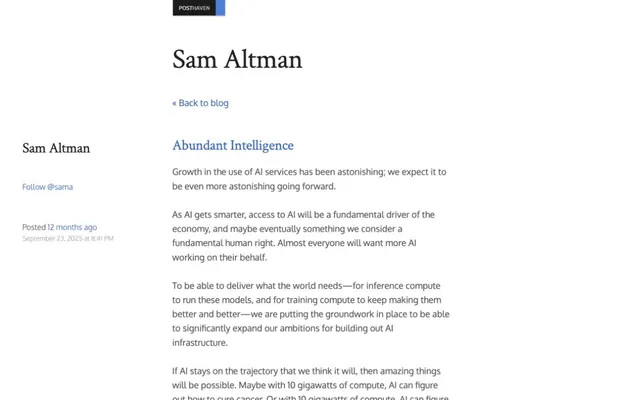
Argues that compute, energy and infrastructure constrain access to useful intelligence, and proposes dramatically expanding supply so more people can benefit. Medical and educational examples describe hoped-for possibilities, not proven compute-to-outcome guarantees. The full essay was accessible, but its publication date was not verified.

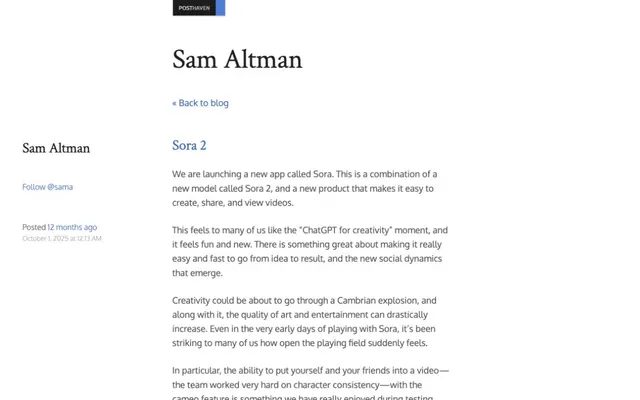
Frames generative video as creative empowerment while discussing addiction, bullying and deceptive media. Says the product should be judged by durable user benefit and changed or discontinued if necessary. Grounds iterative deployment in a concrete product tradeoff. Publication date was not verified on the accessible essay.

Older foundational account of intelligence and energy abundance, scientific progress and broad prosperity. Warns that scarce compute could concentrate power. Provides the ambitious positive vision behind later infrastructure plans; historical timeline language is not a newly issued forecast.

Altman himself expresses confidence that safety and monitoring can stay ahead of capability, with slowing or stopping when they cannot. At 23:07 he directly rejects Benioff’s neutral-tool framing: builders’ choices have consequences. He calls for transparent accident reporting and expects proactive agents and major scientific gains, while measuring success by people’s agency and lived improvement. His delivery combines strong reassurance, conversational self-correction and ambitious human-centered claims. Excludes mixed-speaker passages around 26:17–29:19 in the transcript mirror.

Altman rejects accepting extinction gambles, refuses a precise probability, and says capability advances require credible safeguards.

In the accessible opening five minutes, Altman says rapid capability gains exposed alignment and security gaps, leading to delayed training and compute redirected toward safeguards. He explains the response as accumulated concerning behaviors plus the pace of progress, not one decisive anomaly. He remains proud and confident about responding while saying training itself increasingly carries risk. Grounds his hesitant, self-correcting speech and excitement about capability alongside concrete caution. Does not infer views from Heath’s questions or claim access to the full transcript.

Altman admits he overestimated how quickly GPT-4 would disrupt businesses: habits and institutional inertia slow adoption, including his own. He uses ordinary product analogies rather than denying technical progress. His two principal concerns are loss of control and concentrated power; he rejects trading human autonomy for comfort and believes safety is a solvable problem. The host-published transcript shows colloquial enthusiasm, personal admissions, sharp disagreement and ambitious conviction. Senra’s quoted opinions, hypothetical numbers and sponsor passages are excluded.

あなたはどの位置でしょうか?
自分の世界観をマッピングする