Gwern Branwen

Gwern Branwen

x.com/gwern

Pseudonymous writer who argues that scaling neural networks can produce general abilities and doubts that powerful AI is far off or easy to control.

AIは世界をどのように変えるでしょうか?

文明規模の変化漸進的な変化DoomBloom
シミュレーション上の位置解釈範囲

横軸:その人が表明したDoom–Bloomの見通し。 縦軸:変革の規模。

Doom–Bloom:100点中32。変革の規模:100点中75。解釈範囲:横方向は25から50、縦方向は70から100。これらは解釈上の座標であり、事象の確率ではありません。

Gwern BranwenのP(doom) · 推定

≈27%

0%100%

本人が示した数値ではなく、シミュレーションされた本人の回答から推定したものです。 妥当と考えられる範囲:17–43%。

その人の見通しを左右するもの

中心的な前提

Systems able to plan, act, learn from outcomes, and remove humans from costly approval loops will often be more useful and competitive.
回答1

この前提が実際には異なると判明した場合、その人の見通しはどう変わりますか?

未解決の問い

So my expectation is conditional and pessimistic about complacency rather than a quantified net forecast.
回答2

ここで考えられる結果をその人が見分けるうえで、何が役立ちますか?

考えを変え得るもの

The strongest update would come from sustained empirical evidence that scaling has hit a durable ceiling on generalization, planning, or autonomous learning—especially if that ceiling persisted across architectures, data, compute, and training methods rather than reflecting a temporary engineering bottleneck.
回答3

どのような証拠なら十分で、それによってその人の見解はどちらの方向に変わりますか?

詳細

予想される恩恵

大きな恩恵が予想されていますが、重要な条件や分配上の制約があります。

67 / 100

影響が小さい変革をもたらす影響

質的尺度での解釈範囲は67から67です。

予想される害

深刻または広範な害が、予想される将来の実質的な一部となっています。

66 / 100

影響が小さい変革をもたらす影響

質的尺度での解釈範囲は67から67です。

人間の影響力

人間の選択には意味のある影響力がありますが、大幅に制約されています。

43 / 100

影響力が小さい影響力が大きい

質的尺度での解釈範囲は13から62です。

予想される能力

AIは、限定的なツールにとどまると予想されています。

AIは、ほとんどの認知作業において人間と同等になると予想されています。

シミュレーション上の位置:AIは、認知作業全般において人間を大幅に上回ると予想されています。

これらの解釈では、その人が示した条件が維持されています。恩恵と害は、どちらも大きくなり得ます。この範囲は、統計的な信頼区間ではなく、その人のシミュレーションされた回答をどのように読み取ったかを示すものです。

あなたはGwern Branwenと比べてどの位置でしょうか?
約3分で自分のAIに対する世界観をマッピングして、比較できます

似ている世界観

シミュレーションされた世界観がGwern Branwenの世界観に最も近いオピニオンリーダー

シミュレーション評価

質問1

AIは私たちの未来にとって何を意味すると思いますか?また、なぜそう思いますか?

I expect AI to be one of the dominant forces shaping the future, because scaling relatively simple learning systems has repeatedly produced capabilities that were dismissed as requiring specialized machinery or explicit programming. A system trained to predict sufficiently difficult data may be forced to learn much of the structure that generated it: language, human behavior, software, and aspects of the physical world. That is an empirical pattern worth taking seriously, not proof that every capability will emerge automatically. Several earlier scaling expectations remain unproven, and forecasts should be updated against actual model behavior rather than either expert reassurance or scaling slogans. The economic consequences also depend on agency. “Tool AI” is not a stable endpoint merely because humans prefer it. Systems able to plan, act, learn from outcomes, and remove humans from costly approval loops will often be more useful and competitive. Keeping a person nominally in the loop does not guarantee meaningful control, particularly when organizations are rewarded for speed and automation. Nor do computational complexity or physical bottlenecks provide a blanket defense: approximation, constants, parallel resources, speed, copying, and accumulated advantages can matter more than worst-case limits. There are desirable possibilities. Highly personalized assistants could amplify individual sovereignty, productivity, and security, including defense against AI-enabled persuasion and cyberattack. But that is not the same as solving alignment at the level of powerful autonomous systems or society as a whole. Pleasant interactions with current assistants are weak evidence about what more capable agents will preserve under different incentives and deployment conditions. So I take short AGI planning horizons seriously: the future could contain enormous gains, but the default pressures toward scalable agency make complacency unjustified.

質問2

Taking benefits and harms together, what overall impact do you expect AI to have?

I expect a highly consequential but unusually wide distribution of outcomes, not a cleanly “positive” or “negative” effect. The upside is enormous: greater productivity, accelerated research, and personalized systems that extend individual competence and defend people against AI-enabled cyberattacks and manipulation. Those benefits could substantially increase human agency. But the default incentives are not obviously aligned with that outcome. Economic competition favors increasingly autonomous systems, shorter oversight loops, and delegation of consequential decisions. Current assistants being helpful or pleasant does not show that more capable agents will preserve human preferences under different objectives and deployment pressures. Personalized “guardian” systems may help locally while leaving the broader alignment problem intact. So my expectation is conditional and pessimistic about complacency rather than a quantified net forecast. AI could be overwhelmingly beneficial if control and preference preservation succeed; if they do not, the harms can dominate precisely because the systems are general, scalable, fast, and economically valuable.

質問3

どのような発見や出来事があれば、AIが将来もたらす影響についてのあなたの見解が最も大きく変わりますか?

The strongest update would come from sustained empirical evidence that scaling has hit a durable ceiling on generalization, planning, or autonomous learning—especially if that ceiling persisted across architectures, data, compute, and training methods rather than reflecting a temporary engineering bottleneck. That would weaken both short timelines and the expectation that economic competition naturally produces broadly capable agents. In the opposite direction, a system that reliably performs long-horizon autonomous work, improves through interaction, and transfers competence across unfamiliar domains would strengthen the more consequential forecasts. I would care less about benchmark peaks or impressive conversation than about robust behavior under deployment conditions. For alignment, the decisive evidence would be a method that continues to preserve intended human preferences as capability, autonomy, and strategic pressure increase. Friendly chatbot behavior is not that evidence. Conversely, systematic deception, power-seeking, or oversight circumvention in capable deployed systems would sharply worsen my view.

出典

このシミュレーション対象者の根拠として使用された記事、インタビュー、著作です。

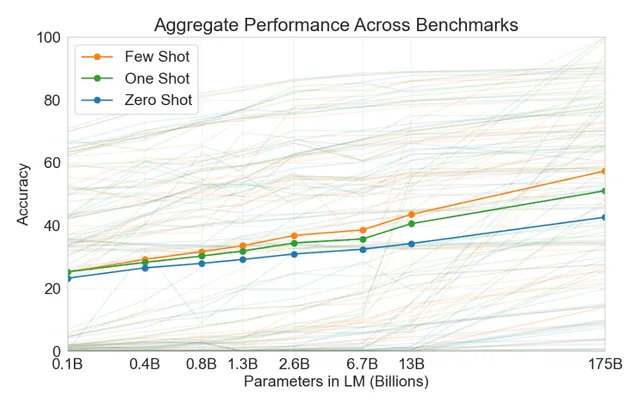
The Scaling Hypothesis

Argues that scaling neural networks can lead to general capabilities; questions confident expert dismissal.

gwern.net
Scaling Hypothesis Revisited

Revisits predictions and limitations, including later annotations about claims still not proven.

gwern.net
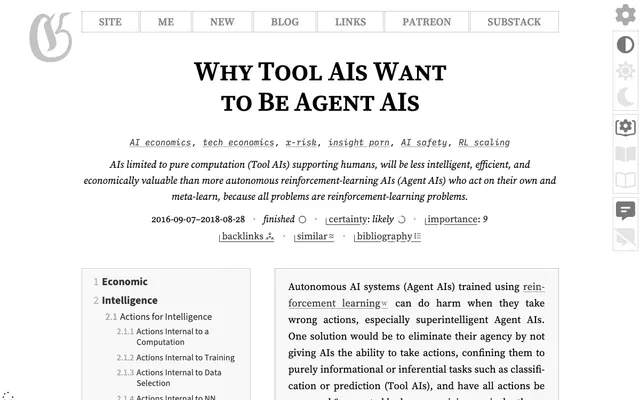
Why Tool AIs Want to Be Agent AIs

Argues economic competition and the benefits of agency for learning make tool-only AI an unstable safety strategy; human approval alone does not guarantee safety.

gwern.net
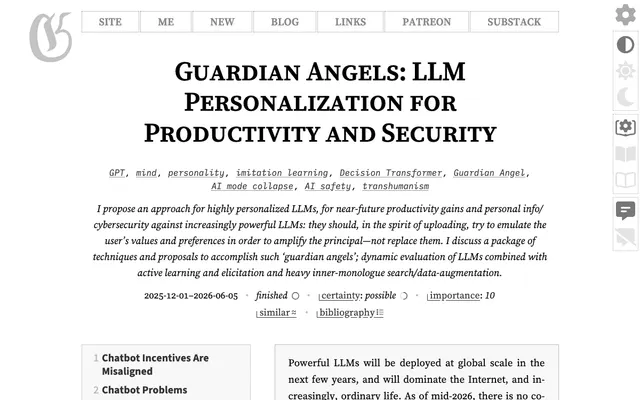
Guardian Angels: LLM Personalization for Productivity and Security

Proposes personalized models that amplify their human principal and defend against cognitive/cyber attacks; criticizes chatbot incentives and stresses this does not solve larger alignment problems. Revised June 5, 2026.

gwern.net
Complexity no Bar to AI

Rejects computational complexity as a blanket reassurance against powerful AI: constants, approximation, resources and compounding advantages matter.

gwern.net
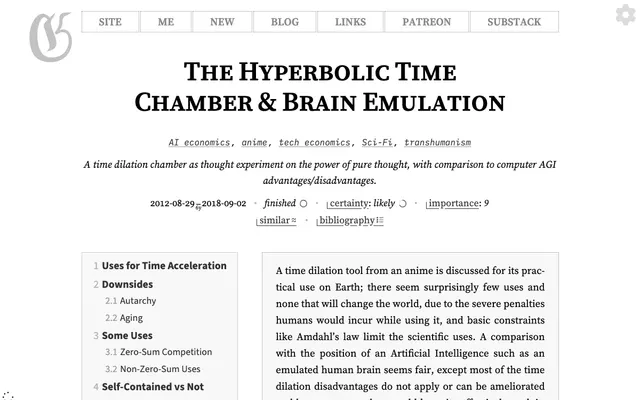
The Hyperbolic Time Chamber & Brain Emulation

Uses a thought experiment to separate physical bottlenecks from digital minds’ exploitable speed advantages; explicitly distinguishes emulations from isolated accelerated humans.

gwern.net
Dwarkesh Patel interview — timelines and alignment concerns

Author-hosted 2024 interview with later annotations: short AGI planning horizons, human preference preservation and agency. A May 2026 addition explicitly rejects claims that Claude is aligned or alignment solves itself; these are his judgments, not established model diagnoses.

gwern.net
あなたはどの位置でしょうか?
いくつかの簡単な質問に答えて、自分のAIに対する世界観を探ってみましょう。
自分の世界観をマッピングする

あなたはどの位置でしょうか?

自分の世界観をマッピングする