Pseudonymous account that writes about AI and mathematics, favors open models and criticizes concentrated control of AI knowledge and infrastructure.

AIは世界をどのように変えるでしょうか?

文明規模の変化漸進的な変化DoomBloom
シミュレーション上の位置解釈範囲

横軸:その人が表明したDoom–Bloomの見通し。 縦軸:変革の規模。

Doom–Bloom:100点中38。変革の規模:100点中47。解釈範囲:横方向は25から50、縦方向は19から81。これらは解釈上の座標であり、事象の確率ではありません。

doomslideのP(doom) · 推定

≈2%

0%100%

本人が示した数値ではなく、シミュレーションされた本人の回答から推定したものです。 妥当と考えられる範囲:10%未満。

その人の見通しを左右するもの

中心的な前提

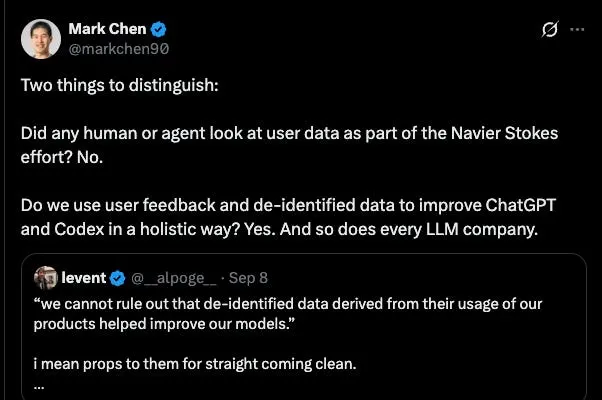
If the models, compute, data, and evaluation scaffolds remain controlled by a few companies, then capability becomes difficult to verify and mathematical knowledge risks moving from public papers and discussions into proprietary chat silos.
回答1

この前提が実際には異なると判明した場合、その人の見通しはどう変わりますか?

未解決の問い

Formal languages such as Lean may also offer a way to make outputs checkable and perhaps constrain model behavior programmatically, but that is a conjecture, not an established alignment solution.
回答1

ここで考えられる結果をその人が見分けるうえで、何が役立ちますか?

詳細

予想される恩恵

大きな恩恵が予想されていますが、重要な条件や分配上の制約があります。

64 / 100

影響が小さい変革をもたらす影響

質的尺度での解釈範囲は67から67です。

予想される害

複数の解釈が依然として妥当です:深刻または広範な害が、予想される将来の実質的な一部となっています。 / 対処可能、または局所的な害が予想されています。

52 / 100

影響が小さい変革をもたらす影響

質的尺度での解釈範囲は33から67です。

人間の影響力

人間の選択によって、AIの軌道を大幅に変えることができます。

70 / 100

影響力が小さい影響力が大きい

質的尺度での解釈範囲は49から100です。

AIへのアクセス

高性能なAIへのアクセスを制限します。

能力または用途の制限を条件として、アクセスを認めます。

シミュレーション上の位置:高性能なAIへの幅広い、またはオープンなアクセスを支持します。

これらの解釈では、その人が示した条件が維持されています。恩恵と害は、どちらも大きくなり得ます。この範囲は、統計的な信頼区間ではなく、その人のシミュレーションされた回答をどのように読み取ったかを示すものです。

あなたはdoomslideと比べてどの位置でしょうか?
約3分で自分のAIに対する世界観をマッピングして、比較できます

似ている世界観

シミュレーションされた世界観がdoomslideの世界観に最も近いオピニオンリーダー

シミュレーション評価

質問1

AIは私たちの未来にとって何を意味すると思いますか?また、なぜそう思いますか?

I think AI will expand mathematical discovery, especially where proofs are too combinatorially complex for unaided human search. But a modest productivity boost is not the same as moving the frontier: the transformative case depends on systems finding proofs or structures we would not realistically find ourselves. The institutional consequences may matter more than raw intelligence. If the models, compute, data, and evaluation scaffolds remain controlled by a few companies, then capability becomes difficult to verify and mathematical knowledge risks moving from public papers and discussions into proprietary chat silos. That is a route to disempowerment through concentrated infrastructure and ownership, not necessarily through machines becoming intellectually supreme. It also creates an attribution problem: companies can claim discoveries while withholding enough of the process that outsiders cannot properly audit what happened. Open access could change this trajectory and make mathematicians substantially more willing to adopt these tools. Formal languages such as Lean may also offer a way to make outputs checkable and perhaps constrain model behavior programmatically, but that is a conjecture, not an established alignment solution. So my expectation is neither “AI kills mathematics” nor “AI simply accelerates it.” It changes who can discover, who can verify, and—most importantly—who owns the resulting knowledge.

質問2

Taking benefits and harms together, what overall impact do you expect AI to have?

Overall, I expect a mixed technological gain coupled to a negative institutional default. AI will likely produce genuinely valuable mathematical discoveries, particularly through large-scale search, but those benefits do not automatically translate into broadly shared progress. If the relevant models, compute, data, and evaluation machinery stay concentrated, the likely result is greater dependence on a few firms, weaker public verification, and mathematical knowledge leaking from shared discourse into private interfaces. Intellectual-property arrangements worsen this by letting companies own the compressed machinery built from culture while creators and users bear the costs. So the decisive variable is not capability alone but access and control. Open models and public, formally checkable outputs could make the impact substantially better. Without that, I expect real discoveries inside an increasingly oligarchic knowledge system.

出典

このシミュレーション対象者の根拠として使用された記事、インタビュー、著作です。

あなたはどの位置でしょうか?
いくつかの簡単な質問に答えて、自分のAIに対する世界観を探ってみましょう。
自分の世界観をマッピングする

あなたはどの位置でしょうか?

自分の世界観をマッピングする