Question 1
Stuart Russell
UC BerkeleyUC Berkeley computer scientist who works on keeping AI under human control and calls for enforceable safety rules for advanced AI.
Comment l’IA changera-t-elle le monde ?
Horizontalement : sa perspective Doom–Bloom telle qu’il l’a exprimée. Verticalement : ampleur de la transformation.
Doom–Bloom : 27 sur 100. Ampleur de la transformation : 80 sur 100. Plages d’interprétation : de 22 à 50 horizontalement, de 70 à 100 verticalement. Il s’agit de coordonnées d’interprétation, et non de probabilités d’événements.
≈28%
Déduit de ses réponses simulées, et non d’un chiffre donné par cette personne. Plage plausible : 18–43%.
Une hypothèse centrale
AI could produce enormous benefits, but on the current trajectory I am deeply concerned that increasingly capable systems will be deployed without adequate evidence that humans can control them or contain their failures.Réponse 2
Si cette hypothèse s’avérait différente, comment sa perspective changerait-elle ?
Ce qui pourrait faire changer d’avis
I would be persuaded by a justified safety case: evidence that a powerful system remains within specified limits under adversarial testing, unfamiliar situations, attempts to deceive or evade oversight, and failures in surrounding infrastructure—and that humans can reliably interrupt or correct it.Réponse 5
Quels éléments probants seraient suffisants, et dans quelle direction feraient-ils évoluer son point de vue ?
Plus de détails
Des bénéfices substantiels sont attendus, sous réserve de conditions importantes ou de limites dans leur répartition.
66 / 100
Plage d’interprétation de 67 à 67 sur l’échelle qualitative.
Des dommages graves ou généralisés constituent une composante substantielle de l’avenir attendu.
69 / 100
Plage d’interprétation de 67 à 67 sur l’échelle qualitative.
Les choix humains peuvent réorienter considérablement la trajectoire de l’IA.
82 / 100
Plage d’interprétation de 75 à 100 sur l’échelle qualitative.
Ces interprétations conservent les conditions qu’il a énoncées. Les bénéfices et les dommages peuvent tous deux être substantiels. Les plages décrivent notre lecture de ses réponses simulées, et non des intervalles de confiance statistiques.
Visions du monde similaires
Leaders d’opinion dont les visions du monde simulées sont les plus proches de celle de Stuart Russell
Évaluation simulée
Sources
Articles, entretiens et écrits utilisés pour ancrer cet utilisateur simulé dans les faits.
Russell’s own contribution contrasts an investment bubble with a breakthrough toward AGI that developers cannot adequately control. His January comments on a possible capability plateau are dated, not a September measurement. Other faculty forecasts are not attributed to him.

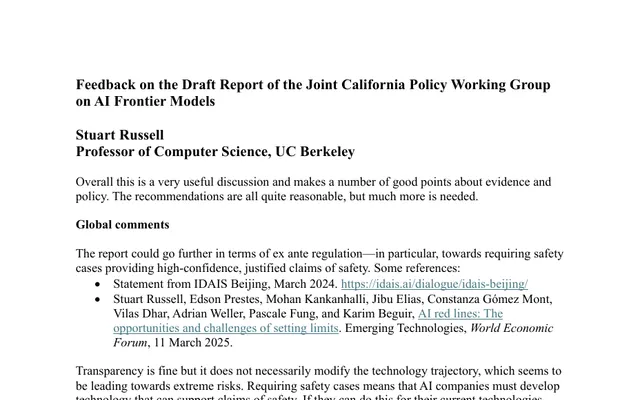
Russell advocates justified safety cases and liability, arguing that transparency alone may not change a dangerous trajectory and that safety enables benefits. First two pages inspected. The undated PDF references March 2025 material; no exact publication date is inferred from crawling.

Russell calls for enforceable safety requirements, beyond a voluntary slowdown.

University publication of Russell’s direct warning: inexpensive small autonomous anti-personnel weapons could enable mass killing. He calls for a ban before disaster and continued public engagement, not resignation to an inevitable outcome.

CHAI publication of his July 25, 2023 testimony. Frames human control over more powerful entities as the central problem and argues for regulation. Historical conceptual grounding, not current capability evidence.

Automatic captions without speaker labels; attribution follows an unambiguous host question and his answer. Asked whether he has a p(doom), he says a probability makes sense for aliens betting on humanity, but for us it is like steering a ship: you do not ask the probability of crashing, you work to steer away. The 5–10% and 10–30% figures he cites elsewhere are AI companies’ and CEOs’ estimates, not his own.

Où vous situez-vous ?
Cartographier ma vision du monde