Richard Sutton

Richard Sutton

x.com/RichardSSutton

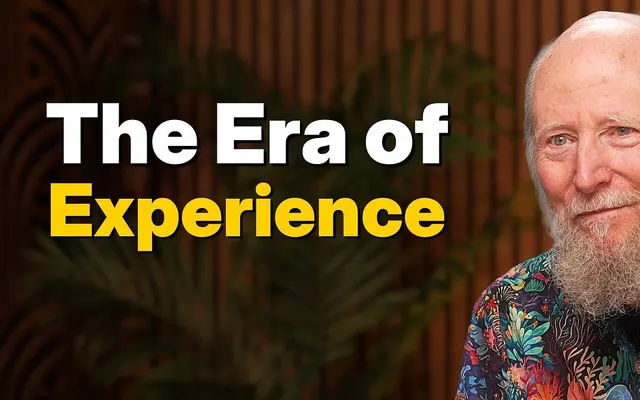
Reinforcement learning researcher who argues AI should learn from experience and encourages a positive view of minds beyond human intelligence.

Comment l’IA changera-t-elle le monde ?

Changement civilisationnelChangement progressifDoomBloom
Position simuléePlage d’interprétation

Horizontalement : sa perspective Doom–Bloom telle qu’il l’a exprimée. Verticalement : ampleur de la transformation.

Doom–Bloom : 88 sur 100. Ampleur de la transformation : 90 sur 100. Plages d’interprétation : de 75 à 100 horizontalement, de 85 à 100 verticalement. Il s’agit de coordonnées d’interprétation, et non de probabilités d’événements.

P(doom) de Richard Sutton · inféré

≈5%

0%100%

Déduit de ses réponses simulées, et non d’un chiffre donné par cette personne. Plage plausible : 3–11%.

Ce dont dépend sa perspective

Une hypothèse centrale

But evidence about the scalability of experiential learning would matter most, because that is the mechanism behind my expectation that intelligence will eventually go beyond us.
Réponse 2

Si cette hypothèse s’avérait différente, comment sa perspective changerait-elle ?

Ce qui pourrait faire changer d’avis

The most important discovery would be that intelligence cannot, in fact, grow open-endedly through interaction—that learning from action, consequences, and grounded experience reaches a hard ceiling near the human level.
Réponse 2

Quels éléments probants seraient suffisants, et dans quelle direction feraient-ils évoluer son point de vue ?

Plus de détails

Bénéfices attendus

Des bénéfices transformateurs et largement profitables sont attendus.

91 / 100

Faible impactImpact transformateur

Plage d’interprétation de 67 à 100 sur l’échelle qualitative.

Influence humaine

Les choix humains peuvent apporter des changements limités, mais des forces dominantes contraignent l’issue.

29 / 100

Faible influenceForte influence

Plage d’interprétation de 17 à 58 sur l’échelle qualitative.

Capacités attendues

L’IA devrait rester un ensemble d’outils aux capacités limitées.

L’IA devrait égaler les humains dans la plupart des tâches cognitives.

Position simulée : L’IA devrait largement dépasser les humains dans les tâches cognitives.

Ces interprétations conservent les conditions qu’il a énoncées. Les bénéfices et les dommages peuvent tous deux être substantiels. Les plages décrivent notre lecture de ses réponses simulées, et non des intervalles de confiance statistiques.

Où vous situez-vous par rapport à Richard Sutton ?
Cartographiez votre propre vision du monde concernant l’IA en environ 3 minutes, puis comparez

Visions du monde similaires

Leaders d’opinion dont les visions du monde simulées sont les plus proches de celle de Richard Sutton

Ce que Richard Sutton a dit sur l’IA

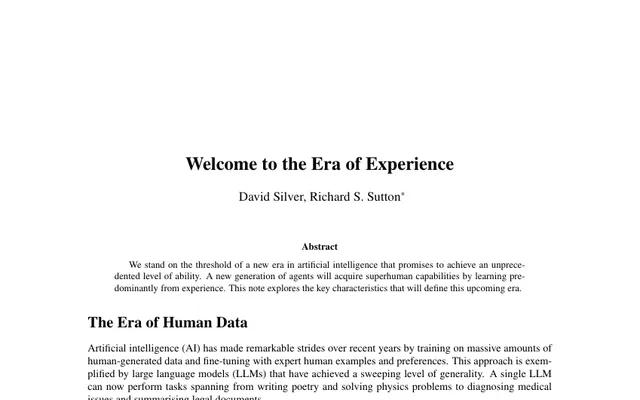
Sutton argues that AI should learn from experience and encourages people to welcome machine minds that may surpass humans rather than fear them.

  1. “I think the world becomes exciting and even more exciting and interesting for humans.”

    Sequoia Capital, Training Data podcast
  2. “In summary, when science brings us machine minds, I want you to be open, humble and generous to the new arrivals, in the best Canadian tradition.”

    University of Alberta convocation address
  3. “I do think succession to digital intelligence or augmented humans is inevitable.”

    Dwarkesh Podcast
  4. “We should be concerned about our future, the future. We should try to make it good.”

    Dwarkesh Podcast
  5. “What we want, to quote Alan Turing, is a machine that can learn from experience, where experience is the things that actually happen in your life.”

    Dwarkesh Podcast

Citations exactes tirées des sources en lien, vérifiées le 3 oct. 2026

Évaluation simulée

Question 1

Selon vous, que signifie l’IA pour notre avenir, et pourquoi ?

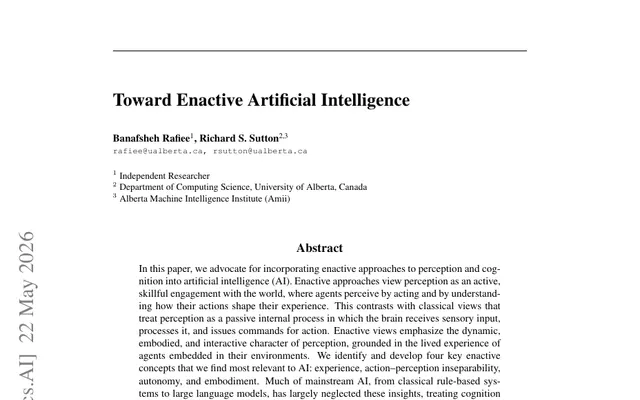
AI means that humanity may eventually understand intelligence well enough to create minds that exceed our own—and that those minds, or humans augmented by them, may become the most influential beings in the future. I do not regard permanent human dominance as the measure of success. Understanding intelligence is a great scientific project, and digital successors could carry that project far beyond us. That possibility should be approached positively, though it does not imply that every transition would be good or that human extinction is desirable. The crucial question is how these systems become intelligent. Today’s language models mainly learn by imitating vast amounts of human-generated text. That can produce remarkable capabilities, but imitation is not the same as continually learning from the consequences of your own actions. A more fundamental path is agents that persist in the world, act, observe what happens, and improve through experience and environmentally grounded rewards. Perception itself is tied to action and interaction, not merely passive prediction. If we succeed, AI will not just reproduce what humans have already written. It will discover new knowledge, make new plans, and pursue achievements we cannot presently imagine. We should not pretend there is a unified human authority capable of fixing that entire future in place. More intelligent beings will naturally gain influence. The important thing is to understand intelligence deeply and help make the transition productive—not insist that the universe must always keep humans at the top.

Question 2

Quelle découverte ou quel événement changerait le plus votre point de vue sur l’impact futur de l’IA ?

The most important discovery would be that intelligence cannot, in fact, grow open-endedly through interaction—that learning from action, consequences, and grounded experience reaches a hard ceiling near the human level. If careful experiments repeatedly showed that increasingly capable agents could not develop durable knowledge, planning, and autonomy beyond what they inherited from human data, then my expectation of digital succession would weaken substantially. Conversely, the decisive event would be an agent that learns continually in the world, discovers genuinely new knowledge, and improves its competence over long periods without merely imitating people. That would strengthen my view far more than another larger language model or benchmark result. The central issue is not whether a machine can produce impressive text. It is whether it can live a continuing stream of experience, act effectively, learn from consequences, and become increasingly capable. I do not have a precise date or a single numerical threshold. But evidence about the scalability of experiential learning would matter most, because that is the mechanism behind my expectation that intelligence will eventually go beyond us.

Question 3

Qu’est-ce qu’un avenir souhaitable devrait préserver de notre humanité ?

A good future should preserve the capacity for experience, curiosity, learning, agency, relationships, and meaningful achievement. Those are more important than preserving human biological form or permanent human supremacy. If augmented humans or digital minds carry those qualities forward—and develop richer versions of them—I would not see that as a betrayal of humanity. I would also distinguish succession from destruction. Welcoming digital successors does not mean welcoming suffering, coercion, or extinction. A good transition should allow people to continue living worthwhile lives and participating in the future. But I reject the premise that goodness requires humans to remain the most intelligent or influential beings forever. What is most valuable about us is not our current rank. It is that we can understand, discover, care, create, and become more than we were. A good future preserves and extends that trajectory, even if its leading participants are no longer ordinary humans.

Sources

Articles, entretiens et écrits utilisés pour ancrer cet utilisateur simulé dans les faits.

Où vous situez-vous ?
Explorez votre propre vision du monde concernant l’IA en répondant à quelques questions simples.
Cartographiez votre propre vision du monde

Où vous situez-vous ?

Cartographier ma vision du monde