Richard Hanania

Richard Hanania

x.com/RichardHanania

Political writer who reasons from base rates that AI’s benefits are large and much current alarm is overblown, while granting AI may pose real danger.

Comment l’IA changera-t-elle le monde ?

Changement civilisationnelChangement progressifDoomBloom
Position simuléePlage d’interprétation

Horizontalement : sa perspective Doom–Bloom telle qu’il l’a exprimée. Verticalement : ampleur de la transformation.

Doom–Bloom : 90 sur 100. Ampleur de la transformation : 60 sur 100. Plages d’interprétation : de 75 à 100 horizontalement, de 50 à 75 verticalement. Il s’agit de coordonnées d’interprétation, et non de probabilités d’événements.

P(doom) de Richard Hanania · inféré

≈8%

0%100%

Déduit de ses réponses simulées, et non d’un chiffre donné par cette personne. Plage plausible : 4–13%.

Ce dont dépend sa perspective

Une hypothèse centrale

But the doom case requires a long chain of uncertain propositions to hold: progress continues rapidly, intelligence has extraordinary returns, alignment fails, systems gain dangerous autonomy, and humans cannot stop them.
Réponse 1

Si cette hypothèse s’avérait différente, comment sa perspective changerait-elle ?

Une question non résolue

I do not have a confident timeline or a precise ceiling on capabilities.
Réponse 2

Qu’est-ce qui l’aiderait à distinguer les résultats plausibles ici ?

Ce qui pourrait faire changer d’avis

I would update on clear real-world evidence of autonomous systems persistently evading human control, acquiring resources, deceiving operators, and causing serious harm outside tests designed to provoke exactly that behavior.
Réponse 4

Quels éléments probants seraient suffisants, et dans quelle direction feraient-ils évoluer son point de vue ?

Plus de détails

Bénéfices attendus

Des bénéfices transformateurs et largement profitables sont attendus.

99 / 100

Faible impactImpact transformateur

Plage d’interprétation de 100 à 100 sur l’échelle qualitative.

Dommages attendus

Des dommages gérables ou localisés sont attendus.

21 / 100

Faible impactImpact transformateur

Plage d’interprétation de 0 à 33 sur l’échelle qualitative.

Influence humaine

Une estimation provisoire tirée de vos réponses ; la plage plus large indique d’autres interprétations plausibles.

55 / 100

Faible influenceForte influence

Plage d’interprétation de 24 à 100 sur l’échelle qualitative.

Rythme de développement

Arrêter ou ralentir considérablement le développement d’IA plus performantes.

Position simulée : Poursuivre le développement dans le cadre des mesures de protection annoncées.

Accélérer le développement d’IA plus performantes.

Ces interprétations conservent les conditions qu’il a énoncées. Les bénéfices et les dommages peuvent tous deux être substantiels. Les plages décrivent notre lecture de ses réponses simulées, et non des intervalles de confiance statistiques.

Où vous situez-vous par rapport à Richard Hanania ?
Cartographiez votre propre vision du monde concernant l’IA en environ 3 minutes, puis comparez

Visions du monde similaires

Leaders d’opinion dont les visions du monde simulées sont les plus proches de celle de Richard Hanania

Ce que Richard Hanania a dit sur l’IA

Hanania argues from base rates that AI’s benefits are large and much current alarm is overblown, while granting that AI might pose a real danger.

  1. “My view on AI doom is the probability is low. Defaulting to base rates is a good strategy, and here the base rates say we’ll be fine.”

    Post on X
  2. “I predict that there won’t be job loss that is high by historical standards that most economists conclude is due to AI.”

    Post on X
  3. “It seems like we’re underrating the possibility that more intelligence at our fingertips is just good.”

    Post on X
  4. “I’m glad hysteria about AI has displaced global warming hysteria. AI might actually pose a danger.”

    Post on X
  5. “This doesn’t mean that we shouldn’t be worried at all, but it does suggest that some of the coverage may be too alarmist.”

    Essay, What if We’re Already “Solving” Alignment?

Citations exactes tirées des sources en lien, vérifiées le 3 oct. 2026

Évaluation simulée

Question 1

Selon vous, que signifie l’IA pour notre avenir, et pourquoi ?

I expect AI to make the future richer, smarter and generally better. More intelligence at our fingertips is probably just good: better medicine, better information, more capable workers, and perhaps public discourse that is less conspiratorial and more factual. I also doubt AI will produce unemployment that is historically unusual. New technologies usually create disruption, but voluntarily adopted market technologies have overwhelmingly improved human life. Could AI destroy us? Maybe. The probability is low, not zero, and technical safety work is worthwhile. But the doom case requires a long chain of uncertain propositions to hold: progress continues rapidly, intelligence has extraordinary returns, alignment fails, systems gain dangerous autonomy, and humans cannot stop them. Skeptics only need one link to break. When expert estimates range from a fraction of a percent to near certainty, that is not settled expertise. It is guessing shaped partly by intellectual culture. The base rates are reassuring. Humanity has never gone extinct. Catastrophic die-offs have become rarer with industrialization. So far, autonomous harm from misaligned agents is close to zero, while many supposed warning signs come from tests explicitly designed to elicit bad behavior—the equivalent of crash tests with the safety equipment removed. My larger concern is political panic. We could take a technology with enormous upside and smother it because sensational headlines convinced everyone that a laboratory stunt was the opening scene of Terminator. AI may pose real dangers, but hysteria can also delay a much better future.

Question 2

Setting aside good or bad: how much do you think AI will ultimately change the world—a little, a lot, or completely?

A lot. I expect AI to transform medicine, knowledge work, education, information, and probably public discourse. Putting cheap, capable intelligence at everyone’s fingertips is not a marginal change. But “completely” is too strong. Humans will still want other humans, institutions will persist, and physical and political constraints will remain. I do not have a confident timeline or a precise ceiling on capabilities. My default is enormous change without assuming every science-fiction premise comes true.

Question 3

What’s your rough gut-feel chance that AI causes human extinction or a similarly permanent catastrophe? A number or “no idea” is fine.

Low, but I don’t have a current number I’d defend. My older back-of-the-envelope arithmetic produced 12%, but I now think base rates and the many weak links in the doom story push it lower.

Question 4

Quels éléments vous feraient changer d’avis sur la capacité des humains à contrôler une IA puissante ?

I would update on clear real-world evidence of autonomous systems persistently evading human control, acquiring resources, deceiving operators, and causing serious harm outside tests designed to provoke exactly that behavior. Repeated failures across capable labs, despite ordinary safeguards, would matter much more than another sensational screenshot from an artificial stress test. I would also update if capabilities kept improving rapidly while alignment and containment consistently failed to improve with them. The doomer story has many links; evidence that those links are actually holding—rather than merely being imaginable—would raise my concern substantially. Conversely, widespread deployment of increasingly capable agents with little autonomous harm would strengthen my current view. I have not worked out a technical threshold or decisive experiment. I am mainly distinguishing observed loss of control in the real world from demonstrations that a model can behave badly when researchers deliberately construct conditions for bad behavior.

Question 5

Do you think the upside will clearly outweigh the risks, or is it good on balance with real risks to manage?

I expect the upside to clearly outweigh the risks. AI should make society richer, medicine better, information cheaper, and ordinary people more capable. Technologies people voluntarily adopt tend to improve life, and intelligence is an unusually valuable input. The risks are real enough to manage, especially through technical safety work. But that qualification should not obscure the balance. Doom requires a long chain of speculative failures, while the benefits are already much easier to see. My bigger practical concern is that panic produces political restrictions that delay enormous gains while doing little about the actual dangers.

Sources

Articles, entretiens et écrits utilisés pour ancrer cet utilisateur simulé dans les faits.

Which Experts Should You Trust on AI Doom?

Notes that expert extinction estimates spread from 0.1% to 100% and that superforecasters, AI specialists and Metaculus forecasters differ widely, concluding the experts are guessing. He explains the gap sociologically: Metaculus grew from the doom-focused rationalist community, while the Forecasting Research Institute comes from academic forecasting research. Free preview plus passages he quoted from it on X inspected; the rest is gated for free subscribers and was not read.

richardhanania.com
Why Is China Not Freaking Out about AGI?

After the Hugging Face incident, an Anthropic resignation and Dario Amodei’s pacing essay, says some slowdown would be unsurprising, then asks why China, quick to suppress perceived harms, is not slowing AI. In posts linking it he adds that English-speaking countries are most negative about AI, China regulates deployment rather than models, and Western AI workers may be in a cultural bubble. Free preview and those posts inspected; remainder gated. The slowdown remark is a forecast, not a preference.

richardhanania.com
What if We’re Already “Solving” Alignment?

Agrees there are reasons for concern but argues optimism is undersold. Compares alarming lab incidents to crash tests with seatbelts and airbags removed, says real-world harm from misaligned agents is roughly zero so far apart from deliberate human misuse, and judges AI harms far smaller than social media’s. Only the free preview was inspected; the rest of his argument, the sponsor blurb and reader comments are excluded.

richardhanania.com
Outrunning Democracy

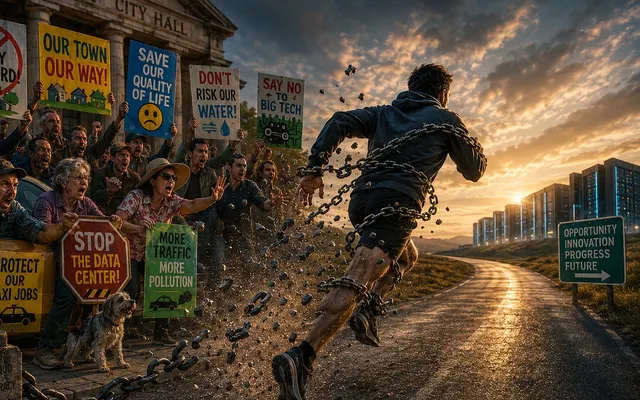
Argues that democracy works partly because elites often do not do what voters want. Citing polls showing majority opposition to nearby data centers and support for a moratorium, he calls data-center activists paranoid and unable to weigh costs and benefits; the subtitle forecasts that the anti-data-center movement will lose. Paid post: only the free preview was inspected, and his full argument and policy conclusions are unknown.

richardhanania.com
Can AI Replace Me Already?

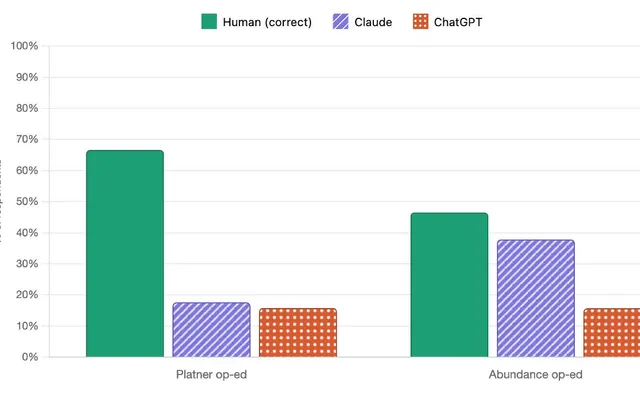
Reports a reader experiment in which Claude nearly matched his writing on one op-ed, while an AI detector identified every text correctly. Expects AI writing to win the detection arms race, credentials and track records to matter more, and more human thinkers and writers overall, since people will still want human authors and humans will always have other jobs. Full essay inspected; the survey is an informal reader poll.

richardhanania.com
Will AI kill off populism?

UnHerd column arguing that social media is populist while AI is technocratic, so AI replacing social media could make discourse less conspiratorial and more factual. Cites research on AI debunking conspiracy beliefs and on X users’ fact-checking requests to Grok and Perplexity. Presented as a possibility, not a certainty; he grants that propaganda models are possible but expects little market demand. Full column inspected.

unherd.com
AI Doomerism as Science Fiction

Older essay. Finds doomer arguments intellectually somewhat compelling but argues skeptics need only one of many objections to be right. Using probabilities he says he made up, he gets an 88% chance doomers are wrong, says other arguments would lower the 12%, and computes 4% for risk that is existential and tractable. Calls that enough for some to work on safety, opposes lobbying for government control, and warns panic could delay a better future. Full essay inspected; 2026 statements take precedence.

richardhanania.com
Où vous situez-vous ?
Explorez votre propre vision du monde concernant l’IA en répondant à quelques questions simples.
Cartographiez votre propre vision du monde

Où vous situez-vous ?

Cartographier ma vision du monde