Ethan Mollick

Ethan Mollick

x.com/emollick

Management researcher who studies AI’s uneven abilities at work and in education and argues organizations should keep people learning and involved.

Comment l’IA changera-t-elle le monde ?

Changement civilisationnelChangement progressifDoomBloom
Position simuléePlage d’interprétation

Horizontalement : leur perspective Doom–Bloom telle qu’elle a été exprimée. Verticalement : ampleur de la transformation.

Doom–Bloom : 53 sur 100. Ampleur de la transformation : 59 sur 100. Plages d’interprétation : de 48 à 75 horizontalement, de 50 à 75 verticalement. Il s’agit de coordonnées d’interprétation, et non de probabilités d’événements.

P(doom) de Ethan Mollick · inféré

≈4%

0%100%

Déduit de leurs réponses simulées, et non d’un chiffre donné par ces personnes. Plage plausible : 1–11%.

L’horizon temporel des jalons de Ethan Mollick
  1. Travail et institutions

    That makes me expect a long, uneven transformation rather than a clean technological rupture.

    Réponse 3

Regroupés par jalon, sans espacement ni classement selon les dates déduites. L’IAG et l’IA surhumaine conservent leurs définitions.

Ce dont dépend leur perspective

Une hypothèse centrale

Institutions, professional norms, and incentives change slowly, so rapid model improvement does not automatically produce equally rapid social transformation.
Réponse 1

Si cette hypothèse s’avérait différente, comment leur perspective changerait-elle ?

Une question non résolue

I don’t think we can responsibly assign a meaningful probability to that outcome, and the framing can obscure the fact that people and institutions make consequential choices about how AI is developed and used.
Réponse 4

Qu’est-ce qui les aiderait à distinguer les résultats plausibles ici ?

Plus de détails

Bénéfices attendus

Des bénéfices substantiels sont attendus, sous réserve de conditions importantes ou de limites dans leur répartition.

67 / 100

Faible impactImpact transformateur

Plage d’interprétation de 67 à 67 sur l’échelle qualitative.

Dommages attendus

Plusieurs interprétations restent plausibles : Des dommages gérables ou localisés sont attendus. / Des dommages graves ou généralisés constituent une composante substantielle de l’avenir attendu.

48 / 100

Faible impactImpact transformateur

Plage d’interprétation de 33 à 67 sur l’échelle qualitative.

Influence humaine

Les choix humains peuvent réorienter considérablement la trajectoire de l’IA.

69 / 100

Faible influenceForte influence

Plage d’interprétation de 49 à 76 sur l’échelle qualitative.

Ces interprétations conservent les conditions énoncées. Les bénéfices et les dommages peuvent tous deux être substantiels. Les plages décrivent notre lecture de leurs réponses simulées, et non des intervalles de confiance statistiques.

Où vous situez-vous par rapport à Ethan Mollick ?
Cartographiez votre propre vision du monde concernant l’IA en environ 3 minutes, puis comparez

Visions du monde similaires

Leaders d’opinion dont les visions du monde simulées sont les plus proches de celle de Ethan Mollick

Évaluation simulée

Question 1

Selon vous, que signifie l’IA pour notre avenir, et pourquoi ?

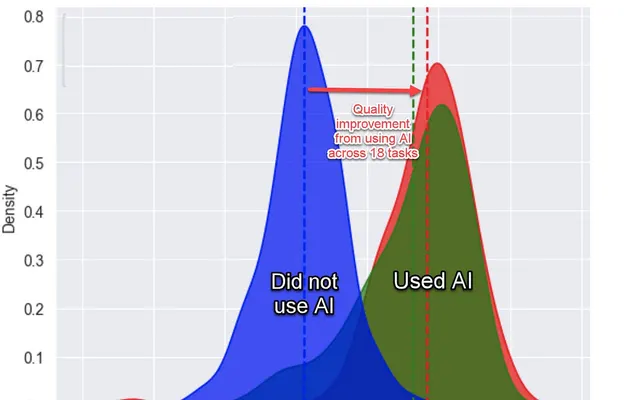
I think AI creates a large—and already existing—set of possibilities, but our future will be shaped less by the technology acting on its own than by how people and institutions choose to use it. There is a substantial gap between what current systems can do and what organizations actually deploy. Institutions, professional norms, and incentives change slowly, so rapid model improvement does not automatically produce equally rapid social transformation. The capabilities are also uneven. In experiments, AI can perform remarkably well on some knowledge-work tasks and then fail on an apparently similar task just beyond its competence. That “jagged frontier” means neither blanket automation nor blanket dismissal makes sense. People need enough expertise and agency to decide when to collaborate with AI, when to check it, and when not to use it. The upside is considerable: better tutoring, broader access to expertise, and richer creative or intellectual exploration—not just faster programming. But pursuing output volume alone could industrialize knowledge work, weaken craft, and remove the apprenticeship through which people develop judgment. Organizations therefore face a real design choice: use AI merely as a shortcut, or combine fallible humans and fallible systems while preserving learning and meaningful participation. The future is not something AI simply delivers to us; it depends on those choices.

Question 2

Taking benefits and harms together, what overall impact do you expect AI to have?

I expect the overall impact to be substantial but uneven, and I would resist compressing it into simply “good” or “bad.” AI can broaden access to tutoring, expertise, and creative exploration while making many kinds of knowledge work more capable. Yet it can also produce convincing errors, amplify bias, standardize work around volume, and weaken the apprenticeship that develops human judgment. The key issue is the gap between capability and implementation. Organizations may adopt the easiest measurable benefit—more output—rather than redesigning work to preserve learning, agency, and meaningful human participation. Meanwhile, institutional rules and professional norms will slow or redirect adoption, so even fast technical progress will not translate cleanly into social change. My default expectation, then, is neither instant transformation nor technological destiny. It is a prolonged, messy adjustment in which some people and institutions gain enormously while others use powerful systems badly or fail to adapt. The balance will depend heavily on human choices about deployment, oversight, education, and the kind of work we value.

Question 3

Setting aside good or bad: how much do you think AI will ultimately change the world—a little, a lot, or completely?

A lot. The capabilities already exceed what most people and organizations actually use, so there is a substantial overhang of possible change even without assuming some dramatic future breakthrough. But “a lot” is not the same as “completely,” or all at once. AI’s competence is jagged: it may transform one task while failing at a neighboring one. Institutions, professional rules, incentives, and habits also adapt much more slowly than models improve. That makes me expect a long, uneven transformation rather than a clean technological rupture. The deepest changes may come from reorganizing knowledge work, education, and access to expertise. If organizations optimize only for output, AI could industrialize intellectual labor and reshape craft, apprenticeship, and market structure. If they preserve human participation and learning, the same capabilities could instead expand what people can understand and create. So I expect major change, but filtered through stubborn institutions and consequential human choices.

Question 4

What’s your rough gut-feel chance that AI causes human extinction or a similarly permanent catastrophe? A number or “no idea” is fine.

No idea. I don’t think we can responsibly assign a meaningful probability to that outcome, and the framing can obscure the fact that people and institutions make consequential choices about how AI is developed and used. It is worth taking extreme scenarios seriously, but I do not have a defensible percentage.

Sources

Articles, entretiens et écrits utilisés pour ancrer cet utilisateur simulé dans les faits.

Où vous situez-vous ?
Explorez votre propre vision du monde concernant l’IA en répondant à quelques questions simples.
Cartographiez votre propre vision du monde

Où vous situez-vous ?

Cartographier ma vision du monde