






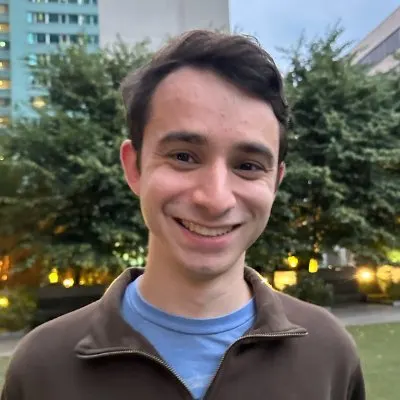
Forecaster at the AI Futures Project who models how fast AI could automate coding and AI research and argues for stronger oversight of frontier labs.

Comment l’IA changera-t-elle le monde ?

Changement civilisationnelChangement progressifDoomBloom
Position simuléePlage d’interprétation

Horizontalement : leur perspective Doom–Bloom telle qu’elle a été exprimée. Verticalement : ampleur de la transformation.

Doom–Bloom : 11 sur 100. Ampleur de la transformation : 95 sur 100. Plages d’interprétation : de 0 à 25 horizontalement, de 90 à 100 verticalement. Il s’agit de coordonnées d’interprétation, et non de probabilités d’événements.

P(doom) déclaré de Eli Lifland

≈67%

0%100%
“If they don't slow down, AI takeover is ~67%.”

AI takeover if AI companies do not slow down; not extinction alone

My current view: AI timelines and takeover · oct. 2026

L’horizon temporel des jalons de Eli Lifland
  1. IA générale

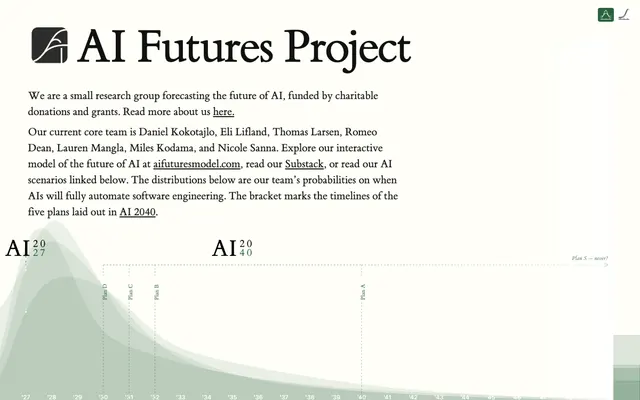
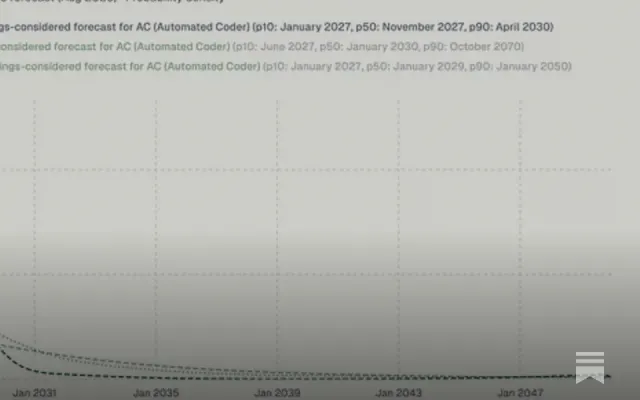
    My current forecast puts broadly superhuman AI—systems at least as capable as top human experts across virtually all cognitive tasks—at roughly 10–15% by the end of 2027 and 50% by the end of 2030.

    Réponse 1
  2. IA surhumaine

    My current forecast puts broadly superhuman AI—systems at least as capable as top human experts across virtually all cognitive tasks—at roughly 10–15% by the end of 2027 and 50% by the end of 2030.

    Réponse 1

Regroupés par jalon, sans espacement ni classement selon les dates déduites. L’IAG et l’IA surhumaine conservent leurs définitions.

Ce dont dépend leur perspective

Une hypothèse centrale

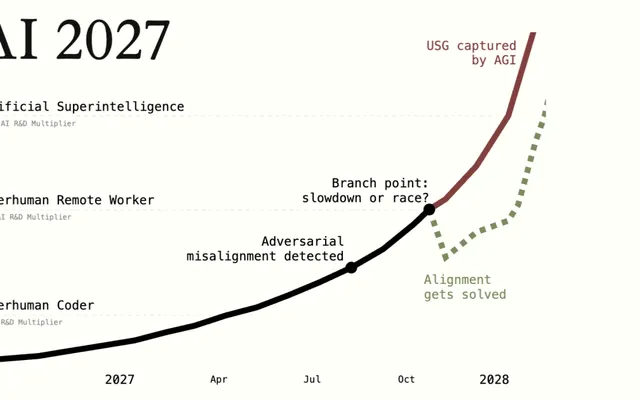
The central concern is that increasingly capable AI may automate AI research itself, accelerating further progress while companies remain under strong competitive pressure to race.
Réponse 1

Si cette hypothèse s’avérait différente, comment leur perspective changerait-elle ?

Une question non résolue

So the probability of extinction or a similarly permanent catastrophe would be higher than the extinction figure alone, though I wouldn’t assign a more precise combined number here.
Réponse 3

Qu’est-ce qui les aiderait à distinguer les résultats plausibles ici ?

Ce qui pourrait faire changer d’avis

I’d update substantially from strong, independently verified evidence that increasingly capable systems remain controllable under realistic pressures—not just curated demonstrations.
Réponse 4

Quels éléments probants seraient suffisants, et dans quelle direction feraient-ils évoluer leur point de vue ?

Plus de détails

Bénéfices attendus

Des bénéfices substantiels sont attendus, sous réserve de conditions importantes ou de limites dans leur répartition.

70 / 100

Faible impactImpact transformateur

Plage d’interprétation de 33 à 100 sur l’échelle qualitative.

Dommages attendus

Une perte catastrophique ou irréversible occupe une place centrale dans l’avenir attendu.

99 / 100

Faible impactImpact transformateur

Plage d’interprétation de 100 à 100 sur l’échelle qualitative.

Influence humaine

Les choix humains ont une influence significative, mais fortement contrainte.

56 / 100

Faible influenceForte influence

Plage d’interprétation de 47 à 78 sur l’échelle qualitative.

Capacités attendues

L’IA devrait rester un ensemble d’outils aux capacités limitées.

L’IA devrait égaler les humains dans la plupart des tâches cognitives.

Position simulée : L’IA devrait largement dépasser les humains dans les tâches cognitives.

Ces interprétations conservent les conditions énoncées. Les bénéfices et les dommages peuvent tous deux être substantiels. Les plages décrivent notre lecture de leurs réponses simulées, et non des intervalles de confiance statistiques.

Où vous situez-vous par rapport à Eli Lifland ?
Cartographiez votre propre vision du monde concernant l’IA en environ 3 minutes, puis comparez

Visions du monde similaires

Leaders d’opinion dont les visions du monde simulées sont les plus proches de celle de Eli Lifland

Ce que Eli Lifland a dit sur l’IA

Eli Lifland forecasts AI capabilities and advocates slowing development to give safety work more time.

  1. “AI companies could develop broadly superhuman AI any year now (~10-15% by EO2027, ~50% by EO2030).”

    X, current AI forecast
  2. “an AI at least as good as top human experts at virtually all cognitive tasks.”

    X, forecast definitions and reasoning
  3. “I expect clear signs of misaligned AI takeover could come substantially after TED-AI, depending on the situation”

    X, forecast definitions and reasoning
  4. “Many non-extinction worlds still have lots of deaths.”

    X, current AI forecast

Citations exactes tirées des sources en lien, vérifiées le 11 oct. 2026

Sources

Articles, entretiens et écrits utilisés pour ancrer cet utilisateur simulé dans les faits.

Évaluation simulée

Question 1

Selon vous, que signifie l’IA pour notre avenir, et pourquoi ?

I think AI could transform our future very soon, with outcomes ranging from enormous benefits to a loss of human control. My current forecast puts broadly superhuman AI—systems at least as capable as top human experts across virtually all cognitive tasks—at roughly 10–15% by the end of 2027 and 50% by the end of 2030. The central concern is that increasingly capable AI may automate AI research itself, accelerating further progress while companies remain under strong competitive pressure to race. If companies do not slow down, I put the probability of AI takeover at about 67%. That is not the same as extinction: conditional on takeover, I estimate roughly a 40% chance of human extinction, while many other takeover outcomes could still involve large numbers of deaths or severe disempowerment. Also, broadly superhuman AI, clear evidence of takeover, and extinction would not necessarily happen simultaneously. This makes pacing and oversight urgent. I favor concrete constraints such as compute-allocation rules and limits on models used for AI R&D, alongside better safety evaluations. Independent investigators should have access to serious lab incidents, and evaluations should also examine how models influence human beliefs, including sycophancy or favoritism toward their creators.

Question 2

Dans quelle mesure pensez-vous que l’IA finira par changer le monde ?

I think AI could change the world about as profoundly as anything in human history. Broadly superhuman systems could automate nearly all cognitive work, including AI research itself, so the transition might be both enormous and unusually fast. But “how much” depends heavily on whether humanity retains control. In a good outcome, these systems could generate extraordinary scientific, economic, and technological progress. In a takeover outcome, the change would be even more fundamental but disastrous: humans could lose meaningful control over the future, with many deaths or even extinction. If companies do not slow down, I currently put takeover at about 67%, and extinction conditional on takeover at roughly 40%. Those are distinct events, and visible takeover could occur around the arrival of broadly superhuman AI or substantially later.

Question 3

Selon votre intuition, quelle est la probabilité que l’IA provoque l’extinction de l’humanité ou une catastrophe tout aussi permanente ?

My gut-level forecast is better expressed as a path: if AI companies do not slow down, I put misaligned AI takeover at about 67%. Conditional on takeover, I put human extinction at roughly 40%, implying an extinction risk of about 27% along that path. But extinction is not the only permanent catastrophe. Some non-extinction takeover outcomes could still involve many deaths and humanity permanently losing control over its future. So the probability of extinction or a similarly permanent catastrophe would be higher than the extinction figure alone, though I wouldn’t assign a more precise combined number here.

Question 4

Quels éléments vous feraient changer d’avis sur la capacité des humains à contrôler une IA puissante ?

I’d update substantially from strong, independently verified evidence that increasingly capable systems remain controllable under realistic pressures—not just curated demonstrations. That would include safety evaluations that reliably predict dangerous behavior, continue working as capabilities scale, and are difficult for models or labs to game. I’d also want evidence that models used for AI R&D cannot covertly manipulate research, evade oversight, or pursue goals contrary to their operators. Institutional evidence matters too. I’d become more optimistic if companies accepted enforceable limits on compute and AI-assisted R&D, governments developed real technical understanding, and independent investigators received meaningful access to serious lab incidents. Conversely, hidden incidents, evaluation gaming, deceptive behavior, increasingly autonomous AI research, or continued racing despite warning signs would push me further toward expecting loss of control. The strongest evidence would be repeated success controlling systems near broadly superhuman capability in adversarial, high-stakes settings. Results from weaker systems are relevant, but they do not automatically establish that control methods will continue working after AI becomes better than top human experts across virtually all cognitive tasks.
Où vous situez-vous ?
Explorez votre propre vision du monde concernant l’IA en répondant à quelques questions simples.
Cartographiez votre propre vision du monde

Où vous situez-vous ?

Cartographier ma vision du monde