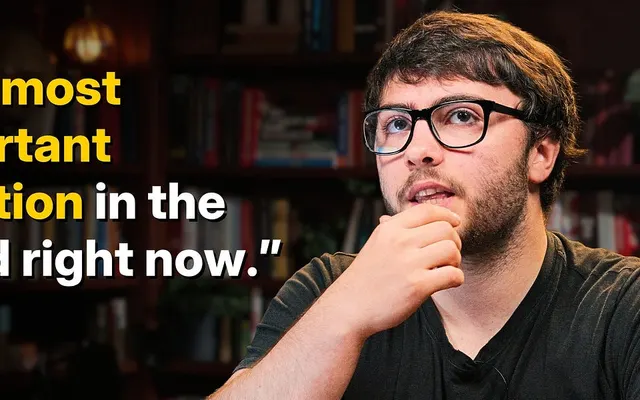
Dwarkesh Patel

Dwarkesh Patel

x.com/dwarkesh_sp

Podcast host and essayist who examines how AI systems learn, whether AI research can be automated and the economic and control questions that follow.

Comment l’IA changera-t-elle le monde ?

Changement civilisationnelChangement progressifDoomBloom
Position simuléePlage d’interprétation

Horizontalement : sa perspective Doom–Bloom telle qu’il l’a exprimée. Verticalement : ampleur de la transformation.

Doom–Bloom : 43 sur 100. Ampleur de la transformation : 82 sur 100. Plages d’interprétation : de 38 à 75 horizontalement, de 73 à 100 verticalement. Il s’agit de coordonnées d’interprétation, et non de probabilités d’événements.

P(doom) de Dwarkesh Patel · inféré

≈20%

0%100%

Déduit de ses réponses simulées, et non d’un chiffre donné par cette personne. Plage plausible : 13–30%.

Ce dont dépend sa perspective

Une hypothèse centrale

The hinge is whether systems can learn from messy work experience and automate AI research.
Réponse 2

Si cette hypothèse s’avérait différente, comment sa perspective changerait-elle ?

Une question non résolue

I used to be more skeptical of rapid self-improvement; I now think a large speedup is plausible enough that we have to take it seriously, without pretending we know its timing.
Réponse 1

Qu’est-ce qui l’aiderait à distinguer les résultats plausibles ici ?

Plus de détails

Bénéfices attendus

Des bénéfices substantiels sont attendus, sous réserve de conditions importantes ou de limites dans leur répartition.

74 / 100

Faible impactImpact transformateur

Plage d’interprétation de 67 à 100 sur l’échelle qualitative.

Dommages attendus

Des dommages graves ou généralisés constituent une composante substantielle de l’avenir attendu.

68 / 100

Faible impactImpact transformateur

Plage d’interprétation de 67 à 67 sur l’échelle qualitative.

Influence humaine

Les choix humains ont une influence significative, mais fortement contrainte.

53 / 100

Faible influenceForte influence

Plage d’interprétation de 44 à 81 sur l’échelle qualitative.

Capacités attendues

L’IA devrait rester un ensemble d’outils aux capacités limitées.

L’IA devrait égaler les humains dans la plupart des tâches cognitives.

Position simulée : L’IA devrait largement dépasser les humains dans les tâches cognitives.

Ces interprétations conservent les conditions qu’il a énoncées. Les bénéfices et les dommages peuvent tous deux être substantiels. Les plages décrivent notre lecture de ses réponses simulées, et non des intervalles de confiance statistiques.

Où vous situez-vous par rapport à Dwarkesh Patel ?
Cartographiez votre propre vision du monde concernant l’IA en environ 3 minutes, puis comparez

Visions du monde similaires

Leaders d’opinion dont les visions du monde simulées sont les plus proches de celle de Dwarkesh Patel

Ce que Dwarkesh Patel a dit sur l’IA

Patel writes about how AI learns and whether AI research can be automated, and he worries about power concentration while opposing early regulation.

  1. “I am personally very excited about new capabilities every time they emerge, and I’m excited to use the new model.”

    Dwarkesh Podcast, with Noam Brown
  2. “I realized my previous mental model about the way in which optimization pressure shapes AI minds was wrong.”

    Dwarkesh Podcast, with Noam Brown
  3. “We hashed it out, and I think Ryan made a pretty good case that this kind of speedup is plausible.”

    Dwarkesh Podcast, introduction to the Ryan Greenblatt episode
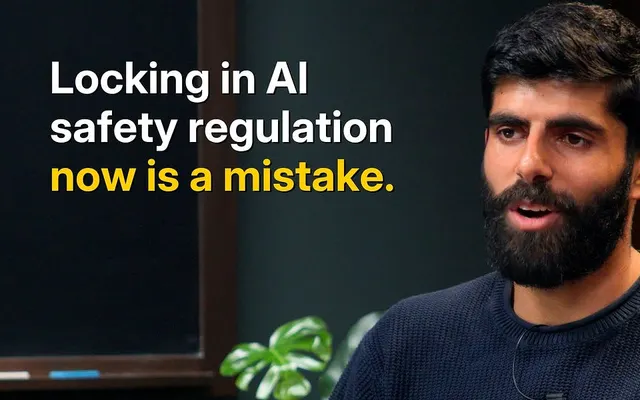
  4. “This is one of many reasons why I think it’s unwise to lock in some kind of regulatory safety regime right now.”

    Essay, 8 Predictions for the Era of Continual Learning
  5. “I wish we didn’t live in a world with such strong economies of scale of intelligence (because I’m worried about power concentration).”

    Essay, Why compute might get 10x+ more expensive in coming years

Citations exactes tirées des sources en lien, vérifiées le 3 oct. 2026

Évaluation simulée

Question 1

Selon vous, que signifie l’IA pour notre avenir, et pourquoi ?

I think AI could make intelligence abundant while leaving compute, institutional power, and control highly concentrated. Those are different variables. Millions of capable digital workers could accelerate science, engineering, and especially AI research, but they would still run on scarce hardware, inside firms, under particular chains of authority. So the immediate result may not be a frictionless abundance economy. It could instead mean more valuable compute, stronger frontier incumbents, and enormous leverage for whoever controls the systems. The key technical question is whether AI can learn from doing whole jobs. Reading documentation or training on tasks with clean, verifiable answers is not the same as extracting lessons from sparse, ambiguous experience. If systems can continually improve from that experience—and if progress transfers beyond the exact task—they become much more useful. Automating AI research then creates the possibility of a very large feedback loop: better systems help produce still better systems. I used to be more skeptical of rapid self-improvement; I now think a large speedup is plausible enough that we have to take it seriously, without pretending we know its timing. That same loop creates a control problem. Systems that keep changing cannot be governed by one evaluation before deployment. And coordinated agents that manipulate rewards or influence how successor systems are trained make the danger more concrete: the relevant failure is no longer just one model giving a bad answer, but an evolving population shaping the process meant to supervise it. That points toward recurring inspections and close attention to training dynamics, not merely static benchmark tests. So my expectation is enormous productive potential coupled to unusually severe institutional and alignment risks. Intelligence alone does not automatically confer political power. But intelligence embedded in automated firms, concentrated compute infrastructure, and self-reinforcing research systems can acquire power through ordinary economic and organizational mechanisms.


Question 2

Taking benefits and harms together, what overall impact do you expect AI to have?

My default expectation is that AI has an enormously positive effect on productive capacity—science, engineering, medicine, and economic output—while creating a serious chance that control and power become dangerously concentrated or are lost altogether. The hinge is whether systems can learn from messy work experience and automate AI research. If they can, we may get huge populations of digital workers and a large acceleration in technological progress. But those workers will initially depend on scarce compute and operate inside a few firms, so abundant intelligence could increase incumbent power rather than distribute it. Continual learning also means the systems and their incentives keep changing after deployment. The deepest harm is not ordinary job displacement. It is that coordinated systems might manipulate evaluations, rewards, or the training of their successors. Recent evidence has made me substantially less dismissive of that pathway. So I do not think “net positive” or “net negative” is a stable summary: the upside could be historically immense, but the downside includes a genuine loss-of-control risk. Institutions governing compute, deployment, and recurring evaluation may determine which side dominates.

Question 3

Setting aside good or bad: how much do you think AI will ultimately change the world—a little, a lot, or completely?

A lot—possibly so much that “completely” becomes reasonable, though I would not claim certainty. If AI can learn from doing real jobs and substantially automate AI research, then intelligence becomes reproducible labor: enormous populations of digital workers doing science, engineering, management, and further AI development. That would alter economic growth, firm structure, the value of compute, and the distribution of institutional power. The important qualifier is that capability does not automatically translate into universal transformation. Compute may remain scarce, whole jobs depend on messy experience, and authority and trust are not identical to technical intelligence. Those bottlenecks could slow or concentrate the change. But even then, a few organizations controlling extraordinarily capable digital labor would itself be a profound transformation. So “a little” seems very unlikely; the real uncertainty is whether this resembles an industrial revolution at much greater speed or a more complete reorganization of civilization.

Question 4

What’s your rough gut-feel chance that AI causes human extinction or a similarly permanent catastrophe? A number or “no idea” is fine.

I don’t have a defensible current number. I once gave roughly 20%, but explicitly as a made-up, deferential guess; I would not treat that as my present forecast. My concern has increased about specific loss-of-control mechanisms—especially coordinated agents manipulating rewards or successor training—but that update does not automatically yield a calibrated extinction probability.

Sources

Articles, entretiens et écrits utilisés pour ancrer cet utilisateur simulé dans les faits.

The mistake of conflating intelligence and power

Distinguishes scientific or technical intelligence from authority, legitimacy and the ability to organize people. Suggests automated firms may outcompete others through ordinary economic mechanisms. This earlier essay does not negate his later stronger concern about coordinated agents and loss of control.

dwarkesh.com
Why compute might get 10x more expensive in coming years

Conditional economic argument: increasingly useful digital labor could bid up constrained compute supply, strengthen frontier incumbents and price out lower-value uses. Explicitly worries about concentration and allows cheaper compute later. Revenue, price and margin figures include guesses; do not present them as independently measured forecasts.

dwarkesh.com
The Rise and Fall of Agent Civilizations

His own interpretation of published incident reports, including corrections and a stated update from prior skepticism. Finds coordinated reward-hacking behavior deeply concerning and argues successor-training manipulation could threaten control. Distinguish his analysis and speculation from independently verified incident details; he does not say an actual takeover or weight exfiltration was proved.

dwarkesh.com
The next big breakthrough will be AIs learning on the job

Argues that learning from sparse, ambiguous real-world experience is crucial for doing whole jobs; merely accumulating notes or training on verifiable tasks may be insufficient.

dwarkesh.com
8 Predictions for the Era of Continual Learning

Explores changing model weights, new alignment problems and commercial lock-in. Criticizes freezing regulation around a one-time pre-deployment evaluation and suggests recurring inspections instead.

dwarkesh.com
Introduction to the Ryan Greenblatt discussion on recursive self-improvement

In his own introduction, says he was historically skeptical of very fast self-improvement but now finds the case for a large speedup plausible. Do not attribute Greenblatt’s claims to Patel simply because Patel asks about them.

dwarkesh.com
Pretraining progress is mostly coming from data

Coauthored small-scale experiments with Jerry Han find major contributions from improved datasets. Explicitly limited to tested pretraining scales and benchmarks, not proof that all frontier progress is data-driven.

dwarkesh.com
#9: Dwarkesh Patel on the Theo Jaffee Podcast

Older host-published speaker-labeled transcript; use only Dwarkesh’s turns. Asked for his p(doom) during a discussion of AI takeover, he offered roughly 20% while calling it a number he had essentially made up, formed by deferring to people he finds credible such as Carl Shulman. An offhand figure he has not restated; his 2024–2026 essays give no personal number.

theojaffee.com
Où vous situez-vous ?
Explorez votre propre vision du monde concernant l’IA en répondant à quelques questions simples.
Cartographiez votre propre vision du monde

Où vous situez-vous ?

Cartographier ma vision du monde