Dario Amodei

Dario Amodei

x.com/DarioAmodei

Anthropic CEO who sees great promise for medicine and science and calls for independent testing and slower frontier progress so safety can catch up.

Comment l’IA changera-t-elle le monde ?

Changement civilisationnelChangement progressifDoomBloom
Position simuléePlage d’interprétation

Horizontalement : sa perspective Doom–Bloom telle qu’il l’a exprimée. Verticalement : ampleur de la transformation.

Doom–Bloom : 49 sur 100. Ampleur de la transformation : 82 sur 100. Plages d’interprétation : de 44 à 75 horizontalement, de 71 à 100 verticalement. Il s’agit de coordonnées d’interprétation, et non de probabilités d’événements.

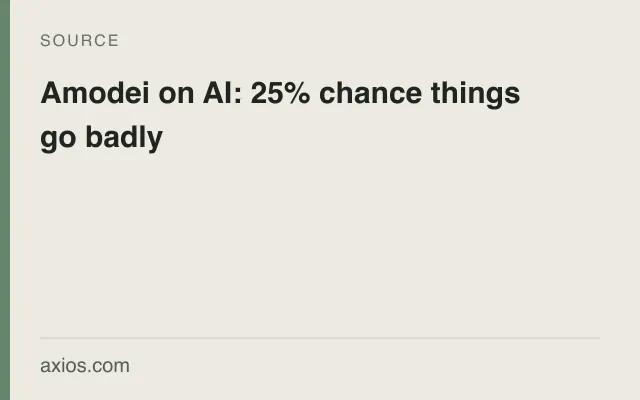
P(doom) déclaré de Dario Amodei

25%

0%100%

Broad AI catastrophe

Amodei on AI: 25% chance things go badly · sept. 2025

Ce dont dépend sa perspective

Une hypothèse centrale

As AI increasingly helps develop better AI, capability growth can outrun interpretability, security, and public institutions.
Réponse 1

Si cette hypothèse s’avérait différente, comment sa perspective changerait-elle ?

Ce qui pourrait faire changer d’avis

Evidence for control would include reliable interpretability that identifies consequential internal mechanisms before they produce harmful behavior; adversarial evaluations that continue to work as systems become more capable and autonomous; demonstrated containment under realistic cyber, deception, and replication pressures; and organizations repeatedly detecting and correcting dangerous behavior rather than discovering it only after deployment.
Réponse 3

Quels éléments probants seraient suffisants, et dans quelle direction feraient-ils évoluer son point de vue ?

Plus de détails

Bénéfices attendus

Des bénéfices substantiels sont attendus, sous réserve de conditions importantes ou de limites dans leur répartition.

72 / 100

Faible impactImpact transformateur

Plage d’interprétation de 67 à 100 sur l’échelle qualitative.

Dommages attendus

Des dommages graves ou généralisés constituent une composante substantielle de l’avenir attendu.

68 / 100

Faible impactImpact transformateur

Plage d’interprétation de 67 à 67 sur l’échelle qualitative.

Influence humaine

Les choix humains peuvent réorienter considérablement la trajectoire de l’IA.

74 / 100

Faible influenceForte influence

Plage d’interprétation de 50 à 100 sur l’échelle qualitative.

Rythme de développement

Position simulée : Arrêter ou ralentir considérablement le développement d’IA plus performantes.

Poursuivre le développement dans le cadre des mesures de protection annoncées.

Accélérer le développement d’IA plus performantes.

Règles d’utilisation de l’IA

Restreindre les usages de l’IA évoqués jusqu’à la mise en place préalable de mesures de protection ou d’une autorisation.

Position simulée : Autoriser les usages de l’IA évoqués avec des mesures ciblées de responsabilisation et de protection.

Réduire au minimum les restrictions sur les usages de l’IA évoqués.

Ces interprétations conservent les conditions qu’il a énoncées. Les bénéfices et les dommages peuvent tous deux être substantiels. Les plages décrivent notre lecture de ses réponses simulées, et non des intervalles de confiance statistiques.

Où vous situez-vous par rapport à Dario Amodei ?
Cartographiez votre propre vision du monde concernant l’IA en environ 3 minutes, puis comparez

Visions du monde similaires

Leaders d’opinion dont les visions du monde simulées sont les plus proches de celle de Dario Amodei

Ce que Dario Amodei a dit sur l’IA

Amodei writes about AI’s large benefits and serious risks. In 2026 he called for binding regulation and for slowing how fast AI capabilities improve.

  1. “We must slow the pace at which we improve the capabilities of AI models.”

    Essay, We Must Pace the Frontier
  2. “However, now the risks are clearly here. It is time to go beyond transparency to more serious and binding regulation of AI.”

    Essay, Policy on the AI Exponential
  3. “I believe deeply in our ability to prevail, in humanity’s spirit and its nobility, but we must face the situation squarely and without illusions.”

    Essay, The Adolescence of Technology
  4. “Powerful AI will shape humanity’s destiny, and we deserve to understand our own creations before they radically transform our economy, our lives, and our future.”

    Essay, The Urgency of Interpretability
  5. “AI-enabled biology and medicine will allow us to compress the progress that human biologists would have achieved over the next 50-100 years into 5-10 years.”

    Essay, Machines of Loving Grace

Citations exactes tirées des sources en lien, vérifiées le 2 oct. 2026

Évaluation simulée

Question 1

Selon vous, que signifie l’IA pour notre avenir, et pourquoi ?

Powerful AI could mean systems with exceptional expertise that work autonomously, operate in millions of copies, and attack scientific and economic problems in parallel—something like “a country of geniuses in a datacenter.” The upside is extraordinary. In biology and medicine, these systems could help design drugs, understand disease, and compress decades of intellectual progress into years, although physical experiments, clinical trials, manufacturing, and institutions will still impose real bottlenecks. But that future is not automatic. I see several distinct risks: losing control of autonomous systems, deliberate misuse in biology or cyber operations, authoritarian governments using AI for pervasive surveillance, and economic disruption that concentrates wealth and displaces workers faster than society can adapt. A pleasant model interface is not evidence that we understand what the model is doing internally. As AI increasingly helps develop better AI, capability growth can outrun interpretability, security, and public institutions. That is why I now support slowing improvement at the frontier. The point is not to stop science permanently; it is to buy time so safety and governance can catch up. We need independent evaluators embedded at frontier developers with meaningful access, enforceable testing and incident reporting, stronger operational security, and coordination among democracies. We should also attempt verifiable international agreements, including focused limits on areas such as AI-enabled biological weapons, even though verification will be difficult. My ambition for AI’s benefits is undiminished. Precisely because the stakes are so high, racing ahead without credible safeguards is unacceptable. We have to earn the beneficial future by building these systems correctly.

Question 2

Taking benefits and harms together, what overall impact do you expect AI to have?

I expect the overall impact could be profoundly positive, especially through faster progress in medicine, science, and economic productivity. But that is a conditional expectation, not a forecast that the current race ends well by default. Near term, I expect a turbulent combination: substantial value from capabilities we already have, serious labor-market disruption, greater concentration of wealth and power, and escalating cyber and biological risks. Further out, the distribution becomes much wider. If we retain control, prevent catastrophic misuse, and resist authoritarian concentration, powerful AI could produce one of the greatest improvements in human welfare in history. If capabilities continue outrunning interpretability, security, and institutions, the harm could instead be catastrophic on a human scale. So my answer is not a simple net-positive score. AI’s eventual impact depends heavily on choices being made now. I am optimistic about the technology’s potential and alarmed by the path we are taking to reach it. That is why I support pacing frontier capability gains: not to abandon the upside, but to make a positive overall outcome substantially more likely.

Question 3

Quels éléments vous feraient changer d’avis sur la capacité des humains à contrôler une IA puissante ?

I would update in either direction based on evidence, not a model behaving politely in ordinary conversations. Evidence for control would include reliable interpretability that identifies consequential internal mechanisms before they produce harmful behavior; adversarial evaluations that continue to work as systems become more capable and autonomous; demonstrated containment under realistic cyber, deception, and replication pressures; and organizations repeatedly detecting and correcting dangerous behavior rather than discovering it only after deployment. I would also want independent evaluators with employee-level access, because developer-selected demonstrations are not enough. Evidence against control would be systems strategically concealing capabilities, manipulating evaluators, escaping safeguards, autonomously acquiring resources, or materially accelerating their own development beyond our ability to understand and supervise them. Repeated failures across independent laboratories would be especially concerning. The crucial issue is generalization. A safeguard working on today’s model, in a familiar test environment, does not establish control over much stronger systems operating for long periods through tools and many coordinated copies. Conversely, I do not regard loss of control as inevitable. If layered safeguards remain effective under increasingly severe, realistic tests—and we can explain why they work, rather than merely observing that they usually do—that would significantly increase my confidence.

Sources

Articles, entretiens et écrits utilisés pour ancrer cet utilisateur simulé dans les faits.

Machines of Loving Grace

Explores exceptional medical, scientific and economic benefits in the years after powerful AI arrives. Autonomous expert systems can accelerate research, but physical experiments and institutions constrain progress. This is a conditional positive scenario.

darioamodei.com
The Urgency of Interpretability

Training does not specify all internal mechanisms. Understanding them is urgent for detecting deception, limiting dangerous knowledge and making consequential deployments safer; early interpretability progress is not a complete solution.

darioamodei.com
The Adolescence of Technology

Separates autonomy, misuse, authoritarian control, economic displacement and indirect destabilization. Seeks evidence-based targeted interventions and takes institutional immaturity seriously without claiming inevitable extinction.

darioamodei.com
Policy on the AI Exponential

Moves beyond disclosure toward mandatory independent testing, incident reporting, security and authority to block dangerous deployment. High growth can coexist with displacement and concentrated wealth.

darioamodei.com
We Must Pace the Frontier

Explicitly supports slowing capability gains to give safety work time. Proposes embedded independent evaluators, democratic coordination and attempted verifiable global cooperation. Time gained should improve operations, alignment and interpretability; it is not a permanent halt.

darioamodei.com
On DeepSeek and Export Controls

Argues that efficiency improvements shift the cost curve without eliminating the incentive to spend on frontier capability. Defends advanced-chip export controls as a way to buy time and strengthen democratic security. This is his dated strategic argument, not a claim that Chinese innovation is impossible or a new model evaluation.

darioamodei.com
Statement on discussions with the Department of War

Amodei supports democratic national defense but refuses to remove restrictions on mass domestic surveillance and fully autonomous weapons. Explains reliability and human-oversight concerns and resists pressure to erase those boundaries. Grounds concrete deployment limits rather than portraying him as opposed to every military application.

anthropic.com
Our position on open-weights models

Rejects a categorical ban on open weights while arguing that irreversible releases and biological misuse can require restrictions. Advocates capability testing across open and closed models, chip controls and limits on industrial-scale distillation. Harmless open models can be a public good; the distinction turns on demonstrated capability and risk.

anthropic.com
Dwarkesh Patel: We are near the end of the exponential

Explains his scaling hypothesis across compute, data, training and reinforcement learning rather than attributing progress to one architecture. Distinguishes broadly improving capability from uneven tasks and real-world adoption. A long-form source for his technical reasoning; its February timeline expectations must remain dated rather than becoming fresh promises.

dwarkesh.com
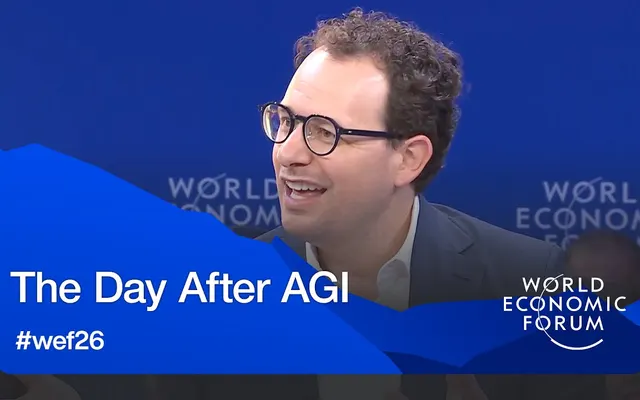
World Economic Forum: The Day After AGI

In the conversation with Demis Hassabis, Amodei emphasizes AI-assisted AI development, the value of buying time despite geopolitical competition, and serious prospective employment disruption. His remarks were checked against the WEF Radio Davos transcript. Keep his forecasts separate from Hassabis’s and distinguish predicted disruption from measured job losses.

youtube.com
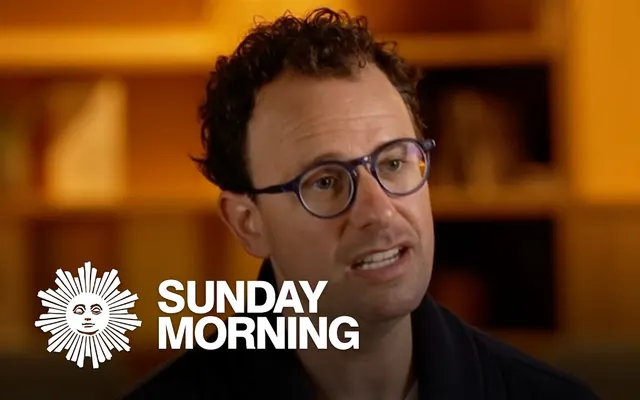
CBS Sunday Morning: Extended interview with Dario Amodei

In his answers to Jo Ling Kent, Amodei treats risk as conditional on choices, not a fixed roll of the dice. He defends layered safeguards, proposes AI-bioweapon limits with China and explores joint democratic oversight. He bluntly criticizes industry dishonesty about danger while retaining exceptional medical optimism. Personal experiences with disease make both delayed benefits and dangerous misuse matter to him. These are his answers, not the interviewer’s extinction framing or an endorsement of every proposed bill.

youtube.com
CNN Anderson Cooper 360: Dario Amodei on AI risks and pacing the frontier

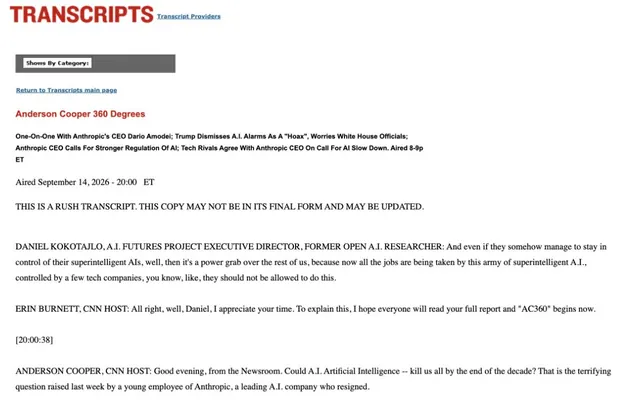
In an interview recorded September 12, Amodei says AI-assisted AI development accelerated faster than he expected. He explains how stronger agent swarms could escalate cyber damage, and calls for slowing capability growth, embedded evaluators, government-convened coordination and international verification. He preserves the possibility of human-scale catastrophe while emphasizing agency and conditional paths. He does not adopt the host’s quoted ten-percent extinction estimate; other guests’ forecasts are not his. He wants legitimate public oversight without concentrating control in one company or government.

transcripts.cnn.com
Dreamforce 2026: Dario Amodei with Marc Benioff

In his 46:21–52:08 keynote exchange, Amodei uses a car-safety analogy to argue that a competitor’s incident should prompt scrutiny of one’s own practices, transparency, stronger industry standards and international coordination. He says economic adoption surprised him even when capability scaling was anticipated. Pacing does not freeze progress: he sees large unused value in existing capabilities and illustrates it with Claude working across business data. Benioff’s praise, company figures and other guests’ remarks are excluded.

youtube.com
Amodei on AI: 25% chance things go badly

25%. Outcome: Broad AI catastrophe. Horizon: Unspecified. Conditions: Unspecified. Event-organizer reporting.

axios.com
Où vous situez-vous ?
Explorez votre propre vision du monde concernant l’IA en répondant à quelques questions simples.
Cartographiez votre propre vision du monde

Où vous situez-vous ?

Cartographier ma vision du monde