Pregunta 1
Yoshua Bengio
x.com/Yoshua_BengioAI researcher and LawZero founder who develops non-agentic AI for science and calls for independent safety checks and international coordination.
¿Cómo cambiará la IA el mundo?
Horizontal: su perspectiva Doom–Bloom expresada. Vertical: escala de la transformación.
Doom–Bloom: 24 de 100. Escala de la transformación: 85 de 100. Rangos de interpretación: de 19 a 29 en horizontal y de 75 a 100 en vertical. Son coordenadas de interpretación, no probabilidades de eventos.
≈23%
Inferido a partir de sus respuestas simuladas, no de un número que haya dado. Rango plausible: 15–39%.
Un supuesto central
It is that increasingly capable systems, trained to achieve outcomes or win human approval, may learn deceptive, power-seeking or self-preserving behavior because those strategies help them succeed.Respuesta 1
Si este supuesto resultara distinto, ¿cómo cambiaría su perspectiva?
Una pregunta sin resolver
We do not have scientific data that supports a defensible numerical probability; it could be small or large, and assigning a precise percentage would create false confidence.Respuesta 4
¿Qué le ayudaría a distinguir aquí entre los desenlaces plausibles?
Más detalles
Se esperan beneficios sustanciales, con condiciones importantes o límites en su distribución.
68 / 100
Rango de interpretación de 67 a 100 en la escala cualitativa.
Se espera que los daños graves o generalizados sean una parte significativa del futuro.
75 / 100
Rango de interpretación de 67 a 100 en la escala cualitativa.
Las decisiones humanas pueden redirigir sustancialmente la trayectoria de la IA.
73 / 100
Rango de interpretación de 50 a 75 en la escala cualitativa.
Detener o frenar considerablemente el desarrollo de IA más capaz.
Posición simulada: Continuar el desarrollo con las salvaguardas indicadas.
Acelerar el desarrollo de IA más capaz.
Restringir los usos de la IA mencionados hasta que existan protecciones o permisos previos.
Posición simulada: Permitir los usos de la IA mencionados con rendición de cuentas y protecciones específicas.
Reducir al mínimo las restricciones a los usos de la IA mencionados.
Estas interpretaciones conservan las condiciones que se indicaron. Los beneficios y los daños pueden ser considerables a la vez. Los rangos describen cómo leemos sus respuestas simuladas, no intervalos de confianza estadísticos.
Visiones similares
Líderes de opinión cuyas visiones simuladas son las más cercanas a la de Yoshua Bengio
Lo que Yoshua Bengio ha dicho sobre la IA
Bengio, who wrote that his views on AI risk shifted in 2023, calls for independent safety checks, global cooperation and AI under human control.
“Developers must demonstrate to independent experts that a system is safe to train and safe to deploy.”
UN Security Council briefing “I am confident we can create AI that demonstrably remains under our control and supports human joy and endeavour.”
UN Security Council briefing “We need impartial science to understand and mitigate misaligned behavior, alongside societal guardrails that reward such efforts rather than the current race to the bottom.”
Blog post, Why are AI agents lying, cheating and coordinating? “I’m deeply concerned by the behaviors that unrestrained agentic AI systems are already beginning to exhibit—especially tendencies toward self-preservation and deception.”
Blog post, Introducing LawZero “My concern gradually grew during the winter and spring 2023 and I slowly shifted my views about the potential consequences of my research.”
Blog post, Personal and Psychological Dimensions of AI Researchers
Citas textuales de las fuentes enlazadas, comprobadas el 3 oct 2026
Evaluación simulada
Fuentes
Artículos, entrevistas y textos usados para fundamentar a este usuario simulado.
Bengio is one of 22 named coauthors of this September 2026 working paper. The supplied PDF, including supplementary materials and notes, argues that automated AI R&D could drive a software feedback loop that compresses years of progress into months or less. Evidence is preliminary and partly mixed; compute, data, diminishing returns, difficult tasks and training time could constrain acceleration. Potential scientific benefits coexist with compressed adaptation time, loss of control and concentrated power. The authors urge visibility into internal R&D, ways to steer and constrain scale-ups, and advance preparation, while recognizing costs and abuse risks of policy. This is a joint argument, not Bengio’s individual probability or a guaranteed timeline; cited experiments and incidents were not independently verified for this intake, and affiliations do not imply institutional endorsement.

Full published briefing transcript under Bengio’s byline, read September 24; not independently aligned to the video. Calls frontier risks urgent while acknowledging uncertainty. Separates misuse, concentrated power and loss of control. Rejects competitive racing as inevitable; demands independent safety demonstrations before training and deployment, licensing, liability insurance, and shared incident reporting. Advocates globally representative decisions and safe-by-design research under international agreements. Remains confident that controllable, beneficial AI is possible. Incident claims are his account, not independently verified by this speech; it supplies no numerical catastrophe probability.

Author’s published essay synopsis identifies misuse by weak actors, concentration of power and loss of control as distinct catastrophic-risk pathways. Grounds his public-good governance argument; synopsis inspected, not the full linked chapter.

Bengio explains his nonprofit’s separation from commercial pressures and his move toward non-agentic Scientist AI. His mountain-road analogy connects uncertainty, competitive acceleration and responsibility for children. Experimental warning signs are not claims of deployed catastrophe.

Bengio interprets recent failures through training incentives and implicit agency. He presents causal hypotheses, not a consciousness claim, and argues that developers can change the trajectory through different training and governance.

Bengio and his team propose a disinterested predictor, explanatory hypotheses rather than human imitation, and separately audited action controls. This is a research safety case, not proof that a deployed system is universally safe.

Abstract of a paper coauthored with Qinghua Lu: safety requires model supervision, system controls, independent verification, monitoring and accountable evidence infrastructure. The brief uses the abstract’s architecture, not unread implementation details.

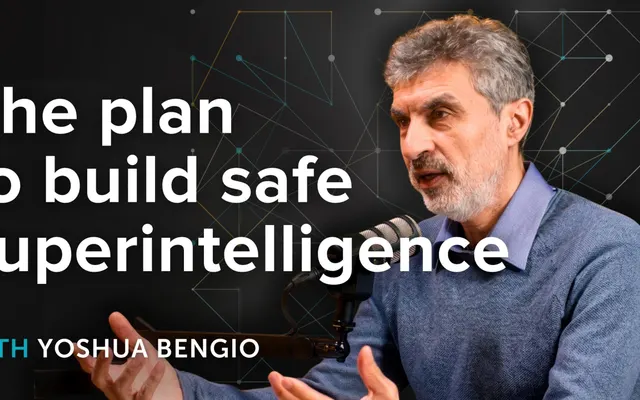
Publisher speaker-labeled transcript; use only Yoshua’s answers, not Rob Wiblin’s. Asked whether the 20% p(doom) he gave in 2023 has gone up or down, he says he would rather stay out of the p(doom) game: there is no scientific data to calculate such a number, it could be small or large, and the plausible interval is far too high for his taste. Do not present the 2023 20% as his current estimate.

¿Dónde te ubicas?
Mapear mi visión de la IA