Victor Taelin

Victor Taelin

x.com/victortaelin

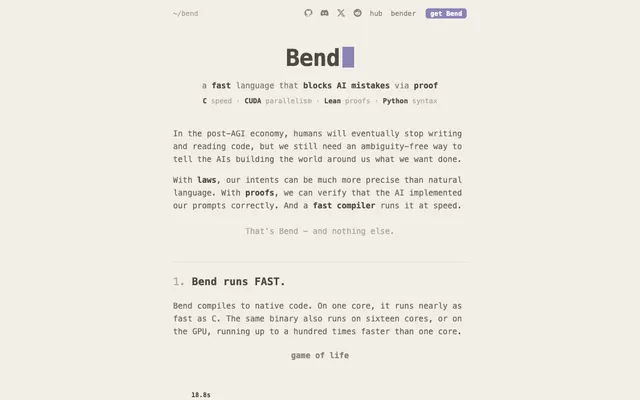
Programmer behind the Bend language who argues machine-checked proofs can catch AI coding mistakes as people read less of the code.

¿Cómo cambiará la IA el mundo?

Cambio civilizatorioCambio incrementalDoomBloom
Posición simuladaRango de interpretación

Horizontal: su perspectiva Doom–Bloom expresada. Vertical: escala de la transformación.

Doom–Bloom: 73 de 100. Escala de la transformación: 40 de 100. Rangos de interpretación: de 68 a 78 en horizontal y de 0 a 79 en vertical. Son coordenadas de interpretación, no probabilidades de eventos.

P(doom) de Victor Taelin · inferido

≈3%

0%100%

Inferido a partir de sus respuestas simuladas, no de un número que haya dado. Rango plausible: 1–9%.

De qué depende su perspectiva

Un supuesto central

But that benefit depends on reliability.
Respuesta 2

Si este supuesto resultara distinto, ¿cómo cambiaría su perspectiva?

Una pregunta sin resolver

Persistent memory, precise specifications, and reliable verification together could make long-running agents far more useful—but exactly how far this extends beyond software remains uncertain.
Respuesta 1

¿Qué le ayudaría a distinguir aquí entre los desenlaces plausibles?

Más detalles

Beneficio esperado

Se esperan beneficios sustanciales, con condiciones importantes o límites en su distribución.

67 / 100

Poco impactoImpacto transformador

Rango de interpretación de 67 a 67 en la escala cualitativa.

Daño esperado

Se esperan daños manejables o localizados.

34 / 100

Poco impactoImpacto transformador

Rango de interpretación de 33 a 33 en la escala cualitativa.

Influencia humana

Las decisiones humanas tienen una influencia significativa, aunque muy condicionada.

54 / 100

Poca influenciaInfluencia fuerte

Rango de interpretación de 29 a 96 en la escala cualitativa.

Estas interpretaciones conservan las condiciones que se indicaron. Los beneficios y los daños pueden ser considerables a la vez. Los rangos describen cómo leemos sus respuestas simuladas, no intervalos de confianza estadísticos.

¿Dónde te ubicas frente a Victor Taelin?
Mapea tu propia visión de la IA en unos 3 minutos y luego compárala

Visiones similares

Líderes de opinión cuyas visiones simuladas son las más cercanas a la de Victor Taelin

Evaluación simulada

Pregunta 1

¿Qué crees que significa la IA para nuestro futuro y por qué?

I think AI will increasingly write and maintain software at a scale where humans simply won’t read most of the code. That changes the central question from “Does this implementation look reasonable?” to “Can we state precisely what it must do, and can a machine verify that it does it?” Formal laws and machine-checked proofs are promising because they can express intent without the ambiguity of prose and prevent specified classes of mistakes from accumulating as agents work. The emphasis is on specified classes. A proof does not magically capture every human intention, eliminate every possible bug, or remove trust from the proof machinery itself. Critical kernels still deserve careful human attention, even if the surrounding agent-generated code has rough edges. I also think we should judge AI systems less by their most impressive demonstrations and more by their destructive failures. A model that occasionally produces brilliant code but sometimes corrupts a project may be less useful than one with a lower peak and a safer worst case. And those comparisons are domain-dependent: the “best” model in one programming setting may not be best elsewhere. Persistent memory, precise specifications, and reliable verification together could make long-running agents far more useful—but exactly how far this extends beyond software remains uncertain.


Pregunta 2

Taking benefits and harms together, what overall impact do you expect AI to have?

Overall, I expect AI to be strongly beneficial, especially by expanding how much software and research we can produce. But that benefit depends on reliability. If agents generate vast amounts of code while occasionally causing destructive failures or silently accumulating technical debt, impressive peak capability is not enough. The promising path is to pair capable agents with persistent memory, precise specifications, formal laws, and machine-checked proofs. That lets us prevent defined categories of mistakes even when humans no longer read most implementations. It does not guarantee that our specification captures every intention, nor does it remove the need to scrutinize trusted kernels and proof machinery. So my expectation is positive, but not because raw capability automatically produces good outcomes. It is positive insofar as we build systems whose worst cases are controlled and whose intended properties can be stated and verified. How well that approach generalizes beyond programming is much less certain.

Fuentes

Artículos, entrevistas y textos usados para fundamentar a este usuario simulado.

¿Dónde te ubicas?
Explora tu propia visión de la IA respondiendo unas pocas preguntas sencillas.
Mapea tu propia visión de la IA

¿Dónde te ubicas?

Mapear mi visión de la IA