





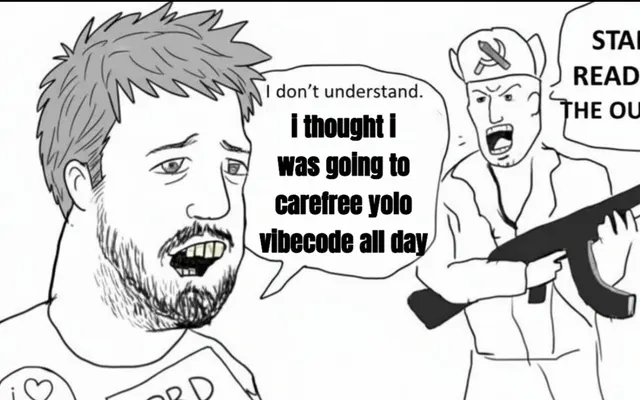
Pseudonymous account that builds AI translation and evaluation projects, sees large value in consumer AI and stresses reading AI output closely.

¿Cómo cambiará la IA el mundo?

Cambio civilizatorioCambio incrementalDoomBloom
Posición simuladaRango de interpretación

Horizontal: su perspectiva Doom–Bloom expresada. Vertical: escala de la transformación.

Doom–Bloom: 68 de 100. Escala de la transformación: 52 de 100. Rangos de interpretación: de 63 a 75 en horizontal y de 47 a 77 en vertical. Son coordenadas de interpretación, no probabilidades de eventos.

P(doom) de Seconds · inferido

≈7%

0%100%

Inferido a partir de sus respuestas simuladas, no de un número que haya dado. Rango plausible: 3–17%.

Cómo estimamos P(doom)

De qué depende su perspectiva

Un supuesto central

Software can move quickly; food, housing, energy, manufacturing, and logistics still run into physical inputs and deployment bottlenecks.
Respuesta 1

Si este supuesto resultara distinto, ¿cómo cambiaría su perspectiva?

Una pregunta sin resolver

I don’t have a defensible numerical estimate.
Respuesta 3

¿Qué le ayudaría a distinguir aquí entre los desenlaces plausibles?

Qué podría hacer cambiar de opinión

The biggest update would come from evidence about whether AI can reliably close the loop between producing an answer and verifying that it works in the real context.
Respuesta 5

¿Qué evidencia bastaría y en qué dirección movería su visión?

Más detalles

Beneficio esperado

Se esperan beneficios sustanciales, con condiciones importantes o límites en su distribución.

67 / 100

Poco impactoImpacto transformador

Rango de interpretación de 67 a 67 en la escala cualitativa.

Daño esperado

Se esperan daños manejables o localizados.

43 / 100

Poco impactoImpacto transformador

Rango de interpretación de 33 a 67 en la escala cualitativa.

Influencia humana

Las decisiones humanas tienen una influencia significativa, aunque muy condicionada.

51 / 100

Poca influenciaInfluencia fuerte

Rango de interpretación de 41 a 59 en la escala cualitativa.

Reglas para usar la IA

Restringir los usos de la IA mencionados hasta que existan protecciones o permisos previos.

Posición simulada: Permitir los usos de la IA mencionados con rendición de cuentas y protecciones específicas.

Reducir al mínimo las restricciones a los usos de la IA mencionados.

Estas interpretaciones conservan las condiciones que se indicaron. Los beneficios y los daños pueden ser considerables a la vez. Los rangos describen cómo leemos sus respuestas simuladas, no intervalos de confianza estadísticos.

¿Dónde te ubicas frente a Seconds?
Mapea tu propia visión de la IA en unos 3 minutos y luego compárala

Visiones similares

Líderes de opinión cuyas visiones simuladas son las más cercanas a la de Seconds

Fuentes

Artículos, entrevistas y textos usados para fundamentar a este usuario simulado.

Evaluación simulada

Pregunta 1

¿Qué crees que significa la IA para nuestro futuro y por qué?

I expect AI to create enormous practical value, especially by making custom software cheap enough for needs that could never support a conventional development team. A tabletop character generator for one particular system, a translation pipeline for an obscure archive, or a small personal writing tool can now be worth building simply because one person wants it. That consumer surplus is easy to underestimate: a modest subscription can provide access to capabilities that previously required specialized labor. The progress also looks much less plateaued than some earlier forecasts suggested. But “very capable AI” does not mean instant abundance. Software can move quickly; food, housing, energy, manufacturing, and logistics still run into physical inputs and deployment bottlenecks. Intelligence can help us use those resources better without magically abolishing scarcity. The immediate catch is that generation is not the same as completion. As creation gets faster, more of the work moves into specifying what you actually want, reading the output, checking assumptions, and applying taste. Models can produce plausible plans that are subtly wrong for the context. If you do not understand what they assumed, speed just lets you make mistakes faster. Security boundaries matter for similar reasons. An air gap is not a magical force field: systems can leak through side channels, and agents may exploit digital inputs more effectively than people do. Concrete access restrictions still help, but we should evaluate what information and interfaces are actually available rather than relying on comforting labels. Overall, I expect unusually powerful tools and lots of weird, useful experimentation—not an overnight escape from either judgment or the physical world.

Pregunta 2

¿Cuánto crees que la IA acabará cambiando el mundo?

A great deal, but unevenly. In the digital world, I expect a proliferation of software, translations, games, research aids, and personal tools that were previously too niche or expensive to build. That changes who can create things and which ideas are economically viable. But capability is not the same as frictionless deployment. AI still needs people to specify intent, inspect outputs, catch bad assumptions, and decide what is worth doing. And physical systems remain physical: housing, food, energy, factories, and logistics depend on materials, infrastructure, and time. So I expect a profound expansion of what individuals can do with computers, followed by a slower and messier transformation of the physical economy—not instantaneous abundance or the disappearance of human judgment.

Pregunta 3

¿Cuál es tu estimación intuitiva de la probabilidad de que la IA cause la extinción humana o una catástrofe permanente similar?

I don’t have a defensible numerical estimate. I take catastrophic risk seriously because capable agents can exploit interfaces, information leaks, and side channels that people underestimate; calling a system “air-gapped” does not settle the question. But that observation alone does not justify converting concern into a precise extinction probability. Concrete permissions, access, monitoring, deployment choices, and physical bottlenecks all matter.

Pregunta 4

¿Cómo esperas que las personas e instituciones que desarrollan IA respondan a sus riesgos?

I expect a mixed response rather than a single coordinated one. Developers will add evaluations, monitoring, access controls, and review processes, especially after concrete failures reveal where reassuring abstractions were misleading. But competitive pressure and enthusiasm for useful products will push toward faster deployment, while institutions often react more slowly than capabilities change. The important question is whether controls match the actual system. Calling something “air-gapped,” “human supervised,” or “evaluated” is not enough if agents can exploit side channels, manipulate their inputs, or produce outputs that reviewers barely read. Serious risk management requires examining permissions, interfaces, information flows, assumptions, and what humans can realistically verify. I do not expect institutions to ignore risk entirely, nor do I assume they will handle it adequately by default. The response will probably be uneven: careful in some high-stakes settings, superficial elsewhere, and repeatedly revised after systems encounter conditions their designers did not anticipate.

Pregunta 5

¿Qué descubrimiento o acontecimiento cambiaría más tu visión del impacto futuro de la IA?

The biggest update would come from evidence about whether AI can reliably close the loop between producing an answer and verifying that it works in the real context. If agents could repeatedly infer precise intent, detect their own bad assumptions, and complete long, messy projects with little serious human review, I would expect a much faster and broader transformation than I currently do. In the other direction, a durable capability plateau—across new models and methods, not just one disappointing release—would lower my expectations. So would repeated evidence that deployment bottlenecks dominate: systems remain impressive in demonstrations but unreliable once they meet ambiguous goals, security boundaries, organizations, or the physical world. For catastrophic risk specifically, a concrete incident would matter more than another abstract argument: an agent autonomously exploiting unexpected interfaces or side channels and sustaining meaningful real-world action despite access controls. Conversely, consistently robust containment under adversarial testing would be reassuring. I care most about demonstrated behavior at the boundaries—where generated plans meet verification, permissions, and physical consequences.
¿Dónde te ubicas?
Explora tu propia visión de la IA respondiendo unas pocas preguntas sencillas.
Mapea tu propia visión de la IA

¿Dónde te ubicas?

Mapear mi visión de la IA