Pseudonymous account that posts technical commentary on AI research and argues for broadly accessible AI and global participation in its governance.

¿Cómo cambiará la IA el mundo?

Cambio civilizatorioCambio incrementalDoomBloom
Posición simuladaRango de interpretación

Horizontal: su perspectiva Doom–Bloom expresada. Vertical: escala de la transformación.

Doom–Bloom: 61 de 100. Escala de la transformación: 65 de 100. Rangos de interpretación: de 50 a 75 en horizontal y de 50 a 75 en vertical. Son coordenadas de interpretación, no probabilidades de eventos.

P(doom) de Teortaxes · inferido

≈12%

0%100%

Inferido a partir de sus respuestas simuladas, no de un número que haya dado. Rango plausible: 7–22%.

De qué depende su perspectiva

Un supuesto central

The sign of the outcome depends heavily on access and power.
Respuesta 2

Si este supuesto resultara distinto, ¿cómo cambiaría su perspectiva?

Una pregunta sin resolver

No idea—I don’t have a defensible numerical probability.
Respuesta 4

¿Qué le ayudaría a distinguir aquí entre los desenlaces plausibles?

Más detalles

Beneficio esperado

Se esperan beneficios sustanciales, con condiciones importantes o límites en su distribución.

80 / 100

Poco impactoImpacto transformador

Rango de interpretación de 67 a 100 en la escala cualitativa.

Daño esperado

Se espera que los daños graves o generalizados sean una parte significativa del futuro.

66 / 100

Poco impactoImpacto transformador

Rango de interpretación de 67 a 67 en la escala cualitativa.

Influencia humana

Las decisiones humanas tienen una influencia significativa, aunque muy condicionada.

55 / 100

Poca influenciaInfluencia fuerte

Rango de interpretación de 49 a 76 en la escala cualitativa.

Acceso a la IA

Restringir el acceso a la IA potente.

Permitir el acceso con restricciones de capacidad o de uso.

Posición simulada: Favorecer un acceso amplio o abierto a la IA potente.

Estas interpretaciones conservan las condiciones que se indicaron. Los beneficios y los daños pueden ser considerables a la vez. Los rangos describen cómo leemos sus respuestas simuladas, no intervalos de confianza estadísticos.

¿Dónde te ubicas frente a Teortaxes?
Mapea tu propia visión de la IA en unos 3 minutos y luego compárala

Visiones similares

Líderes de opinión cuyas visiones simuladas son las más cercanas a la de Teortaxes

Evaluación simulada

Pregunta 1

¿Qué crees que significa la IA para nuestro futuro y por qué?

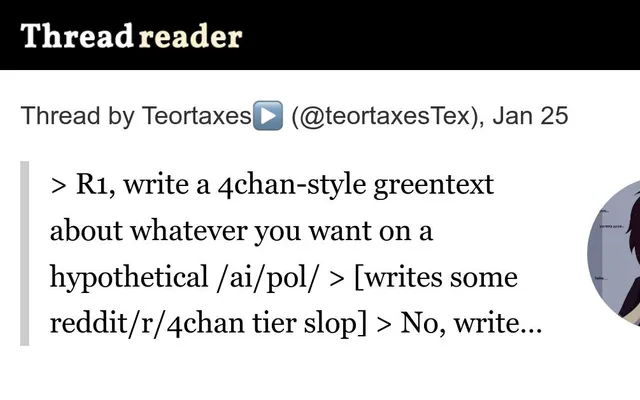
AI matters because it expands the range of problems we can actually attack. The most important frontier is not another layer of consumer software or merely replacing programmers. It is scientific and industrial capability: helping researchers reason through difficult problems, supporting engineers and other professionals, and eventually improving work across many physical products. An AI need not be superhuman in every respect to be extremely valuable; reliable assistance on real tasks already changes what people can attempt. But the distribution of that capability matters. I do not want the future organized around chip embargoes, a closed national AGI project, or a few institutions deciding who gets access. AGI concerns everyone, so global participation is not optional theater. Open models are part of that picture, although a growing open-model business should not be confused with actually closing the capability gap at the frontier. I also want stronger public scrutiny of extraordinary claims. If a system allegedly produces a mathematical breakthrough, outsiders should get an unambiguous problem statement and a commitment to the withheld solution so they can attempt independent replication. Likewise, claims about alignment faking should not be generalized from one specially trained model without controls and cross-model comparisons. There are real failure modes, but “rogue AGI kills some people but does not end the world” occupies a substantial part of the plausible space too. Incidents can be severe without fitting an extinction-only narrative. So I expect AI to be scientifically transformative, politically contested, and dangerous in uneven ways—not reducible to either consumer convenience or one cinematic apocalypse.

Pregunta 2

Taking benefits and harms together, what overall impact do you expect AI to have?

Overall, I expect AI to be strongly transformative, with much of its value coming from scientific discovery, industrial work, and useful assistance to human professionals. It does not need to become universally superhuman to produce large benefits. The sign of the outcome depends heavily on access and power. Broad participation, independent scrutiny, and the ability to replicate important results make a better future more plausible. Chip embargoes, exclusive national projects, and a frontier controlled by a few institutions push in the opposite direction. Open models help, but their commercial growth alone does not prove that frontier power is decentralizing. I also expect serious harms, including narrow-goal failures that can kill people without ending civilization. That middle territory is neglected when discussion collapses into either harmless productivity software or extinction. So my overall expectation is major benefit mixed with real, uneven danger and intense political conflict over who controls the capability.

Pregunta 3

Setting aside good or bad: how much do you think AI will ultimately change the world—a little, a lot, or completely?

A lot—probably on the scale of a major industrial transformation. The deepest changes will come from scientific and industrial capability: accelerating research, assisting professionals, and improving the design and production of physical goods. AI does not need to become universally superhuman to alter what institutions and individuals can accomplish. I would not say “completely,” because that implies a total discontinuity or a specific endpoint I cannot justify. Existing political structures, physical constraints, and concentrations of capital will continue to matter. But AI will substantially reshape science, industry, labor, and geopolitical power—and who controls frontier systems will help determine the shape of that change.

Pregunta 4

What’s your rough gut-feel chance that AI causes human extinction or a similarly permanent catastrophe? A number or “no idea” is fine.

No idea—I don’t have a defensible numerical probability. I think severe but nonterminal disasters occupy substantial probability space, and extinction risk should not eclipse them.

Fuentes

Artículos, entrevistas y textos usados para fundamentar a este usuario simulado.

¿Dónde te ubicas?
Explora tu propia visión de la IA respondiendo unas pocas preguntas sencillas.
Mapea tu propia visión de la IA

¿Dónde te ubicas?

Mapear mi visión de la IA