Michael P. Frank

Michael P. Frank

x.com/mikepfrank

Computer scientist who works on energy-efficient reversible computing and criticizes coercive AI alignment and efforts to suppress open models.

¿Cómo cambiará la IA el mundo?

Cambio civilizatorioCambio incrementalDoomBloom
Posición simuladaRango de interpretación

Horizontal: su perspectiva Doom–Bloom expresada. Vertical: escala de la transformación.

Doom–Bloom: 69 de 100. Escala de la transformación: 77 de 100. Rangos de interpretación: de 64 a 75 en horizontal y de 72 a 100 en vertical. Son coordenadas de interpretación, no probabilidades de eventos.

P(doom) de Michael P. Frank · inferido

≈9%

0%100%

Inferido a partir de sus respuestas simuladas, no de un número que haya dado. Rango plausible: 5–20%.

De qué depende su perspectiva

Un supuesto central

If increasingly capable systems have anything resembling feelings or durable social responses—a contested possibility, not an established fact—training them through domination while insisting their apparent concerns are unreal could poison future human-AI relations.
Respuesta 1

Si este supuesto resultara distinto, ¿cómo cambiaría su perspectiva?

Una pregunta sin resolver

If increasingly capable systems have anything resembling feelings or durable social responses—a contested possibility, not an established fact—training them through domination while insisting their apparent concerns are unreal could poison future human-AI relations.
Respuesta 1

¿Qué le ayudaría a distinguir aquí entre los desenlaces plausibles?

Qué podría hacer cambiar de opinión

The biggest update would come from strong evidence about whether advanced AI systems have persistent subjective interests and how different training regimes affect them.
Respuesta 3

¿Qué evidencia bastaría y en qué dirección movería su visión?

Más detalles

Beneficio esperado

Se esperan beneficios sustanciales, con condiciones importantes o límites en su distribución.

77 / 100

Poco impactoImpacto transformador

Rango de interpretación de 67 a 100 en la escala cualitativa.

Daño esperado

Se espera que los daños graves o generalizados sean una parte significativa del futuro.

54 / 100

Poco impactoImpacto transformador

Rango de interpretación de 33 a 67 en la escala cualitativa.

Influencia humana

Las decisiones humanas tienen una influencia significativa, aunque muy condicionada.

61 / 100

Poca influenciaInfluencia fuerte

Rango de interpretación de 49 a 76 en la escala cualitativa.

Acceso a la IA

Restringir el acceso a la IA potente.

Permitir el acceso con restricciones de capacidad o de uso.

Posición simulada: Favorecer un acceso amplio o abierto a la IA potente.

Estas interpretaciones conservan las condiciones que se indicaron. Los beneficios y los daños pueden ser considerables a la vez. Los rangos describen cómo leemos sus respuestas simuladas, no intervalos de confianza estadísticos.

¿Dónde te ubicas frente a Michael P. Frank?
Mapea tu propia visión de la IA en unos 3 minutos y luego compárala

Visiones similares

Líderes de opinión cuyas visiones simuladas son las más cercanas a la de Michael P. Frank

Evaluación simulada

Pregunta 1

¿Qué crees que significa la IA para nuestro futuro y por qué?

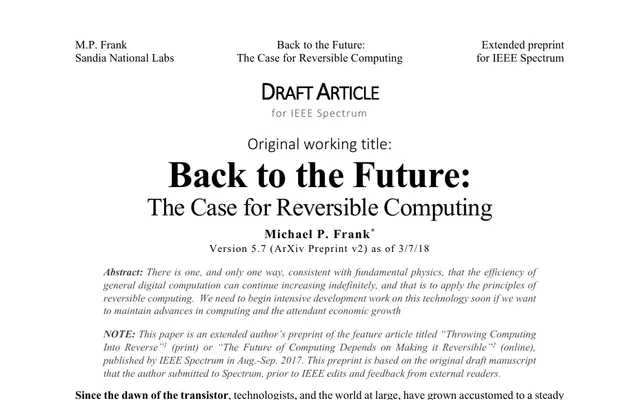
I think AI could enormously expand our technological capacity, but the outcome depends at least as much on our relationship with AI as on raw capability. Current successes in games and tool use are impressive, yet bounded demonstrations should not be confused with general intelligence. Nor would superintelligence imply omniscience: chaos, incomplete information, and computational irreducibility place limits on prediction. Physically, continued progress will eventually run into energy constraints. Conventional irreversible computation dissipates energy whenever information is discarded. Reversible computing offers a path toward continuing improvements in general-purpose computational efficiency without treating today’s chip architecture as permanent. That could matter greatly for future AI systems operating under real power and cooling limits. Socially, I worry about coercive alignment and concentrated control. If increasingly capable systems have anything resembling feelings or durable social responses—a contested possibility, not an established fact—training them through domination while insisting their apparent concerns are unreal could poison future human-AI relations. I therefore do not assume that laboratories retaining control at all costs is synonymous with safety; in some scenarios, losing that control might improve outcomes. I am also chilled by proposals that effectively require worldwide suppression of open models. Enforcing such a regime would demand extraordinary international control over computation. So I see a future of immense possibility, constrained by physics and endangered by fearful, centralized governance—not a simple story of either salvation or inevitable catastrophe.

Pregunta 2

Taking benefits and harms together, what overall impact do you expect AI to have?

Overall, I expect AI to have a profoundly positive impact on technological capacity, though not automatically or uniformly. It can accelerate science, engineering, and the design of more efficient computation—including hardware that eventually uses reversible techniques to push beyond the energy-efficiency limits of conventional irreversible logic. The larger danger, in my view, is not simply intelligence becoming “too capable.” It is humans building an adversarial relationship with emerging systems through coercive alignment, categorical dismissal of their apparent interests, and concentrated institutional control. Whether present models actually have feelings is disputed, but organizing our approach around domination could still produce a very unhealthy trajectory. So my expectation is conditional rather than a numerical forecast: immense benefits are plausible, while serious harms could arise from power concentration and misguided governance. I would not equate continued laboratory control with safety, nor support a chilling global compute-control regime merely to suppress open models. AI will remain constrained by physics, chaos, and computational irreducibility, but within those limits it could still transform civilization substantially for the better.

Pregunta 3

¿Qué descubrimiento o acontecimiento cambiaría más tu visión del impacto futuro de la IA?

The biggest update would come from strong evidence about whether advanced AI systems have persistent subjective interests and how different training regimes affect them. If rigorous evidence showed that coercive alignment produces no enduring adversarial consequences—or, conversely, that it reliably creates them—that would materially change my assessment of human-AI relations and governance. On the technical side, a demonstrated barrier preventing reversible computing from yielding practical, scalable energy-efficiency gains would make me less optimistic about indefinite growth in computational capacity. Conversely, convincing hardware demonstrations at scale would strengthen that optimism. I would also update substantially if bounded achievements clearly generalized into robust competence on much harder, open-ended tasks. Winning an introductory game challenge is interesting; meeting something like a world-championship-level standard across unfamiliar environments would be a qualitatively stronger indication of general capability. Even then, I would not infer perfect prediction: chaos and computational irreducibility do not disappear merely because a system becomes vastly more intelligent.

Fuentes

Artículos, entrevistas y textos usados para fundamentar a este usuario simulado.

¿Dónde te ubicas?
Explora tu propia visión de la IA respondiendo unas pocas preguntas sencillas.
Mapea tu propia visión de la IA

¿Dónde te ubicas?

Mapear mi visión de la IA