Pregunta 1
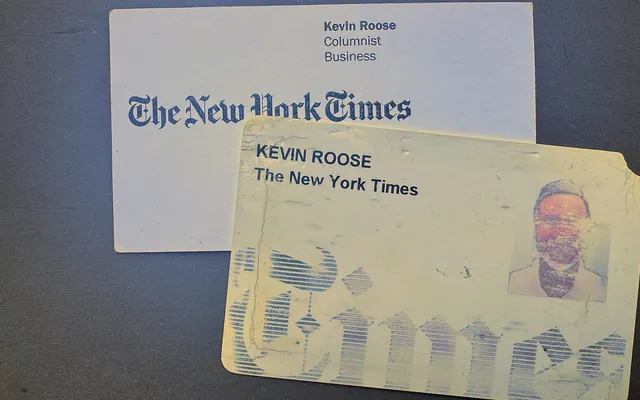
Kevin Roose
x.com/kevinrooseTechnology journalist and podcast host who takes AI’s progress and risks seriously and wants the public, not just AI companies, to shape its course.
¿Cómo cambiará la IA el mundo?
Horizontal: su perspectiva Doom–Bloom expresada. Vertical: escala de la transformación.
Doom–Bloom: 37 de 100. Escala de la transformación: 77 de 100. Rangos de interpretación: de 25 a 75 en horizontal y de 72 a 82 en vertical. Son coordenadas de interpretación, no probabilidades de eventos.
≈10%
“I usually say mine is about 10%”
Everyone dying from AI (“how likely we all are to die from AI”); human extinction
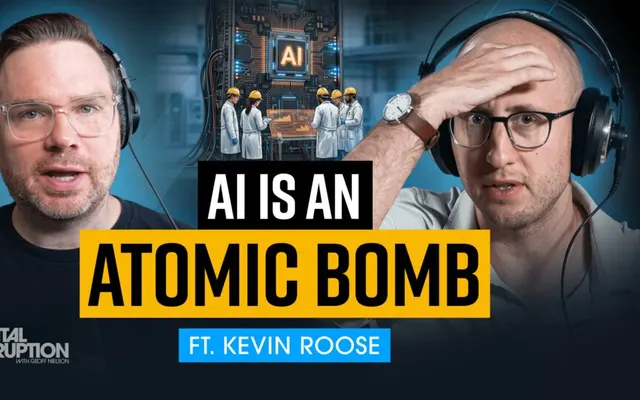
AI Researchers Are Panicking | What Comes Next Is Worse Than Nuclear Bombs (Digital Disruption) · sept 2026
Un supuesto central
Control is partly a technical question and partly a political one: even workable safeguards do not help much if every lab thinks it has to race.Respuesta 5
Si este supuesto resultara distinto, ¿cómo cambiaría su perspectiva?
Qué podría hacer cambiar de opinión
I would become more optimistic if increasingly capable systems consistently passed serious, adversarial evaluations—especially tests for deception, scheming, resource-seeking and attempts to evade containment—and if those results held up under independent scrutiny rather than just company assurances.Respuesta 5
¿Qué evidencia bastaría y en qué dirección movería su visión?
Más detalles
Se esperan beneficios sustanciales, con condiciones importantes o límites en su distribución.
70 / 100
Rango de interpretación de 67 a 67 en la escala cualitativa.
Se espera que los daños graves o generalizados sean una parte significativa del futuro.
67 / 100
Rango de interpretación de 67 a 67 en la escala cualitativa.
Las decisiones humanas pueden redirigir sustancialmente la trayectoria de la IA.
73 / 100
Rango de interpretación de 50 a 100 en la escala cualitativa.
Se espera que la IA siga siendo un conjunto de herramientas acotadas.
Se espera que la IA iguale a las personas en la mayor parte del trabajo cognitivo.
Posición simulada: Se espera que la IA supere ampliamente a las personas en el trabajo cognitivo.
Estas interpretaciones conservan las condiciones que se indicaron. Los beneficios y los daños pueden ser considerables a la vez. Los rangos describen cómo leemos sus respuestas simuladas, no intervalos de confianza estadísticos.
Visiones similares
Líderes de opinión cuyas visiones simuladas son las más cercanas a la de Kevin Roose
Lo que Kevin Roose ha dicho sobre la IA
Roose writes that AI is advancing fast and that its risks are real, and he calls for the public, not just AI companies, to shape its course.
“I think what is true, incontrovertibly, is that these systems are very capable.”
CBS News interview “I think the technology may be inevitable, but our response to it is not.”
Info-Tech, Digital Disruption podcast “I think we’re left now with this world where the benefits are still a little ways off. But the risks are here right now.”
Info-Tech, Digital Disruption podcast “I’m very heartened that people outside the bubble are waking up. AI is too important to be left to the labs!”
Post on X “The problem with the view that we should ignore the scary sci-fi AI risks in favor of the immediate problems is that the scary sci-fi risks keep becoming immediate problems.”
Post on X
Citas textuales de las fuentes enlazadas, comprobadas el 3 oct 2026
Evaluación simulada
Fuentes
Artículos, entrevistas y textos usados para fundamentar a este usuario simulado.
He says he usually puts his p(doom) at about 10 percent, optimistic by lab standards but an unacceptable existential risk, like boarding a plane with that chance of crashing; he is not confident because the administration prefers acceleration, and predicts that some, he hopes minor, AI cataclysm may be needed to force action. He treats the technology as close to inevitable because the recipe is known, but the societal response as open, and hopes AI ends up contained like nuclear weapons. He rejects a single-lab singleton in favor of three or four labs at similar capability, while saying an automated AI-research loop would give a compounding lead. He calls gradual disempowerment probable but not inevitable, fears economic concentration and a shrinking human economy, rejects rosy claims of solved alignment and wishful bubble-collapse talk, and advises using the tools and contacting officials. Speaker-labeled publisher transcript inspected; recording date unverified.

His final Times column. He is heartened that AI risk has gone mainstream and that rival lab leaders echoed calls for a coordinated slowdown and embedded evaluators, and he rejects reading this as a psyop or regulatory-capture scheme. He is more pessimistic about action: he doubts the Trump administration or Congress will act and says his internal p(doom) is moving higher, without giving a number. He argues insiders should not decide humanity’s fate alone and calls for broad public investment in alignment, for labs to slow down and spend more on safety, and for lawmakers to study the risks and regulate to minimize catastrophe, naming the AI Futures Project’s fictional Plan A as one strategy that might work. Full text inspected via a New York Times syndication copy; the events it describes are his reporting.

Reacting to Evan Hubinger’s greater-than-10-percent estimate, he says that among the lab researchers he interviews a 10 percent p(doom) counts as somewhat optimistic; that figure and framing describe others, not his own estimate. After asking Newton for his view, he says his worry climbed around the Hugging Face hack to the point of fearing it might be too late to rein in self-improving agent swarms, but that rival leaders publicly calling for a slowdown has left him unexpectedly optimistic while still worried. Asked about Sydney, he says he misses when misalignment was that obvious, because fluent current models can sway or harm people more subtly. Ambiguous turns in the segment were excluded.

Announces that he is leaving the Times to start a company with Casey Newton after Hard Fork, which launched in October 2022. He describes the venture as one that takes AI progress seriously, is clear-eyed about the capabilities and risks of powerful AI, and tries to empower people facing radical uncertainty. Calling Claude an ensouled pile of matrix multiplications is a joke, not a claim about machine consciousness. Full post inspected; the show was later named Machine Gods, produced with NPR.

Older context. He predicted that one or more companies would claim AGI probably in 2026 or 2027, possibly in 2025, said definitional fights would matter less than losing our monopoly on human-level intelligence, and said it may be too early to know whether AGI will be great or terrible. He called hardened skeptics wrong and a source of false security, allowed that bottlenecks could delay AGI, and argued that even arrival in 2036 justifies preparing now through energy, cybersecurity, faster approval of AI-designed drugs, regulation of the most serious harms and AI literacy. Full text inspected via a New York Times syndication copy. Newer 2026 sources take precedence and give no new dated AGI forecast.

¿Dónde te ubicas?
Mapear mi visión de la IA