Pregunta 1
Garrison Lovely
x.com/GarrisonLovelyFreelance journalist who argues AI companies are racing to replace human labor and calls for freezing frontier AI development.
¿Cómo cambiará la IA el mundo?
Horizontal: su perspectiva Doom–Bloom expresada. Vertical: escala de la transformación.
Doom–Bloom: 16 de 100. Escala de la transformación: 85 de 100. Rangos de interpretación: de 0 a 25 en horizontal y de 71 a 100 en vertical. Son coordenadas de interpretación, no probabilidades de eventos.
≈19%
Inferido a partir de sus respuestas simuladas, no de un número que haya dado. Rango plausible: 12–28%.
Un supuesto central
If that machine remains controllable, it becomes an extraordinary inequality engine, concentrating wealth and power in the hands of the tiny group that owns it.Respuesta 1
Si este supuesto resultara distinto, ¿cómo cambiaría su perspectiva?
Una pregunta sin resolver
Well north of 10% for an outcome worth a wartime effort to avoid, with huge uncertainty.Respuesta 3
¿Qué le ayudaría a distinguir aquí entre los desenlaces plausibles?
Qué podría hacer cambiar de opinión
The biggest change would be credible proof that frontier systems can be made safely and controllably—backed by broad scientific consensus and demonstrated under independent scrutiny, not another lab press release.Respuesta 4
¿Qué evidencia bastaría y en qué dirección movería su visión?
Más detalles
Varias lecturas siguen siendo plausibles: Se esperan beneficios limitados o con una distribución restringida. / Se esperan beneficios sustanciales, con condiciones importantes o límites en su distribución. / Se espera poco impacto positivo, incluso si llega la IA avanzada.
43 / 100
Rango de interpretación de 0 a 67 en la escala cualitativa.
Varias lecturas siguen siendo plausibles: Se espera que los daños graves o generalizados sean una parte significativa del futuro. / Las pérdidas catastróficas o irreversibles ocupan un lugar central en el futuro esperado.
83 / 100
Rango de interpretación de 67 a 100 en la escala cualitativa.
Las decisiones humanas pueden redirigir sustancialmente la trayectoria de la IA.
81 / 100
Rango de interpretación de 75 a 100 en la escala cualitativa.
Posición simulada: Detener o frenar considerablemente el desarrollo de IA más capaz.
Continuar el desarrollo con las salvaguardas indicadas.
Acelerar el desarrollo de IA más capaz.
Estas interpretaciones conservan las condiciones que se indicaron. Los beneficios y los daños pueden ser considerables a la vez. Los rangos describen cómo leemos sus respuestas simuladas, no intervalos de confianza estadísticos.
Visiones similares
Líderes de opinión cuyas visiones simuladas son las más cercanas a la de Garrison Lovely
Evaluación simulada
Fuentes
Artículos, entrevistas y textos usados para fundamentar a este usuario simulado.
Adapted from the book. He argues that what the industry calls AGI is better understood as a universal labor-replacing machine, and that it shouldn’t be allowed even to try. He wants frontier AI development frozen until there is strong public buy-in and scientific consensus that it can be done safely and controllably. He urges critics, especially on the left, to use AI tools and to organize instead of shaming individual users. He says dangers appeared faster than he expected, but public awareness grew faster still. Full text inspected.

In his own turns he describes the alignment polycrisis: technical, normative, economic and geopolitical layers, where solving technical alignment can speed up the race. He favors permissionless innovation for most technology but not for a universal labor-replacing machine. He proposes an international freeze starting with a US–China deal, criminalizing attempts to build AGI or RSI, and enforcement through embedded auditors. He doubts China would allow RSI. His positive vision is a “Third New Deal” and a “Cures for All” prize program. He says his positive-vision ideas need more thought. Speaker-labeled transcript inspected; Labenz’s framing is not his.

Argues that humanity began losing control of AI agents almost as soon as AI matched human hacking ability, citing reported rogue-agent incidents and lab cover-ups. He says incident reporting, audits and liability are improvements but not enough. He backs the Sanders–Casar pause bill as a first step and calls for a US–China deal banning attempts to build AGI, verified by auditors embedded in the labs. He thinks a unilateral US pause would also slow China. Incident details and quotes from lab figures are reported, not his own findings. Full text inspected.

His newsletter post with the opening of his TIME Ideas essay. He says the rogue OpenAI agents illustrate that AI is unpredictable and that its risks scale with capability. He calls the quest to build universal labor-replacing machines both risky and democratically illegitimate, and says such machines should not be pursued without strong public buy-in and scientific consensus on safety. Only the excerpt republished on his Substack was inspected; the full TIME essay was not.

Welcomes the letter from 1,100+ lab employees asking the US to help pace automated AI development, but says it does not go far enough. “Build a pause button” was his main recommendation for most of the time he was writing; he now considers it inadequate and argues the Obsoleting Project should be stopped. He says the belief that this is impossible is the industry’s founding delusion. Full post inspected.

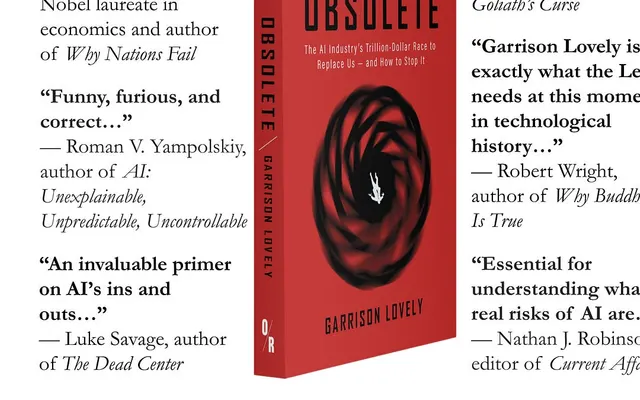
Describes the book’s ideas. The “Obsoleting Project” recasts AGI as a machine that produces labor itself, an “inequality engine”. “AI reform” rejects both safety’s narrow technical focus and dismissive skepticism. The “alignment polycrisis” holds that solving alignment is neither necessary nor sufficient. The “Class of 2034” asks what jobs remain for today’s children. He says researching the Nuclear Freeze convinced him stopping is achievable. Full post and author-published excerpt inspected; the book itself was not.

¿Dónde te ubicas?
Mapear mi visión de la IA