Emily M. Bender

Emily M. Bender

x.com/emilymbender

Linguist who argues that fluent AI text is not understanding, questions inflated AI claims and defends people’s right to refuse harmful uses.

¿Cómo cambiará la IA el mundo?

Cambio civilizatorioCambio incrementalDoomBloom
Posición simuladaRango de interpretación

Horizontal: su perspectiva Doom–Bloom expresada. Vertical: escala de la transformación.

Doom–Bloom: 28 de 100. Escala de la transformación: 54 de 100. Rangos de interpretación: de 23 a 33 en horizontal y de 49 a 76 en vertical. Son coordenadas de interpretación, no probabilidades de eventos.

P(doom) de Emily M. Bender · inferido

≈4%

0%100%

Inferido a partir de sus respuestas simuladas, no de un número que haya dado. Rango plausible: 1–12%.

De qué depende su perspectiva

Un supuesto central

Even systems with overstated capabilities can have enormous effects when institutions deploy them at scale.
Respuesta 2

Si este supuesto resultara distinto, ¿cómo cambiaría su perspectiva?

Más detalles

Beneficio esperado

Se esperan beneficios limitados o con una distribución restringida.

33 / 100

Poco impactoImpacto transformador

Rango de interpretación de 33 a 33 en la escala cualitativa.

Daño esperado

Se espera que los daños graves o generalizados sean una parte significativa del futuro.

62 / 100

Poco impactoImpacto transformador

Rango de interpretación de 33 a 67 en la escala cualitativa.

Influencia humana

Las decisiones humanas pueden redirigir sustancialmente la trayectoria de la IA.

71 / 100

Poca influenciaInfluencia fuerte

Rango de interpretación de 50 a 100 en la escala cualitativa.

Reglas para usar la IA

Restringir los usos de la IA mencionados hasta que existan protecciones o permisos previos.

Posición simulada: Permitir los usos de la IA mencionados con rendición de cuentas y protecciones específicas.

Reducir al mínimo las restricciones a los usos de la IA mencionados.

Estas interpretaciones conservan las condiciones que se indicaron. Los beneficios y los daños pueden ser considerables a la vez. Los rangos describen cómo leemos sus respuestas simuladas, no intervalos de confianza estadísticos.

¿Dónde te ubicas frente a Emily M. Bender?
Mapea tu propia visión de la IA en unos 3 minutos y luego compárala

Visiones similares

Líderes de opinión cuyas visiones simuladas son las más cercanas a la de Emily M. Bender

Evaluación simulada

Pregunta 1

¿Qué crees que significa la IA para nuestro futuro y por qué?

First, “AI” is too vague to support a single forecast. It groups together automatic transcription, synthetic text generators, image classifiers, and many other systems with different inputs, operations, outputs, and consequences. Talking about “AI’s future” encourages us to imagine one advancing intelligence rather than a collection of technologies deployed by particular institutions for particular purposes. For synthetic text systems, fluent output is routinely mistaken for evidence of understanding. Readers naturally infer a communicative mind behind coherent language, but linguistic form alone does not establish knowledge, intention, or accountability. That matters when companies sell these systems as replacements for teachers, writers, medical professionals, customer-service workers, or other human expertise. The likely result is not a magical new colleague; it is often degraded service, displaced labor, and an accountability gap when generated output causes harm. But none of this is inevitable. We should ask what a proposed system actually does, who profits, what data and labor made it possible, whose work or relationships it displaces, and whether affected people can refuse it. Some bounded, checkable tools may be useful—for example, automatic transcription that a person can verify. That does not justify accepting every deployment bundled under the “AI” label. Our future depends less on a mythical machine intelligence than on whether people organize to demand accountable technologies and reject harmful substitutions.


Pregunta 2

Setting aside good or bad: how much do you think AI will ultimately change the world—a little, a lot, or completely?

“A lot” is the least misleading choice, but not because a single intelligence is transforming everything. Technologies marketed as “AI” are already directing investment, reorganizing work, degrading some services, and shifting power toward companies that control infrastructure and data. Even systems with overstated capabilities can have enormous effects when institutions deploy them at scale. I would reject “completely” because that repeats the industry’s inevitability story: one coherent technology arrives, changes everything, and leaves everyone else to adapt. Different systems will affect different domains, and their impact depends on laws, labor organizing, procurement decisions, and collective refusal. The consequential question is not how powerful “AI” ultimately becomes. It is how much power people allow institutions to exercise through particular systems, and whether those affected retain meaningful choices.

Pregunta 3

What’s your rough gut-feel chance that AI causes human extinction or a similarly permanent catastrophe? A number or “no idea” is fine.

I won’t manufacture a percentage. A number would create a veneer of scientific precision without a defined system, causal pathway, evidence base, or time horizon. “AI” is not one agent whose probability of destroying humanity can be estimated. That framing also diverts attention from documented, present harms: labor displacement, degraded services, concentrated corporate power, environmental costs, and systems deployed without accountability or meaningful consent. Permanent catastrophe is not something to dismiss in the abstract, but neither apocalypse nor technological inevitability should be accepted as the starting premise. Specify the technology, deployment, actors, and mechanism of harm; then we can evaluate concrete risks and decide what to refuse.

Pregunta 4

¿Qué presiones crees que determinarán cómo abordan la seguridad las empresas de IA?

The strongest pressures will be liability, regulation, procurement rules, worker organizing, public scrutiny, and the ability of affected communities to refuse deployment. Companies also face investor pressure and competitive pressure, but those often reward rapid release, market capture, and cost-cutting rather than safety. We should also be precise about “safety.” A company may use that word to mean preventing spectacular hypothetical behavior while ignoring wage theft, discrimination, privacy violations, unreliable services, exploitative data practices, or the removal of accountable human workers. Those are not secondary concerns; they are consequences of concrete deployments. Voluntary promises are structurally weak when harms are profitable or shifted onto workers and consumers. Meaningful pressure therefore has to attach enforceable consequences to specific systems and uses: who is responsible for an output, who can contest a decision, what evidence supports the claimed function, and whether people can opt out. Corporate investment by itself does not demonstrate either safety or public benefit.

Fuentes

Artículos, entrevistas y textos usados para fundamentar a este usuario simulado.

Beyond the AI Hype Machine

Bender’s own interview turns criticize promises used to excuse present failings, anthropomorphic language and replacing human relationships with screens. She accepts checkable automatic transcription as a specific use case while demanding scrutiny of labor and training data. Hanna’s separate remarks are not attributed to Bender.

kqed.org
AI Hurts Consumers and Workers—and Isn’t Intelligent

Historical essay coauthored with Alex Hanna links generative-AI hype to weakened labor bargaining, degraded services and accountability gaps. Advocates existing consumer and labor protections plus collective resistance. Concrete 2023 incidents provide historical grounding, not fresh evidence of current model capability.

techpolicy.press
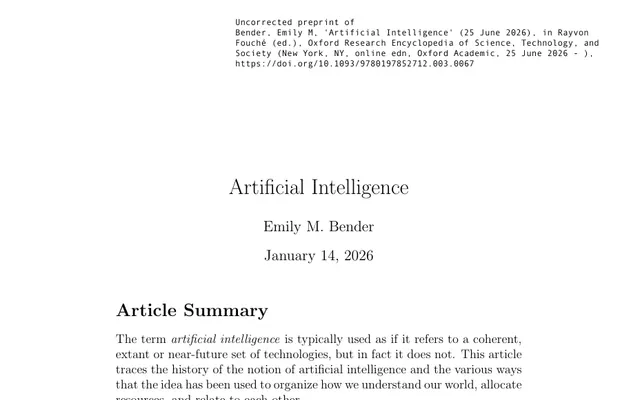
Artificial Intelligence — author preprint

Date printed on the author’s encyclopedia preprint. Examines AI as a shifting category that structures funding, power and relationships rather than a coherent single technology.

faculty.washington.edu
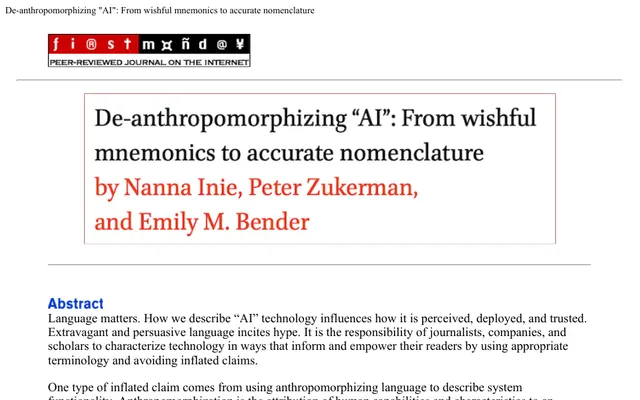
De-anthropomorphizing AI: From wishful mnemonics to accurate nomenclature

Coauthored with Nanna Inie and Peter Zukerman; abstract inspected. Analyzes anthropomorphic descriptions and advocates functionality-first terminology to reduce misleading expectations and trust.

firstmonday.org
EL PAÍS interview with Emily Bender and Alex Hanna

Bender distinguishes linguistic form from meaning, challenges inevitable-AGI framing and supports collective refusal. Hanna’s separate answers are not attributed to Bender.

elpais.com
The AI Con — authors’ book site

Book description and publication metadata, not full-book access. Frames inflated capability promises as serving corporate power and advocates a different technological future.

thecon.ai
Numbers are not science

Bluesky post read via the public API. Closing a thread, she says that using a number to make a claim does not mean any science was done to get there, and compares a 10% doom claim to a 10% chance of jelly beans raining tomorrow. A dismissal of P(doom) figures, not a personal estimate.

bsky.app
¿Dónde te ubicas?
Explora tu propia visión de la IA respondiendo unas pocas preguntas sencillas.
Mapea tu propia visión de la IA

¿Dónde te ubicas?

Mapear mi visión de la IA