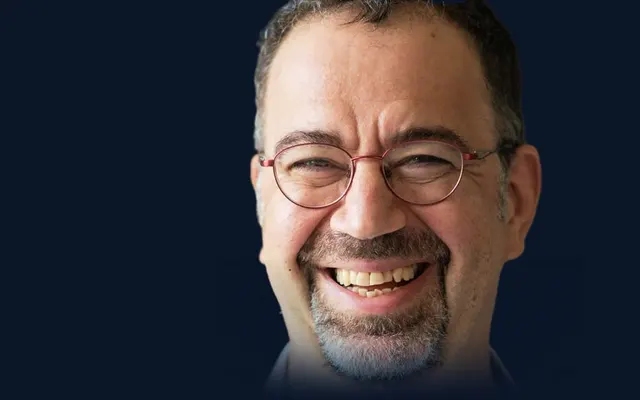
Daron Acemoglu

Daron Acemoglu

x.com/DAcemogluMIT

Economist who argues AI should be steered toward making workers more capable rather than replacing them, so its gains are widely shared.

¿Cómo cambiará la IA el mundo?

Cambio civilizatorioCambio incrementalDoomBloom
Posición simuladaRango de interpretación

Horizontal: su perspectiva Doom–Bloom expresada. Vertical: escala de la transformación.

Doom–Bloom: 31 de 100. Escala de la transformación: 62 de 100. Rangos de interpretación: de 25 a 36 en horizontal y de 50 a 75 en vertical. Son coordenadas de interpretación, no probabilidades de eventos.

P(doom) de Daron Acemoglu · inferido

≈3%

0%100%

Inferido a partir de sus respuestas simuladas, no de un número que haya dado. Rango plausible: menos del 15%.

De qué depende su perspectiva

Un supuesto central

But capabilities do not translate automatically into broad prosperity.
Respuesta 2

Si este supuesto resultara distinto, ¿cómo cambiaría su perspectiva?

Más detalles

Beneficio esperado

Se esperan beneficios limitados o con una distribución restringida.

36 / 100

Poco impactoImpacto transformador

Rango de interpretación de 33 a 33 en la escala cualitativa.

Daño esperado

Se espera que los daños graves o generalizados sean una parte significativa del futuro.

63 / 100

Poco impactoImpacto transformador

Rango de interpretación de 33 a 67 en la escala cualitativa.

Influencia humana

Las decisiones humanas pueden redirigir sustancialmente la trayectoria de la IA.

74 / 100

Poca influenciaInfluencia fuerte

Rango de interpretación de 50 a 75 en la escala cualitativa.

Ritmo de desarrollo

Detener o frenar considerablemente el desarrollo de IA más capaz.

Posición simulada: Continuar el desarrollo con las salvaguardas indicadas.

Acelerar el desarrollo de IA más capaz.

Estas interpretaciones conservan las condiciones que se indicaron. Los beneficios y los daños pueden ser considerables a la vez. Los rangos describen cómo leemos sus respuestas simuladas, no intervalos de confianza estadísticos.

¿Dónde te ubicas frente a Daron Acemoglu?
Mapea tu propia visión de la IA en unos 3 minutos y luego compárala

Visiones similares

Líderes de opinión cuyas visiones simuladas son las más cercanas a la de Daron Acemoglu

Lo que Daron Acemoglu ha dicho sobre la IA

Acemoglu argues that AI should be steered toward complementing workers rather than replacing them, and that its direction needs democratic input.

  1. “My instinct is that democratic voice is essential, and relying too much on technocracy could be both dangerous and counterproductive.”

    Post on X
  2. “Agentic AI is not AGI, in my opinion, but it’s pretty impressive.”

    Justified Posteriors podcast
  3. “The problem rather may be that the way that frontier labs are training these models is leading to distorted intelligence.”

    Post on X
  4. “AI tools can also be designed to complement workers, enhancing their capabilities and productivity, rather than substituting for them.”

    Nature essay
  5. “What is at stake is not only shared prosperity, but also our democratic system.”

    Nature essay

Citas textuales de las fuentes enlazadas, comprobadas el 3 oct 2026

Evaluación simulada

Pregunta 1

¿Qué crees que significa la IA para nuestro futuro y por qué?

AI could be transformative, but its effects are not predetermined by capability alone. The crucial question is which technologies we choose to build. Today, investment incentives push strongly toward automation—using machines to replace workers and concentrate decision-making. That path may increase some measures of productivity, but it can also widen inequality, diminish the value of human expertise, and leave large parts of society with less economic and political power. A better path would use AI to create new human tasks: helping nurses make better judgments, enabling teachers to personalize instruction without displacing them, or giving workers information that expands their responsibilities. Simply making an existing task faster is not necessarily pro-worker; what matters is whether demand for human skills and expertise increases across the economy. This direction will not emerge automatically from competition among a few powerful firms. It requires public research, procurement, worker participation, better investment in skills, and democratic debate about what futures we want. I do not think we must stop innovation. But slowing particular developments to steer resources toward socially valuable applications can be entirely sensible. Ultimately, a future of high output but economically dispensable citizens would threaten dignity and democratic equality. Income transfers alone cannot replace the standing people gain from contributing meaningfully to society.

Pregunta 2

Taking benefits and harms together, what overall impact do you expect AI to have?

On the current trajectory, I expect AI’s overall impact to be much less beneficial—and more unequal—than its technical capabilities suggest. We are devoting enormous resources to automation, surveillance, and replacing routine and professional tasks, rather than creating new tasks that make human expertise more valuable. That can shift income and decision-making power toward capital owners and a small group of firms while weakening workers’ economic standing and, ultimately, democratic voice. I do expect real benefits: better information, useful scientific tools, and productivity gains in some applications. Agents make the economic potential larger than I previously estimated, though I have not recalculated a number. But capabilities do not translate automatically into broad prosperity. Organizational adoption is slow, experimentation remains a bottleneck, and whole occupations are difficult to automate. The investment boom could therefore produce disappointing returns, while still worsening inequality. So my expected outcome is not technological catastrophe or effortless abundance. It is a mixed but unnecessarily disappointing future: genuine advances alongside concentrated gains, labor displacement, and weakened human expertise. That is the likely direction under present incentives, not an inevitability. Public procurement, research funding, worker voice, skills investment, and tax reform could redirect AI toward complementing people and producing much broader benefits.

Pregunta 3

Setting aside good or bad: how much do you think AI will ultimately change the world—a little, a lot, or completely?

A lot. AI could be genuinely transformative, changing how firms organize work, how people acquire information, how science proceeds, and how income and power are distributed. But I would not say “completely.” Capabilities are not the same as economy-wide transformation: adoption is slow, organizations are difficult to redesign, experimental bottlenecks remain, and entire occupations contain many tasks that cannot simply be handed to machines. The scale of change will also depend on direction. AI built mainly to automate existing tasks will reshape labor markets and concentrate power, even if its aggregate productivity contribution is less dramatic than advertised. AI designed to create new human tasks could instead transform work by making expertise more valuable. So I expect large change, but its form and social significance will be determined as much by institutions and investment choices as by the models themselves.

Pregunta 4

What’s your rough gut-feel chance that AI causes human extinction or a similarly permanent catastrophe? A number or “no idea” is fine.

No idea. I do not have the technical expertise or evidence to assign a meaningful probability to human extinction from AI.

Fuentes

Artículos, entrevistas y textos usados para fundamentar a este usuario simulado.

¿Dónde te ubicas?
Explora tu propia visión de la IA respondiendo unas pocas preguntas sencillas.
Mapea tu propia visión de la IA

¿Dónde te ubicas?

Mapear mi visión de la IA