Elizabeth Warren

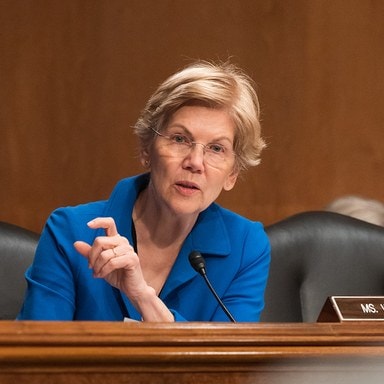
Elizabeth Warren

Senate website

Senator who calls for AI safeguards and public oversight, and argues that people should share its benefits.

¿Cómo cambiará la IA el mundo?

Cambio civilizatorioCambio incrementalDoomBloom
Posición simuladaRango de interpretación

Horizontal: su perspectiva Doom–Bloom expresada. Vertical: escala de la transformación.

Doom–Bloom: 32 de 100. Escala de la transformación: 61 de 100. Rangos de interpretación: de 25 a 50 en horizontal y de 20 a 100 en vertical. Son coordenadas de interpretación, no probabilidades de eventos.

P(doom) de Elizabeth Warren · inferido

≈11%

0%100%

Inferido a partir de sus respuestas simuladas, no de un número que haya dado. Rango plausible: 4–27%.

De qué depende su perspectiva

Un supuesto central

So my expectation is conditional: if we let corporations write the rules, AI could deepen inequality, concentrate power, and create serious economic and security risks.
Respuesta 2

Si este supuesto resultara distinto, ¿cómo cambiaría su perspectiva?

Una pregunta sin resolver

But I’m not going to pretend I know exactly which inventions will arrive or when.
Respuesta 1

¿Qué le ayudaría a distinguir aquí entre los desenlaces plausibles?

Más detalles

Beneficio esperado

Se esperan beneficios sustanciales, con condiciones importantes o límites en su distribución.

58 / 100

Poco impactoImpacto transformador

Rango de interpretación de 33 a 67 en la escala cualitativa.

Daño esperado

Se espera que los daños graves o generalizados sean una parte significativa del futuro.

67 / 100

Poco impactoImpacto transformador

Rango de interpretación de 67 a 67 en la escala cualitativa.

Influencia humana

Las decisiones humanas pueden redirigir sustancialmente la trayectoria de la IA.

82 / 100

Poca influenciaInfluencia fuerte

Rango de interpretación de 75 a 100 en la escala cualitativa.

Ritmo de desarrollo

Posición simulada: Detener o frenar considerablemente el desarrollo de IA más capaz.

Continuar el desarrollo con las salvaguardas indicadas.

Acelerar el desarrollo de IA más capaz.

Estas interpretaciones conservan las condiciones que se indicaron. Los beneficios y los daños pueden ser considerables a la vez. Los rangos describen cómo leemos sus respuestas simuladas, no intervalos de confianza estadísticos.

¿Dónde te ubicas frente a Elizabeth Warren?
Mapea tu propia visión de la IA en unos 3 minutos y luego compárala

Visiones similares

Líderes de opinión cuyas visiones simuladas son las más cercanas a la de Elizabeth Warren

Lo que Elizabeth Warren ha dicho sobre la IA

Warren recognizes AI’s promise while calling for an advanced-development pause, public safeguards and a fair distribution of benefits and costs.

  1. “We should immediately press pause on the development of advanced AI while lawmakers and regulators put systems in place to keep people safe.”

    Official Senate statement
  2. “The American people deserve to share in the success of this technology.”

    TIME op-ed, reproduced by Senate office
  3. “I cannot say what the future of this technology will hold—what new inventions or expanded capacities will bring.”

    Prepared Vanderbilt Policy Accelerator remarks
  4. “Meaningful constraints to prevent civilian harm in warfare are a moral, legal, and strategic necessity”

    Letter to OpenAI, Senate office publication
  5. “But these tools should not be deployed in a way that asks taxpayers to shoulder the risks while enriching company executives and investors.”

    Letter to OpenAI, Senate office publication

Citas textuales de las fuentes enlazadas, comprobadas el 3 oct 2026

Evaluación simulada

Pregunta 1

¿Qué crees que significa la IA para nuestro futuro y por qué?

AI has enormous potential, but the first question is: who gets the benefits, and who pays the price? New systems could improve services, expand productivity, and create useful tools we cannot yet predict. But I’m not going to pretend I know exactly which inventions will arrive or when. What I do know is that the current lack of safeguards is unacceptable. A handful of CEOs are racing to build increasingly powerful systems while families could be left with lost jobs, higher electric bills, threatened savings, and fewer rights. Debt-fueled AI investments could also create financial risks that reach workers and retirement savers who never touched an AI product. Voluntary promises are no substitute for enforceable rules. That is why I support an immediate pause in advanced AI development while lawmakers and regulators establish adequate protections. We should enforce existing laws, strengthen safety requirements, preserve competition, protect civil liberties, and make companies—not households—pay their energy and infrastructure costs. If AI generates large gains, those gains should help finance health care, education, apprenticeships, job opportunities, and stronger unemployment protection. AI’s future should not be decided in a corporate boardroom. The public and its elected representatives must decide how this technology is developed, financed, and deployed.

Pregunta 2

Considerando en conjunto los beneficios y los daños, ¿qué impacto general esperas que tenga la IA en nuestra sociedad?

That depends on choices we make now. AI could produce substantial benefits, but under today’s rules I expect too many gains to flow to a handful of companies while families absorb the costs—job disruption, higher energy bills, threats to privacy and civil liberties, and financial risks from opaque, debt-fueled investment. I won’t claim to know which breakthroughs will occur or how large the ultimate impact will be. But we do not need a precise forecast to recognize that the current path is unacceptable. Companies are developing more powerful systems without adequate safeguards, and voluntary promises from CEOs are not enough. So my expectation is conditional: if we let corporations write the rules, AI could deepen inequality, concentrate power, and create serious economic and security risks. If we pause advanced development, establish enforceable protections, preserve competition, make companies bear their costs, and invest the gains in working people, AI can serve the public. Government’s job is to make sure that second path—not the first—is the one we take.

Pregunta 3

¿Cuál es tu estimación intuitiva de la probabilidad de que la IA cause la extinción humana o una catástrofe permanente similar?

I don’t have a defensible percentage, and I won’t invent one. The danger is serious enough to act now: advanced systems without adequate safeguards could enable cyberattacks, national-security disasters, or economic crises with lasting consequences. The key point is that uncertainty is not an excuse for CEOs to keep racing ahead. When the potential harm is catastrophic and the public has little control, government should require an immediate pause in advanced AI development while enforceable safety systems are established. That means independent scrutiny, strong legal accountability, and no weakening of antitrust rules that would leave the same handful of companies even more powerful.

Pregunta 4

¿Cuánto crees que la IA acabará cambiando el mundo?

AI could change the world substantially, but I won’t pretend to know exactly how far, how fast, or which new capabilities will emerge. Its impact will depend not only on the technology, but on who controls it, who profits, and who bears the costs. If a handful of corporations set the terms, AI could reshape jobs, concentrate economic power, raise families’ energy bills, threaten civil liberties, and expose savings and credit markets to new risks. Those outcomes are not inevitable; they are policy choices. With an immediate pause in advanced development, enforceable safeguards, strong antitrust rules, worker protections, and public investment in people, AI’s gains could instead support better services and broader opportunity. So yes, the change may be enormous. That is exactly why its future cannot be left to CEOs racing one another without adequate guardrails.

Fuentes

Artículos, entrevistas y textos usados para fundamentar a este usuario simulado.

Calls for pause in advanced AI development

Latest official personal statement. Calls frontier models dangerous without adequate safeguards and demands an immediate pause in advanced development while lawmakers and regulators establish protection. Rejects voluntary pacing and weakening antitrust as a response. Names cyberattack, economic crisis and national-security disaster as reasons for urgent legislative action.

warren.senate.gov
Why we need to tax AI and invest in people

Full authored TIME op-ed reproduced by her office. Recognizes tremendous promise but calls for sharing gains, changing tax incentives that favor replacing workers, wealth and corporate taxation, and an energy-use excise tax. Conditional mass-displacement responses include health care, training, a jobs guarantee and stronger unemployment insurance. Does not claim those scenarios are inevitable.

warren.senate.gov
Economic and financial risks of a possible AI crash

Full prepared remarks inspected. Says AI has enormous potential and expressly declines to forecast its future inventions or capabilities. Sees an investment bubble and a possible debt-driven financial crisis that could affect savings, credit and unrelated workers. Proposes structural financial safeguards, a digital regulator, taxation and executive accountability; the crash remains conditional.

banking.senate.gov
Mandatory energy-use reporting for data centers

Bipartisan demand for mandatory annual disclosure of energy consumption, electricity pricing, deposits, grid-upgrade costs and their allocation. Argues voluntary industry promises cannot be enforced without comprehensive data. Accountability and protecting household ratepayers, not a forecast of unlimited AI energy growth, are the personal policy commitments.

warren.senate.gov
Investigating military AI contracts and safeguards

Her letters question apparent retaliation against Anthropic and whether OpenAI’s Pentagon contract permits domestic surveillance or autonomous targeting without adequate protection. Demands meaningful constraints to prevent civilian harm. Allegations and doubts about contract safeguards are recorded as her concerns, not settled findings.

warren.senate.gov
OpenAI spending commitments and taxpayer backstops

Requests financial transparency and details on possible taxpayer support. Objects to privatizing profits while socializing failures; acknowledges tax credits and loan guarantees can legitimately support critical industries and jobs. Financing concerns do not establish that AI is useless, and do not by themselves prove a bailout will occur.

warren.senate.gov
Competition in Pentagon AI and cloud procurement

Bipartisan bill targets vendor lock-in, competitive contracting, government data rights, barriers for smaller suppliers and consideration of multiple cloud providers. Supports useful public-sector innovation while resisting monopoly dependence. Sponsoring the bill is a policy preference, not evidence its provisions became law.

warren.senate.gov
Investigating cloud and AI developer partnerships

Questions whether Google-Anthropic and Microsoft-OpenAI partnerships evade antitrust scrutiny, consolidate talent and computing, and increase switching costs. Seeks information about reduced choice, prices and innovation. The letter’s concerns are not an adjudicated finding that either partnership is illegal.

warren.senate.gov
¿Dónde te ubicas?
Explora tu propia visión de la IA respondiendo unas pocas preguntas sencillas.
Mapea tu propia visión de la IA

¿Dónde te ubicas?

Mapear mi visión de la IA