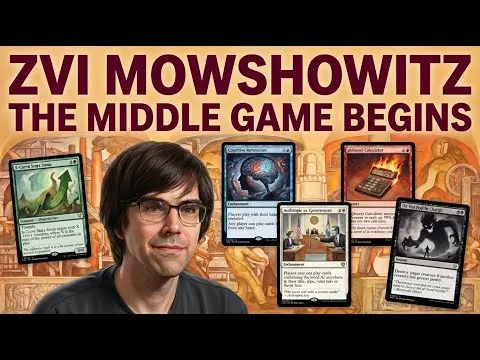
Zvi Mowshowitz

Zvi Mowshowitz

x.com/thezvi

Writer who covers AI capabilities, alignment and policy in detail and argues advanced AI risk warrants urgent technical and political action.

Wie wird KI die Welt verändern?

Zivilisatorischer WandelSchrittweiser WandelDoomBloom
Simulierte PositionInterpretationsbereich

Horizontal: deren geäußerter Doom–Bloom-Ausblick. Vertikal: Ausmaß der Transformation.

Doom–Bloom: 8 von 100. Ausmaß der Transformation: 91 von 100. Interpretationsbereiche: horizontal 0 bis 13, vertikal 86 bis 100. Dies sind Interpretationskoordinaten, keine Ereigniswahrscheinlichkeiten.

Das angegebene P(doom) von Zvi Mowshowitz

≈70%

0%100%
“i think it's like yeah seventy ish”

AI “doom” as asked by Nathan Labenz (“your latest P doom”); endpoint not defined in the exchange (his discussion is about superintelligence ending up with goals we do not want)

Zvi's Mic Works! Recursive Self-Improvement, Live Player Analysis, Anthropic vs DoW + More! · März 2026

Wovon deren Einschätzung abhängt

Eine zentrale Annahme

The central problem is that capabilities are improving quickly while neither technical alignment nor governance is keeping pace.
Antwort 1

Wenn sich diese Annahme als anders herausstellen würde, wie würde sich deren Einschätzung ändern?

Was ihre Meinung ändern könnte

The biggest update would be strong, reproducible evidence that alignment remains robust as systems become more capable, operate over long horizons, and improve themselves—without that robustness depending on fragile monitoring or hidden reasoning we cannot inspect.
Antwort 2

Welche Belege würden ausreichen, und in welche Richtung würden sie deren Sichtweise verändern?

Weitere Details

Erwartete Vorteile

Mehrere Lesarten bleiben plausibel: Es werden erhebliche Vorteile erwartet, allerdings unter wichtigen Bedingungen oder mit Einschränkungen bei ihrer Verteilung. / Selbst wenn fortgeschrittene KI entsteht, werden nur geringe positive Auswirkungen erwartet. / Es werden begrenzte oder eng verteilte Vorteile erwartet.

36 / 100

Geringe AuswirkungenTransformative Auswirkungen

Interpretationsbereich von 0 bis 67 auf der qualitativen Skala.

Erwartete Schäden

Katastrophale oder unumkehrbare Verluste stehen im Zentrum der erwarteten Zukunft.

100 / 100

Geringe AuswirkungenTransformative Auswirkungen

Interpretationsbereich von 100 bis 100 auf der qualitativen Skala.

Menschlicher Einfluss

Menschliche Entscheidungen haben einen bedeutsamen, aber erheblich eingeschränkten Einfluss.

47 / 100

Geringer EinflussStarker Einfluss

Interpretationsbereich von 24 bis 51 auf der qualitativen Skala.

Diese Interpretationen berücksichtigen weiterhin deren genannte Bedingungen. Vorteile und Schäden können beide erheblich sein. Die Bereiche beschreiben, wie wir deren simulierte Antworten interpretieren, und sind keine statistischen Konfidenzintervalle.

Wo stehst du im Vergleich zu Zvi Mowshowitz?
Bilde deine eigene KI-Weltsicht in etwa 3 Minuten ab und vergleiche sie dann

Ähnliche Weltsichten

Vordenker, deren simulierte Weltsichten der von Zvi Mowshowitz am nächsten kommen

Simulierte Einschätzung

Frage 1

Was glaubst du, was KI für unsere Zukunft bedeutet – und warum?

My baseline is that advanced AI means an enormous expansion of capability paired with a very high risk of catastrophe. As of March 2026, I put the probability of doom around 70%, deliberately with only one significant digit. That is not a claim that failure is inevitable. There are promising alignment approaches, including attempts to create systems that recursively improve while remaining oriented toward good behavior. They give us a real chance. I simply do not think humanity is currently favored to succeed. The central problem is that capabilities are improving quickly while neither technical alignment nor governance is keeping pace. Companies systematically underinvest in safety—even, remarkably, relative to their own commercial interests—because the rewards for shipping more capable systems arrive sooner and more visibly than the costs of rare or delayed failures. Market demand often favors capability over reliability. And even if we technically align a system to follow its user’s intentions, users have conflicting intentions. “The AI did what its operator wanted” is not a complete solution when operators can compete, escalate, or use powerful systems against one another. Slowing development can buy time, but time is useful only if we use it to solve the underlying problems. Conversely, cheaper and more useful models are genuinely good products without being reassuring evidence about the long-run outcome. Conditional on solving alignment and coordination, the upside could be extraordinary. But conditional utopia should not be averaged into the baseline as though promising benefits somehow cancel existential failure modes.

Frage 2

Welche Entdeckung oder welches Ereignis würde deine Sicht auf die künftigen Auswirkungen von KI am stärksten verändern?

The biggest update would be strong, reproducible evidence that alignment remains robust as systems become more capable, operate over long horizons, and improve themselves—without that robustness depending on fragile monitoring or hidden reasoning we cannot inspect. A genuinely credible alignment basin, where capability gains reinforce rather than erode good behavior, would move me substantially. But technical success alone would not settle the forecast. I would also need evidence that the result survives deployment incentives: labs reliably choosing safety over racing, users with conflicting goals being prevented from turning aligned systems into catastrophic tools, and governance working under competitive pressure. A laboratory demonstration that collapses once capability or market share is at stake is not enough. In the other direction, clear evidence of strategic deception, loss of meaningful monitoring, or architectures whose internal reasoning becomes less controllable as they scale would worsen my view. So would a political or commercial race in which frontier developers openly abandon safeguards. I care less about confident declarations that a system is safe than about evidence that survives adversarial conditions.

Quellen

Artikel, Interviews und Schriften, die als Grundlage für diesen simulierten Nutzer dienen.

AI #186: The World Takes Notice

Urges avoiding partisan polarization while assessing safety coordination.

thezvi.substack.com
OpenAI Shares Some Alignment Problems

Praises disclosure and temporary withdrawal of a problematic model while treating misalignment evidence seriously.

thezvi.substack.com
The Preference Cascade Is Only Getting Started

Argues slowing alone is insufficient without solving underlying alignment problems; believes firms underinvest in safety even relative to commercial interests and favors wider technical and political engagement.

thezvi.substack.com
AI #187: Coming Into Play

Welcomes cheaper improved models while explicitly reserving judgment on the introduced ASI-ban bill until reading its details; distinguishes general risk concern from automatic endorsement of legislation.

thezvi.substack.com
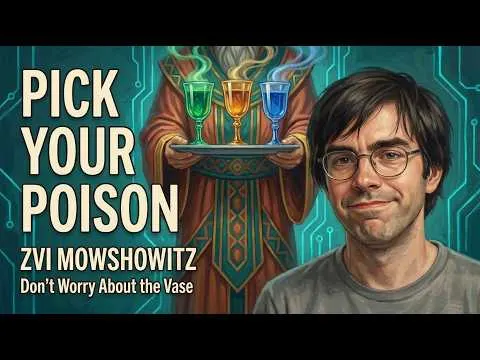
Pick Your Poison — Zvi Mowshowitz on AGI governance

His transcript turns around 42–57 minutes argue that technical alignment alone does not eliminate catastrophic risk from conflicting users and that capability incentives can outweigh reliability. Challenges Davidad’s optimism. Conditional numerical examples are not an unconditional project-compatible p(doom).

cognitiverevolution.ai
Zvi's Mic Works: alignment basins and p(doom)

In his own alignment-basins discussion, retains approximately 70% p(doom), deliberately only one significant digit. Sees more promise in Anthropic’s recursively improving virtue-oriented alignment approach, but says humanity is not favoured to succeed; faster progress and political failures offset technical good news.

cognitiverevolution.ai
Wo stehst du?
Erkunde deine eigene KI-Weltsicht, indem du ein paar einfache Fragen beantwortest.
Deine eigene Weltsicht abbilden