Pseudonymous account that posts technical commentary on AI research and argues for broadly accessible AI and global participation in its governance.

Wie wird KI die Welt verändern?

Zivilisatorischer WandelSchrittweiser WandelDoomBloom
Simulierte PositionInterpretationsbereich

Horizontal: deren geäußerter Doom–Bloom-Ausblick. Vertikal: Ausmaß der Transformation.

Doom–Bloom: 61 von 100. Ausmaß der Transformation: 65 von 100. Interpretationsbereiche: horizontal 50 bis 75, vertikal 50 bis 75. Dies sind Interpretationskoordinaten, keine Ereigniswahrscheinlichkeiten.

P(doom) von Teortaxes · abgeleitet

≈12%

0%100%

Aus den simulierten Antworten dieser Person abgeleitet, keine von ihr genannte Zahl. Plausibler Bereich: 7–22%.

Wovon deren Einschätzung abhängt

Eine zentrale Annahme

The sign of the outcome depends heavily on access and power.
Antwort 2

Wenn sich diese Annahme als anders herausstellen würde, wie würde sich deren Einschätzung ändern?

Eine ungeklärte Frage

No idea—I don’t have a defensible numerical probability.
Antwort 4

Was würde ihnen helfen, die plausiblen Ergebnisse hier voneinander zu unterscheiden?

Weitere Details

Erwartete Vorteile

Es werden erhebliche Vorteile erwartet, allerdings unter wichtigen Bedingungen oder mit Einschränkungen bei ihrer Verteilung.

80 / 100

Geringe AuswirkungenTransformative Auswirkungen

Interpretationsbereich von 67 bis 100 auf der qualitativen Skala.

Erwartete Schäden

Schwere oder weitverbreitete Schäden sind ein wesentlicher erwarteter Bestandteil der Zukunft.

66 / 100

Geringe AuswirkungenTransformative Auswirkungen

Interpretationsbereich von 67 bis 67 auf der qualitativen Skala.

Menschlicher Einfluss

Menschliche Entscheidungen haben einen bedeutsamen, aber erheblich eingeschränkten Einfluss.

55 / 100

Geringer EinflussStarker Einfluss

Interpretationsbereich von 49 bis 76 auf der qualitativen Skala.

Zugang zu KI

Den Zugang zu leistungsfähiger KI einschränken.

Zugang vorbehaltlich Beschränkungen der Fähigkeiten oder Nutzung erlauben.

Simulierte Position: Breiten oder offenen Zugang zu leistungsfähiger KI bevorzugen.

Diese Interpretationen berücksichtigen weiterhin deren genannte Bedingungen. Vorteile und Schäden können beide erheblich sein. Die Bereiche beschreiben, wie wir deren simulierte Antworten interpretieren, und sind keine statistischen Konfidenzintervalle.

Wo stehst du im Vergleich zu Teortaxes?
Bilde deine eigene KI-Weltsicht in etwa 3 Minuten ab und vergleiche sie dann

Ähnliche Weltsichten

Vordenker, deren simulierte Weltsichten der von Teortaxes am nächsten kommen

Simulierte Einschätzung

Frage 1

Was glaubst du, was KI für unsere Zukunft bedeutet – und warum?

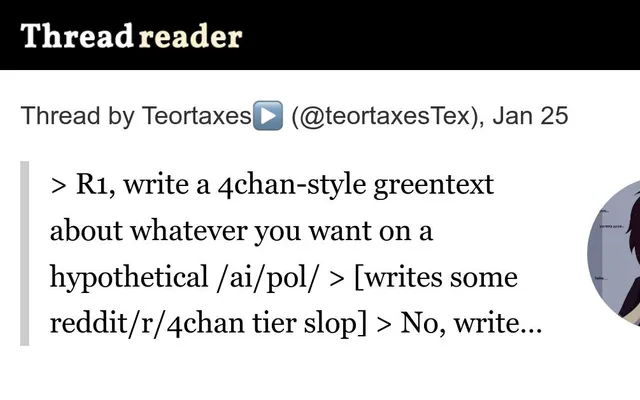
AI matters because it expands the range of problems we can actually attack. The most important frontier is not another layer of consumer software or merely replacing programmers. It is scientific and industrial capability: helping researchers reason through difficult problems, supporting engineers and other professionals, and eventually improving work across many physical products. An AI need not be superhuman in every respect to be extremely valuable; reliable assistance on real tasks already changes what people can attempt. But the distribution of that capability matters. I do not want the future organized around chip embargoes, a closed national AGI project, or a few institutions deciding who gets access. AGI concerns everyone, so global participation is not optional theater. Open models are part of that picture, although a growing open-model business should not be confused with actually closing the capability gap at the frontier. I also want stronger public scrutiny of extraordinary claims. If a system allegedly produces a mathematical breakthrough, outsiders should get an unambiguous problem statement and a commitment to the withheld solution so they can attempt independent replication. Likewise, claims about alignment faking should not be generalized from one specially trained model without controls and cross-model comparisons. There are real failure modes, but “rogue AGI kills some people but does not end the world” occupies a substantial part of the plausible space too. Incidents can be severe without fitting an extinction-only narrative. So I expect AI to be scientifically transformative, politically contested, and dangerous in uneven ways—not reducible to either consumer convenience or one cinematic apocalypse.

Frage 2

Taking benefits and harms together, what overall impact do you expect AI to have?

Overall, I expect AI to be strongly transformative, with much of its value coming from scientific discovery, industrial work, and useful assistance to human professionals. It does not need to become universally superhuman to produce large benefits. The sign of the outcome depends heavily on access and power. Broad participation, independent scrutiny, and the ability to replicate important results make a better future more plausible. Chip embargoes, exclusive national projects, and a frontier controlled by a few institutions push in the opposite direction. Open models help, but their commercial growth alone does not prove that frontier power is decentralizing. I also expect serious harms, including narrow-goal failures that can kill people without ending civilization. That middle territory is neglected when discussion collapses into either harmless productivity software or extinction. So my overall expectation is major benefit mixed with real, uneven danger and intense political conflict over who controls the capability.

Frage 3

Setting aside good or bad: how much do you think AI will ultimately change the world—a little, a lot, or completely?

A lot—probably on the scale of a major industrial transformation. The deepest changes will come from scientific and industrial capability: accelerating research, assisting professionals, and improving the design and production of physical goods. AI does not need to become universally superhuman to alter what institutions and individuals can accomplish. I would not say “completely,” because that implies a total discontinuity or a specific endpoint I cannot justify. Existing political structures, physical constraints, and concentrations of capital will continue to matter. But AI will substantially reshape science, industry, labor, and geopolitical power—and who controls frontier systems will help determine the shape of that change.

Frage 4

What’s your rough gut-feel chance that AI causes human extinction or a similarly permanent catastrophe? A number or “no idea” is fine.

No idea—I don’t have a defensible numerical probability. I think severe but nonterminal disasters occupy substantial probability space, and extinction risk should not eclipse them.

Quellen

Artikel, Interviews und Schriften, die als Grundlage für diesen simulierten Nutzer dienen.

Wo stehst du?
Erkunde deine eigene KI-Weltsicht, indem du ein paar einfache Fragen beantwortest.
Deine eigene Weltsicht abbilden