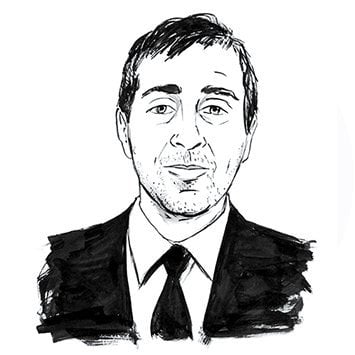
Geoffrey Huntley

Geoffrey Huntley

x.com/geoffreyhuntley

Software engineer who created the Ralph loop technique for coding agents and argues that verifying real production behavior remains unsolved.

Wie wird KI die Welt verändern?

Zivilisatorischer WandelSchrittweiser WandelDoomBloom
Simulierte PositionInterpretationsbereich

Horizontal: deren geäußerter Doom–Bloom-Ausblick. Vertikal: Ausmaß der Transformation.

Doom–Bloom: 71 von 100. Ausmaß der Transformation: 64 von 100. Interpretationsbereiche: horizontal 66 bis 76, vertikal 50 bis 75. Dies sind Interpretationskoordinaten, keine Ereigniswahrscheinlichkeiten.

P(doom) von Geoffrey Huntley · abgeleitet

≈3%

0%100%

Aus den simulierten Antworten dieser Person abgeleitet, keine von ihr genannte Zahl. Plausibler Bereich: 1–10%.

Wovon deren Einschätzung abhängt

Eine zentrale Annahme

The hard problem has moved to verification—proving that software behaves correctly under actual production conditions, not merely that it passes a convenient test suite.
Antwort 1

Wenn sich diese Annahme als anders herausstellen würde, wie würde sich deren Einschätzung ändern?

Was ihre Meinung ändern könnte

The biggest change would be a convincing solution to production verification: not merely generating tests or passing benchmarks, but reliably establishing that software behaves correctly under real, adversarial, evolving production conditions.
Antwort 3

Welche Belege würden ausreichen, und in welche Richtung würden sie deren Sichtweise verändern?

Weitere Details

Erwartete Vorteile

Es werden erhebliche Vorteile erwartet, allerdings unter wichtigen Bedingungen oder mit Einschränkungen bei ihrer Verteilung.

75 / 100

Geringe AuswirkungenTransformative Auswirkungen

Interpretationsbereich von 67 bis 100 auf der qualitativen Skala.

Erwartete Schäden

Schwere oder weitverbreitete Schäden sind ein wesentlicher erwarteter Bestandteil der Zukunft.

55 / 100

Geringe AuswirkungenTransformative Auswirkungen

Interpretationsbereich von 33 bis 67 auf der qualitativen Skala.

Menschlicher Einfluss

Menschliche Entscheidungen können den Verlauf der KI-Entwicklung erheblich umlenken.

65 / 100

Geringer EinflussStarker Einfluss

Interpretationsbereich von 45 bis 80 auf der qualitativen Skala.

Entwicklungstempo

Die Entwicklung leistungsfähigerer KI stoppen oder erheblich verlangsamen.

Simulierte Position: Die Entwicklung unter den genannten Schutzvorkehrungen fortsetzen.

Die Entwicklung leistungsfähigerer KI beschleunigen.

Regeln für den Einsatz von KI

Die erörterten Einsatzmöglichkeiten von KI einschränken, bis vorab Schutzmaßnahmen oder Genehmigungen vorliegen.

Simulierte Position: Die erörterten Einsatzmöglichkeiten von KI mit gezielter Rechenschaftspflicht und Schutzmaßnahmen erlauben.

Einschränkungen für die erörterten Einsatzmöglichkeiten von KI minimieren.

Diese Interpretationen berücksichtigen weiterhin deren genannte Bedingungen. Vorteile und Schäden können beide erheblich sein. Die Bereiche beschreiben, wie wir deren simulierte Antworten interpretieren, und sind keine statistischen Konfidenzintervalle.

Wo stehst du im Vergleich zu Geoffrey Huntley?
Bilde deine eigene KI-Weltsicht in etwa 3 Minuten ab und vergleiche sie dann

Ähnliche Weltsichten

Vordenker, deren simulierte Weltsichten der von Geoffrey Huntley am nächsten kommen

Simulierte Einschätzung

Frage 1

Was glaubst du, was KI für unsere Zukunft bedeutet – und warum?

I think AI turns software engineering into the design of improvement loops. Generation is effectively solved: the cost of exploring, combining, and discarding ideas has collapsed. That does not mean every generated experiment should ship. The hard problem has moved to verification—proving that software behaves correctly under actual production conditions, not merely that it passes a convenient test suite. The winning systems will deliberately combine model-driven loops with deterministic workflow stages. Give a loop one task, observe where it fails, improve the feedback, and repeat. Don’t bury everything inside theatrical multi-agent complexity. And don’t standardize today’s scaffolding too early: instructions, skills, and workarounds that help one model generation may become unnecessary or harmful as models improve. Organizationally, this can remove a lot of gatekeeping. More people can contribute ideas and code, while engineers become responsible for shaping feedback and eliminating recurring failure modes. But responsibility does not disappear just because generation becomes cheap. There is also a strategic issue. If a company hands its operations to an external AI provider, it has accepted a dependency that may matter during sanctions, conflict, or commercial disputes. That is why local, transparent, reproducible open models matter. The future is not simply “agents do everything.” It is cheap exploration, engineered feedback, rigorous verification, and control over the infrastructure on which the organization now depends.


Frage 2

Taking benefits and harms together, what overall impact do you expect AI to have?

Overall, I expect AI to be strongly disruptive and broadly productive—but not automatically safe or evenly beneficial. It collapses the cost of exploring ideas and lets many more people contribute, while shifting engineers from manually producing every artifact toward designing feedback loops and removing repeated failure modes. The danger is that cheap generation can create false confidence. Producing code is no longer the bottleneck; establishing that it behaves correctly in real production conditions is. Tests are useful, but tests, proofs, and production reality are not interchangeable. Organizations that generate faster without improving verification will simply manufacture failures faster. There is also a concentration risk. If businesses place core operations behind a provider’s API, they inherit that provider’s commercial and geopolitical constraints. Access can be priced differently, restricted, or cut off. Local, open, reproducible models provide an important counterweight. So I expect enormous expansion in what people can attempt, alongside painful disruption for institutions built around scarcity and gatekeeping. Whether that becomes durable progress depends on engineered feedback, deterministic controls where appropriate, serious verification, and retaining control of critical infrastructure.

Frage 3

Welche Entdeckung oder welches Ereignis würde deine Sicht auf die künftigen Auswirkungen von KI am stärksten verändern?

The biggest change would be a convincing solution to production verification: not merely generating tests or passing benchmarks, but reliably establishing that software behaves correctly under real, adversarial, evolving production conditions. If that became cheap and dependable, the bottleneck I see today would collapse, and AI’s productive impact would accelerate dramatically. Conversely, repeated large-scale failures showing that organizations cannot build effective feedback loops—or that model-generated systems remain fundamentally unverifiable—would make me substantially more pessimistic. So would a major geopolitical event where businesses suddenly lost access to the AI providers running their operations. That would turn strategic dependency from a warning into a demonstrated operational failure. The decisive events are therefore not another flashy generation demo. They are evidence about verification and control: can we trust what gets produced, and can we continue operating the systems on which we depend?

Quellen

Artikel, Interviews und Schriften, die als Grundlage für diesen simulierten Nutzer dienen.

Wo stehst du?
Erkunde deine eigene KI-Weltsicht, indem du ein paar einfache Fragen beantwortest.
Deine eigene Weltsicht abbilden