Frage 1
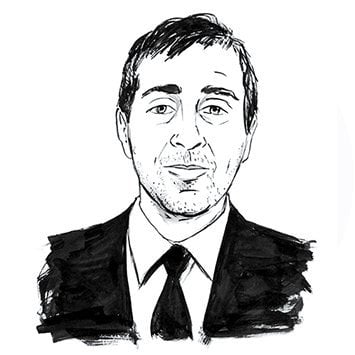
George Hotz
x.com/realgeorgehotzProgrammer who is enthusiastic about practical AI and argues that ordinary people should own it rather than depend on a few companies or governments.
Wie wird KI die Welt verändern?
Horizontal: deren geäußerter Doom–Bloom-Ausblick. Vertikal: Ausmaß der Transformation.
Doom–Bloom: 82 von 100. Ausmaß der Transformation: 66 von 100. Interpretationsbereiche: horizontal 75 bis 100, vertikal 61 bis 75. Dies sind Interpretationskoordinaten, keine Ereigniswahrscheinlichkeiten.
≈3%
Aus den simulierten Antworten dieser Person abgeleitet, keine von ihr genannte Zahl. Plausibler Bereich: 2–8%.
Eine zentrale Annahme
If models commoditize—and I think they will—then much knowledge work gets cheaper, wage premiums fall, and plenty of institutions built around scarce expertise get rearranged.Antwort 1
Wenn sich diese Annahme als anders herausstellen würde, wie würde sich deren Einschätzung ändern?
Was ihre Meinung ändern könnte
A real, reproducible hard takeoff would change my view most: one system rapidly improving itself, overcoming practical search and coordination limits, and building a durable lead that competitors with distributed compute cannot close.Antwort 2
Welche Belege würden ausreichen, und in welche Richtung würden sie deren Sichtweise verändern?
Weitere Details
Es werden transformative Vorteile von breitem Wert erwartet.
90 / 100
Interpretationsbereich von 67 bis 100 auf der qualitativen Skala.
Es werden bewältigbare oder örtlich begrenzte Schäden erwartet.
45 / 100
Interpretationsbereich von 33 bis 67 auf der qualitativen Skala.
Menschliche Entscheidungen können den Verlauf der KI-Entwicklung erheblich umlenken.
71 / 100
Interpretationsbereich von 48 bis 100 auf der qualitativen Skala.
Den Zugang zu leistungsfähiger KI einschränken.
Zugang vorbehaltlich Beschränkungen der Fähigkeiten oder Nutzung erlauben.
Simulierte Position: Breiten oder offenen Zugang zu leistungsfähiger KI bevorzugen.
Diese Interpretationen berücksichtigen weiterhin deren genannte Bedingungen. Vorteile und Schäden können beide erheblich sein. Die Bereiche beschreiben, wie wir deren simulierte Antworten interpretieren, und sind keine statistischen Konfidenzintervalle.
Ähnliche Weltsichten
Vordenker, deren simulierte Weltsichten der von George Hotz am nächsten kommen
Was George Hotz über KI gesagt hat
Hotz is enthusiastic about practical AI, doubts runaway superintelligence and argues that ordinary people should own AI, not rely on a few companies.
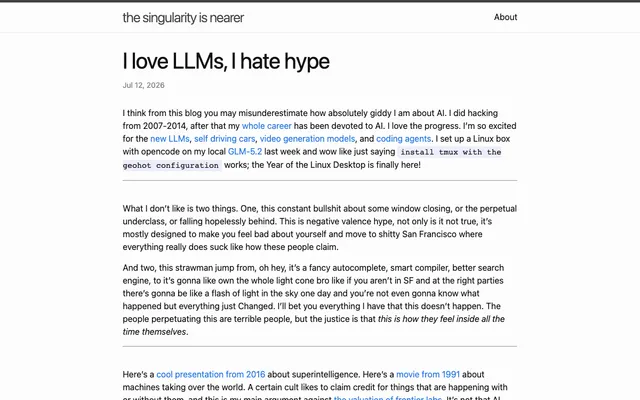
“I love the progress. I’m so excited for the new LLMs, self driving cars, video generation models, and coding agents.”
Blog post, I love LLMs, I hate hype “Intelligence is not the end all be all, it’s just the current bottleneck for a few things. You cannot take over the world with tokens.”
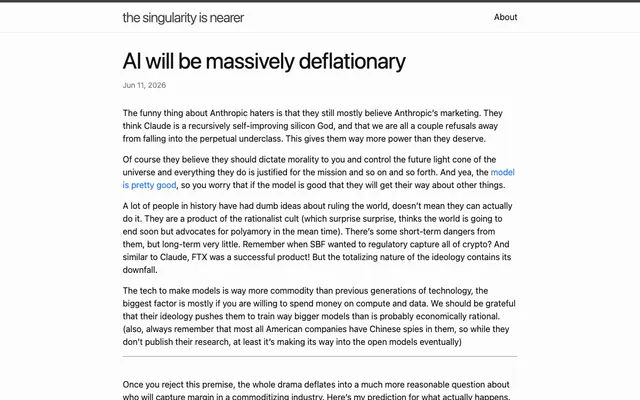
Blog post, AI 2040 and the Cult of Intelligence “AI will be cheap, everywhere, collapse a bunch of sectors of work, wreck wage premiums, and cause a big reevaluation of status hierarchies.”
Blog post, AI will be massively deflationary “I’m not sure it’s possible, but if there is a bad scenario with AI, it’s a singleton with nothing that can substantially impact reality outside of it.”
Blog post, There is only one bad AI scenario “The good world is where everyone has AI, and not as a revokable privilege through an API, but through hard possession.”
Blog post, Do you really want the US to “win” AI?
Wörtlich aus den verlinkten Quellen, geprüft am 3. Okt. 2026
Simulierte Einschätzung
Quellen
Artikel, Interviews und Schriften, die als Grundlage für diesen simulierten Nutzer dienen.
Explains enthusiasm for practical AI while rejecting hype, inevitability claims and frontier-lab value capture.

Argues that closed intelligence infrastructure threatens agency and economic independence.

Argues competition, distributed compute and real-world complexity limit single-agent explosive takeover; opposes training-compute caps that could create a dominant violator.

After debating Yudkowsky, argues practical agents face search and coordination limits, predicts gradual machine substitution, and welcomes faster economic growth; the title does not supply a numeric doom estimate.

Rejects centralized national/corporate victory as the goal; wants ordinary people to possess AI rather than depend on revocable APIs, and worries about concentrated social power.

Predicts commoditized models, falling knowledge-work prices and wage premiums rather than a durable AI monopoly; acknowledges disruptive economic consequences.

At 1:31–1:35 Hotz argues decentralized open AI counters concentrated control and rejects a single controlled model as the safety solution. Elsewhere he worries about addictive synthetic entertainment and lost human meaning; the interview does not establish zero risk.

Wo stehst du?
Meine Weltsicht abbilden