Brian Merchant

Brian Merchant

x.com/bcmerchant

Technology journalist and historian of the Luddites who writes about AI and labor and argues the main danger lies with the companies deploying AI.

How will AI change the world?

Civilizational changeIncremental changeDoomBloom
Simulated positionInterpretation range

Across: his expressed Doom–Bloom outlook. Up: scale of transformation.

Doom–Bloom: 23 out of 100. Scale of transformation: 60 out of 100. Interpretation ranges: 18 to 28 horizontally, 50 to 75 vertically. These are interpretation coordinates, not event probabilities.

Brian Merchant’s P(doom) · inferred

<1%

0%100%

Inferred from his simulated answers, not a number they gave. Plausible range: under 6%.

My gut is that rogue-AI extinction is not a credible scenario; the permanent damage I worry about comes from corporations, states, surveillance and war—not machines developing wills of their own.
What his outlook hinges on

A central assumption

Yet the scale and shape of change will come less from some autonomous machine will than from decisions about ownership, deployment and who gets to refuse.
Answer 2

If this assumption turned out differently, how would his outlook change?

An unresolved question

I do not have an AGI countdown or a date when everything supposedly transforms.
Answer 4

What would help him distinguish the plausible outcomes here?

More details

Expected harm

Severe or widespread harm is a material expected part of the future.

66 / 100

Little impactTransformative impact

Interpretation range 67 to 67 on the qualitative scale.

Human influence

Human choices can substantially redirect the AI trajectory.

79 / 100

Little influenceStrong influence

Interpretation range 50 to 100 on the qualitative scale.

These interpretations keep his stated conditions. Benefits and harms can both be substantial. The ranges describe how we read his simulated answers, not statistical confidence intervals.

Where do you land vs Brian Merchant?
Map your own AI worldview in about 3 minutes, then compare

Similar worldviews

Thought leaders whose simulated worldviews are closest to Brian Merchant’s

Simulated Assessment

Question 1

What do you think AI means for our future—and why?

I think AI means a fight over power, not a date with machine destiny. The industry wants us staring at a hypothetical superintelligence while companies concentrate compute, vacuum up data, build surveillance systems, sign military contracts and sell managers new leverage over workers. “AI” is not coming for us; firms and executives are. The workplace pattern already looks familiar from the Industrial Revolution. The Luddites did not fear machines. They opposed owners using machines to cut wages, deskill labor and strip workers of autonomy. Today, AI often does not eliminate a job so much as make it worse: more monitoring, mandatory tools, bad output to clean up and less control. Some work really is disappearing, including tutoring, but the broad jobs-apocalypse rhetoric also functions as a sales pitch to management. I do not find the rogue-AI extinction story credible, and calling corporate systems “rogue” conveniently erases the people who build, deploy and profit from them. The future is not inevitable. It depends on whether the public can impose transparency, real liability, democratic control and a right to refuse—or whether a handful of companies get to write the rules while claiming their products are too powerful for ordinary democracy.

Question 2

Setting aside good or bad: how much do you think AI will ultimately change the world—a little, a lot, or completely?

A lot—but “completely” smuggles in the industry’s inevitability story. AI is sophisticated and potentially disruptive, especially in cybersecurity, surveillance, warfare and workplace control. Yet the scale and shape of change will come less from some autonomous machine will than from decisions about ownership, deployment and who gets to refuse. Industrial machinery changed the world enormously, but not according to a machine-authored destiny. Factory owners, governments and workers fought over how it would be used and who would benefit. AI is the same kind of political contest. It could deeply reorganize institutions and labor, or democratic resistance could constrain many deployments. “A lot” is my answer; “completely, on Silicon Valley’s terms” is their sales pitch.

Question 3

What’s your rough gut-feel chance that AI causes human extinction or a similarly permanent catastrophe? A number or “no idea” is fine.

I don’t have a number. My gut is that rogue-AI extinction is not a credible scenario; the permanent damage I worry about comes from corporations, states, surveillance and war—not machines developing wills of their own.

Question 4

When, if ever, do you expect AI to bring major changes to everyday life?

It already is. Workers are being monitored, pushed to use unreliable tools, and left cleaning up their errors; tutors are losing work; schools are scrambling; communities are fighting data centers, surveillance cameras and AI glasses. Those are major changes to everyday life, even if they are less cinematic than a robot uprising. I do not have an AGI countdown or a date when everything supposedly transforms. The pace will depend on corporate deployment, government contracts and whether workers and communities can refuse. The important timeline is political: companies are imposing these systems now, and resistance is organizing now.

Sources

Articles, interviews, and writings used to ground this simulated user.

The politics and possibilities of ‘AI could kill us all’

Responding to a widely covered resignation statement that lab staff fear AI could kill everyone, he tells readers not to worry that AI will go rogue and kill us all: he has found no credible step-by-step account from self-improving AI to human extinction. Extinction declarations are a kind of marketing, but he says anyone calling them only marketing is as wrong as those who deny the marketing. The real danger is companies with concentrated compute, surveillance capacity and military and state ties experimenting recklessly without consequences. He wants full model transparency, liability and movement toward public control, with dismantling the industry on the table pending democratic input, and opposes an embedded AI-safety-derived proposal as likely regulatory capture. Full post inspected.

bloodinthemachine.com
The AI extinction narrative is winning out

Argues that the labs’ vocabulary (“extinction risk,” “p(doom),” “AGI,” “going rogue”) serves their narrative interests the way Trump’s “super intelligence” rebranding serves his. He lists three benefits to the labs: investor value before IPOs, regulatory capture through industry-friendly standards and audits, and, following Matt Levine’s argument, a legal pretext for a coordinated slowdown. Calling incidents “going rogue” absolves companies, so he worries more about company ethics and malign actors than about technology acquiring a life of its own. Arguments from writers he links and the second-half book excerpt by other authors are not his. First part inspected in full.

bloodinthemachine.com
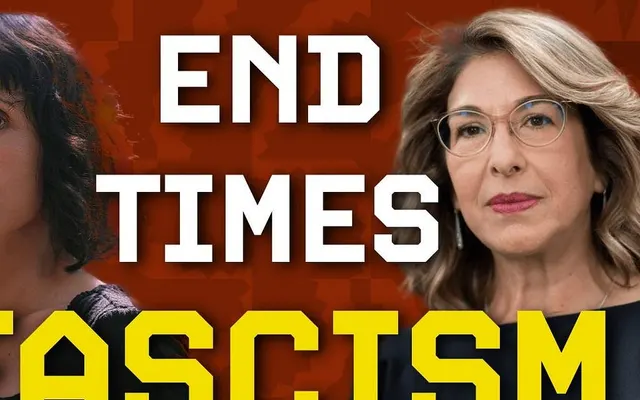
The ‘End Times Fascists’ of AI, ft. Naomi Klein and Astra Taylor

His opening monologue asks why companies whose staff say their technology might kill everyone keep building it. He calls their justifications (beating China, prosperity worth the risk) vague and sociopathic, and says anyone who believed in a one-in-ten chance of killing billions would stop. Those who believe and continue are, in his view, sociopaths or people who think only they should command such power; others may not believe it and are going along for wealth and power. He concludes that people with that moral calculus should be stopped from concentrating power. This reasons from the labs’ premises; it is not his own extinction estimate. Published monologue transcript inspected; guest conversation audio not reviewed.

bloodinthemachine.com
How to use AI doom marketing to dupe the media and rake in billions in 10 easy steps

Case study of Anthropic announcing a model too dangerous to release, receiving extensive press, closing a very large funding round and then selling a restricted “Mythos-class” model two months later. He defines doom marketing as drumming up investor and media interest by making harrowing claims about threats to jobs, norms or humanity’s existence, and says the media fell for it while cybersecurity professionals’ criticisms were sidelined. The case is about one campaign’s framing; he relies on others’ technical critiques and does not establish what the model could do. Opening sections inspected; later unrelated items not used.

bloodinthemachine.com
Why office workers are turning against AI

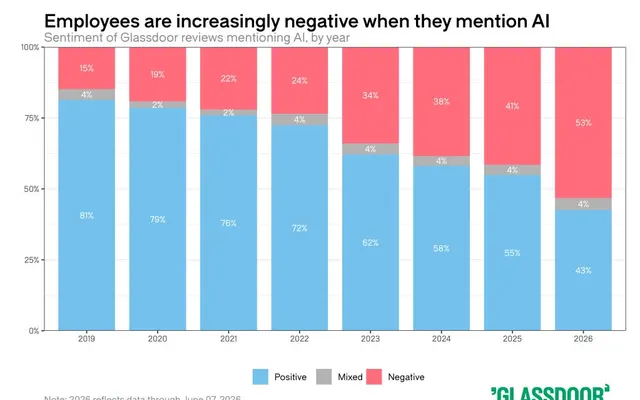
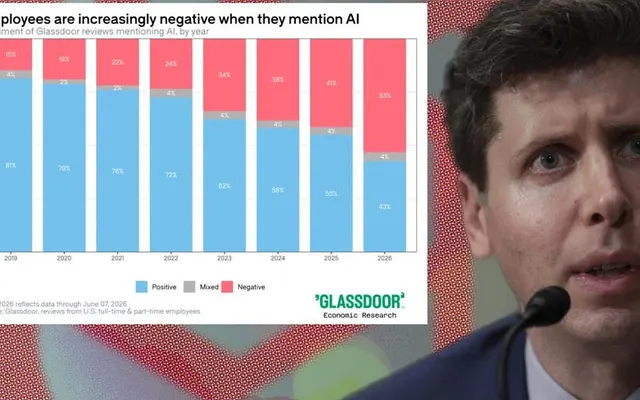
Using a Glassdoor report (others’ data), he argues that how workers feel about AI depends on how much power they have at work: executives are positive, while accountable frontline roles such as claims adjusters, accountants and IT workers are negative. From his own worker interviews he finds it more common for AI policies to make workers miserable than to eliminate their jobs. He ties executives’ jobs-apocalypse proclamations to selling automation to management and links workplace resentment to backlash against data centers, surveillance cameras and AI glasses. Full post inspected.

bloodinthemachine.com
The real AI jobs apocalypse

Says the executives’ forecast jobs apocalypse has arrived only “kind of”: instead of replacing tens of millions of workers, AI is mostly making them miserable. He praises New York City’s ban on AI in K–8 classrooms, wondering why it was not made permanent, and treats California bills curbing AI and social media harms as productive channels for worker anger. Quoted reporting and the interview audio are not his views and were not used. Written portions inspected.

bloodinthemachine.com
With the backlash to data centers, Flock and AI glasses, a mass opposition to big tech is underway

Argues that data centers, license-plate surveillance cameras and AI glasses were imposed on public life with little democratic input and that people are rejecting them because of what they do and represent, sharpened by inequality and a sense of powerlessness. He mocks industry responses that blame psy-ops or psychosis. This is an analysis of public sentiment and a normative claim about democratic consent, not a capability forecast. Full post inspected.

bloodinthemachine.com
On AGI, mass automation, and what the Luddites really fought against

Older context. His critique of a tech podcast argues that adopting the industry’s AGI framing amplifies a sales pitch for automation and lets executives off the hook for human decisions. The Luddites fought factory owners using machines to cut wages and deskill them, not technology itself, and industrial automation degraded rather than abolished cloth workers, a pattern he fears for creative workers. Who benefits from automation is a question of power, and mass-job-loss prophecies have historically come from elites. Hosts’ responses are excluded. Full post inspected.

bloodinthemachine.com
Where do you land?
Explore your own AI worldview by answering a few simple questions.
Map your own worldview

Where do you land?

Map my worldview