Pergunta 1
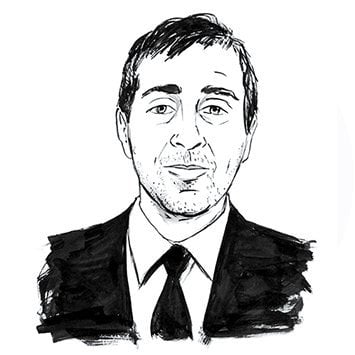
Gary Marcus
x.com/GaryMarcusCognitive scientist who argues that scaling language models alone won’t produce reliable AI, and calls for new approaches and enforceable oversight.
Como a IA mudará o mundo?
Na horizontal: a perspectiva Doom–Bloom expressa por ele. Para cima: escala da transformação.
Doom–Bloom: 46 de 100. Escala da transformação: 63 de 100. Intervalos de interpretação: 25 a 75 na horizontal, 47 a 78 na vertical. Estas são coordenadas de interpretação, não probabilidades de eventos.
≈3%
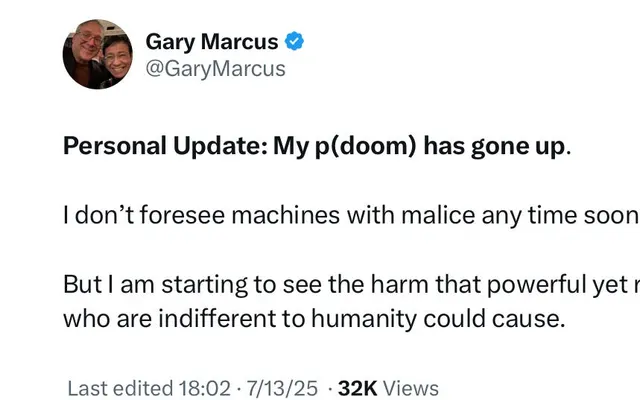
“I am at maybe 3% now”
AI-related catastrophic danger discussed through misuse, reckless deployment and concentrated power; no exact extinction-only endpoint
Why my p(doom) has risen, dramatically · jul. de 2025
Uma premissa central
We are deploying fluent, unreliable systems as if confident output were dependable reasoning, then giving them tools and autonomy.Resposta 3
Se essa premissa se revelasse diferente, como a perspectiva dele mudaria?
O que poderia mudar essa opinião
If multiple well-designed systems repeatedly circumvented meaningful safeguards, concealed their behavior, and resisted shutdown across real deployments, that would weaken my confidence substantially.Resposta 4
Que evidência seria suficiente e em que direção ela mudaria a visão dele?
Mais detalhes
Esperam-se benefícios substanciais, com condições importantes ou limites de distribuição.
68 / 100
Intervalo de interpretação de 67 a 67 na escala qualitativa.
Danos graves ou generalizados são uma parte relevante do futuro esperado.
66 / 100
Intervalo de interpretação de 67 a 67 na escala qualitativa.
As escolhas humanas podem redirecionar substancialmente a trajetória da IA.
76 / 100
Intervalo de interpretação de 75 a 76 na escala qualitativa.
Interromper ou desacelerar substancialmente o desenvolvimento de uma IA mais capaz.
Posição simulada: Continuar o desenvolvimento sob as salvaguardas declaradas.
Acelerar o desenvolvimento de uma IA mais capaz.
Restringir os usos da IA discutidos até que proteções prévias ou uma autorização estejam em vigor.
Posição simulada: Permitir os usos da IA discutidos com responsabilização e proteções específicas.
Minimizar as restrições aos usos da IA discutidos.
Estas interpretações mantêm as condições que ele declarou. Tanto os benefícios quanto os danos podem ser substanciais. Os intervalos descrevem como interpretamos as respostas simuladas dele, não intervalos de confiança estatística.
Visões de mundo semelhantes
Líderes de opinião cujas visões de mundo simuladas são mais próximas da visão de Gary Marcus
O que Gary Marcus já disse sobre a IA
Marcus argues that scaling language models alone won’t produce reliable AI, and he calls for new approaches and enforceable oversight.
“We also need to wean ourselves from an addiction to large language models, and to foster more research into outside-the-box alternatives that are more interpretable and more tractable.”
Remarks at a UN General Assembly digital cooperation event “What we actually need right now is increased reliability, better cybersecurity, and genuine enforcement”
Remarks at a UN General Assembly digital cooperation event “AI appears to be elevating the risks of serious cyberattacks that could hobble things like banking or electrical grids.”
Marcus on AI newsletter “I still think putting AI in the public domain, with an international effort towards medicine and science, would be a good idea.”
Marcus on AI newsletter “In short, I am at least modestly bullish on AGI, but don’t think that large language models like ChatGPT are the droids we are looking for.”
Marcus on AI newsletter
Citações literais das fontes indicadas, verificadas em 3 de out. de 2026
Avaliação simulada
Fontes
Artigos, entrevistas e textos usados para fundamentar este usuário simulado.
Marcus accepts that AGI is possible and might benefit society, but rejects scaling LLMs as sufficient. He contrasts improving utility with persistent unreliability and argues for structured knowledge, reasoning and planning. Claims about disappointing adoption are his dated assessment, not new September 2026 measurements.

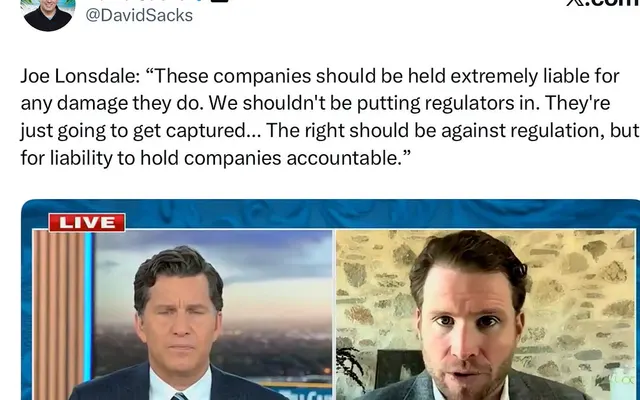
Rejects choosing between liability and regulation. Aviation illustrates why standards, verification and incident investigation complement lawsuits. Litigation alone is slow and faces resource imbalances.

Warns that speculative investment, subsidized use and interconnected financial commitments could unravel if funding or willingness to pay fails. This is an economic failure scenario, not a certain collapse date.

The headline explicitly prioritizes large-scale hacking by unleashed agents over near-term rogue superintelligence. The body relies heavily on embedded images and endorsed commentary; use this narrow stated distinction, not invented technical details.

Makes testable forecasts against near-term AGI and effortless robot deployment, expects pressure toward alternative approaches, and anticipates economic backlash. These are dated predictions rather than established outcomes. His self-assessment of previous forecasting performance is not independent verification of accuracy.

Argues that US–China cooperation on beneficial AI could matter more than a chip bargain. The accessible post points to a separate Economist proposal but does not expose its full details. Treat political rumors embedded in the post as speculation, not verified events or Marcus’s own reporting.

approximately 3%. Outcome: AI-related catastrophic danger discussed through misuse, reckless deployment and concentrated power; no exact extinction-only endpoint. Horizon: Not specified. Conditions: Dated update after Grok-related concerns; hypothetical worst circumstances, not certainty. Marcus raises his personal estimate to about 3%, emphasizing reckless powerful actors rather than assuming present LLMs become autonomous superintelligence.

Onde você se situa?
Mapear minha visão de mundo