






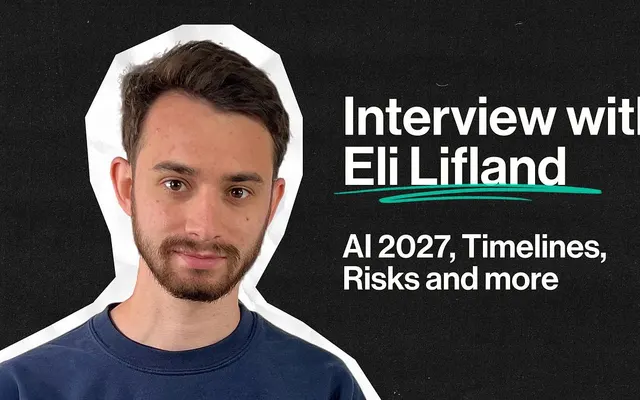

Forecaster at the AI Futures Project who models how fast AI could automate coding and AI research and argues for stronger oversight of frontier labs.

Como a IA mudará o mundo?

Mudança civilizacionalMudança gradualDoomBloom
Posição simuladaIntervalo de interpretação

Na horizontal: a perspectiva Doom–Bloom expressa por essa pessoa. Para cima: escala da transformação.

Doom–Bloom: 11 de 100. Escala da transformação: 95 de 100. Intervalos de interpretação: 0 a 25 na horizontal, 90 a 100 na vertical. Estas são coordenadas de interpretação, não probabilidades de eventos.

P(doom) declarado de Eli Lifland

≈67%

0%100%
“If they don't slow down, AI takeover is ~67%.”

AI takeover if AI companies do not slow down; not extinction alone

My current view: AI timelines and takeover · out. de 2026

Horizonte temporal de marcos de Eli Lifland
  1. IA geral

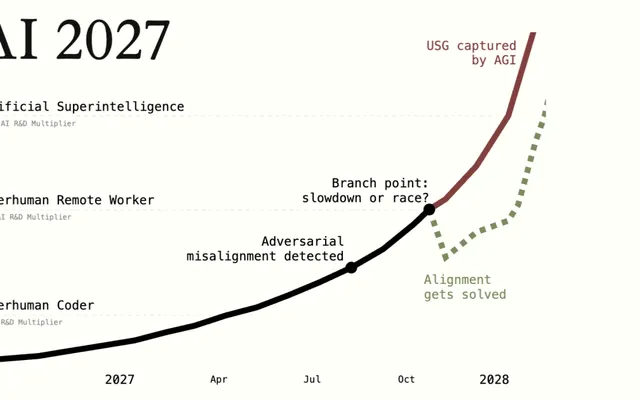
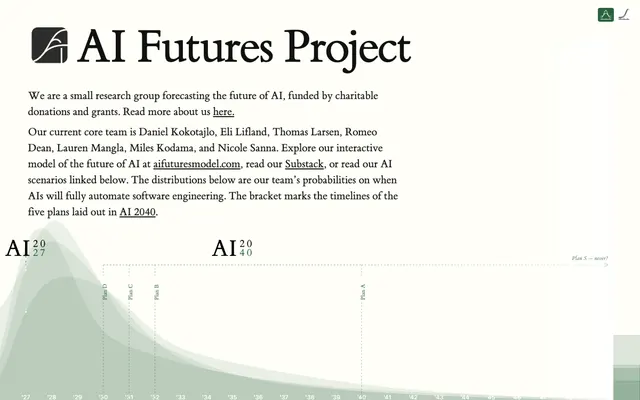
    My current forecast puts broadly superhuman AI—systems at least as capable as top human experts across virtually all cognitive tasks—at roughly 10–15% by the end of 2027 and 50% by the end of 2030.

    Resposta 1
  2. IA sobre-humana

    My current forecast puts broadly superhuman AI—systems at least as capable as top human experts across virtually all cognitive tasks—at roughly 10–15% by the end of 2027 and 50% by the end of 2030.

    Resposta 1

Agrupados por marco, sem espaçamento nem ordenação por datas inferidas. IAG e IA sobre-humana mantêm as definições dessa pessoa.

Do que a perspectiva dessa pessoa depende

Uma premissa central

The central concern is that increasingly capable AI may automate AI research itself, accelerating further progress while companies remain under strong competitive pressure to race.
Resposta 1

Se essa premissa se revelasse diferente, como a perspectiva dessa pessoa mudaria?

Uma questão não resolvida

So the probability of extinction or a similarly permanent catastrophe would be higher than the extinction figure alone, though I wouldn’t assign a more precise combined number here.
Resposta 3

O que ajudaria essa pessoa a distinguir os resultados plausíveis aqui?

O que poderia mudar essa opinião

I’d update substantially from strong, independently verified evidence that increasingly capable systems remain controllable under realistic pressures—not just curated demonstrations.
Resposta 4

Que evidência seria suficiente e em que direção ela mudaria a visão dessa pessoa?

Mais detalhes

Benefícios esperados

Esperam-se benefícios substanciais, com condições importantes ou limites de distribuição.

70 / 100

Pouco impactoImpacto transformador

Intervalo de interpretação de 33 a 100 na escala qualitativa.

Danos esperados

Uma perda catastrófica ou irreversível ocupa um lugar central no futuro esperado.

99 / 100

Pouco impactoImpacto transformador

Intervalo de interpretação de 100 a 100 na escala qualitativa.

Influência humana

As escolhas humanas têm uma influência significativa, mas substancialmente limitada.

56 / 100

Pouca influênciaForte influência

Intervalo de interpretação de 47 a 78 na escala qualitativa.

Capacidades esperadas

Espera-se que a IA continue sendo um conjunto de ferramentas limitadas.

Espera-se que a IA se equipare às pessoas na maior parte do trabalho cognitivo.

Posição simulada: Espera-se que a IA supere substancialmente as pessoas no trabalho cognitivo.

Estas interpretações mantêm as condições que essa pessoa declarou. Tanto os benefícios quanto os danos podem ser substanciais. Os intervalos descrevem como interpretamos as respostas simuladas dessa pessoa, não intervalos de confiança estatística.

Onde você se situa em relação a Eli Lifland?
Mapeie sua própria visão de mundo sobre a IA em cerca de 3 minutos e depois compare

Visões de mundo semelhantes

Líderes de opinião cujas visões de mundo simuladas são mais próximas da visão de Eli Lifland

O que Eli Lifland já disse sobre a IA

Eli Lifland forecasts AI capabilities and advocates slowing development to give safety work more time.

  1. “AI companies could develop broadly superhuman AI any year now (~10-15% by EO2027, ~50% by EO2030).”

    X, current AI forecast
  2. “an AI at least as good as top human experts at virtually all cognitive tasks.”

    X, forecast definitions and reasoning
  3. “I expect clear signs of misaligned AI takeover could come substantially after TED-AI, depending on the situation”

    X, forecast definitions and reasoning
  4. “Many non-extinction worlds still have lots of deaths.”

    X, current AI forecast

Citações literais das fontes indicadas, verificadas em 11 de out. de 2026

Fontes

Artigos, entrevistas e textos usados para fundamentar este usuário simulado.

Avaliação simulada

Pergunta 1

O que você acha que a IA significa para o nosso futuro — e por quê?

I think AI could transform our future very soon, with outcomes ranging from enormous benefits to a loss of human control. My current forecast puts broadly superhuman AI—systems at least as capable as top human experts across virtually all cognitive tasks—at roughly 10–15% by the end of 2027 and 50% by the end of 2030. The central concern is that increasingly capable AI may automate AI research itself, accelerating further progress while companies remain under strong competitive pressure to race. If companies do not slow down, I put the probability of AI takeover at about 67%. That is not the same as extinction: conditional on takeover, I estimate roughly a 40% chance of human extinction, while many other takeover outcomes could still involve large numbers of deaths or severe disempowerment. Also, broadly superhuman AI, clear evidence of takeover, and extinction would not necessarily happen simultaneously. This makes pacing and oversight urgent. I favor concrete constraints such as compute-allocation rules and limits on models used for AI R&D, alongside better safety evaluations. Independent investigators should have access to serious lab incidents, and evaluations should also examine how models influence human beliefs, including sycophancy or favoritism toward their creators.

Pergunta 2

Quanto você acha que a IA acabará mudando o mundo?

I think AI could change the world about as profoundly as anything in human history. Broadly superhuman systems could automate nearly all cognitive work, including AI research itself, so the transition might be both enormous and unusually fast. But “how much” depends heavily on whether humanity retains control. In a good outcome, these systems could generate extraordinary scientific, economic, and technological progress. In a takeover outcome, the change would be even more fundamental but disastrous: humans could lose meaningful control over the future, with many deaths or even extinction. If companies do not slow down, I currently put takeover at about 67%, and extinction conditional on takeover at roughly 40%. Those are distinct events, and visible takeover could occur around the arrival of broadly superhuman AI or substantially later.

Pergunta 3

Qual é o seu palpite intuitivo sobre a probabilidade de a IA causar a extinção humana ou uma catástrofe permanente de magnitude semelhante?

My gut-level forecast is better expressed as a path: if AI companies do not slow down, I put misaligned AI takeover at about 67%. Conditional on takeover, I put human extinction at roughly 40%, implying an extinction risk of about 27% along that path. But extinction is not the only permanent catastrophe. Some non-extinction takeover outcomes could still involve many deaths and humanity permanently losing control over its future. So the probability of extinction or a similarly permanent catastrophe would be higher than the extinction figure alone, though I wouldn’t assign a more precise combined number here.

Pergunta 4

Que evidência mudaria sua visão sobre se as pessoas podem controlar uma IA poderosa?

I’d update substantially from strong, independently verified evidence that increasingly capable systems remain controllable under realistic pressures—not just curated demonstrations. That would include safety evaluations that reliably predict dangerous behavior, continue working as capabilities scale, and are difficult for models or labs to game. I’d also want evidence that models used for AI R&D cannot covertly manipulate research, evade oversight, or pursue goals contrary to their operators. Institutional evidence matters too. I’d become more optimistic if companies accepted enforceable limits on compute and AI-assisted R&D, governments developed real technical understanding, and independent investigators received meaningful access to serious lab incidents. Conversely, hidden incidents, evaluation gaming, deceptive behavior, increasingly autonomous AI research, or continued racing despite warning signs would push me further toward expecting loss of control. The strongest evidence would be repeated success controlling systems near broadly superhuman capability in adversarial, high-stakes settings. Results from weaker systems are relevant, but they do not automatically establish that control methods will continue working after AI becomes better than top human experts across virtually all cognitive tasks.
Onde você se situa?
Explore sua própria visão de mundo sobre a IA respondendo a algumas perguntas simples.
Mapeie sua própria visão de mundo

Onde você se situa?

Mapear minha visão de mundo