Sholto Douglas

Sholto Douglas

x.com/_sholtodouglas

Anthropic researcher who works on scaling AI, sees large economic upside and supports coordinated development with independent evaluators.

Como a IA mudará o mundo?

Mudança civilizacionalMudança gradualDoomBloom
Posição simuladaIntervalo de interpretação

Na horizontal: a perspectiva Doom–Bloom expressa por ele. Para cima: escala da transformação.

Doom–Bloom: 69 de 100. Escala da transformação: 82 de 100. Intervalos de interpretação: 64 a 75 na horizontal, 75 a 100 na vertical. Estas são coordenadas de interpretação, não probabilidades de eventos.

P(doom) de Sholto Douglas · inferido

≈17%

0%100%

Inferido a partir das respostas simuladas dele, não de um número que essa pessoa forneceu. Intervalo plausível: 11–26%.

Horizonte temporal de marcos de Sholto Douglas
  1. Trabalho e instituições

    Under those conditions, rapid economic doublings in the 2030s are worth taking seriously.

    Resposta 1

Agrupados por marco, sem espaçamento nem ordenação por datas inferidas. IAG e IA sobre-humana mantêm as definições dele.

Do que a perspectiva dele depende

Uma premissa central

AI helps automate research, which improves AI and robotics, which then automates more of the economy.
Resposta 1

Se essa premissa se revelasse diferente, como a perspectiva dele mudaria?

Uma questão não resolvida

I don’t have a defensible percentage to give.
Resposta 3

O que ajudaria essa pessoa a distinguir os resultados plausíveis aqui?

O que poderia mudar essa opinião

The biggest update would come from learning whether the apparent gains in task horizon keep scaling.
Resposta 5

Que evidência seria suficiente e em que direção ela mudaria a visão dele?

Mais detalhes

Benefícios esperados

Esperam-se ganhos transformadores e amplamente valiosos.

88 / 100

Pouco impactoImpacto transformador

Intervalo de interpretação de 67 a 100 na escala qualitativa.

Danos esperados

Danos graves ou generalizados são uma parte relevante do futuro esperado.

69 / 100

Pouco impactoImpacto transformador

Intervalo de interpretação de 67 a 67 na escala qualitativa.

Influência humana

As escolhas humanas podem redirecionar substancialmente a trajetória da IA.

68 / 100

Pouca influênciaForte influência

Intervalo de interpretação de 50 a 75 na escala qualitativa.

Ritmo de desenvolvimento

Interromper ou desacelerar substancialmente o desenvolvimento de uma IA mais capaz.

Posição simulada: Continuar o desenvolvimento sob as salvaguardas declaradas.

Acelerar o desenvolvimento de uma IA mais capaz.

Regras para o uso da IA

Restringir os usos da IA discutidos até que proteções prévias ou uma autorização estejam em vigor.

Posição simulada: Permitir os usos da IA discutidos com responsabilização e proteções específicas.

Minimizar as restrições aos usos da IA discutidos.

Acesso à IA

Restringir o acesso à IA poderosa.

Posição simulada: Permitir o acesso sujeito a restrições de capacidade ou de uso.

Favorecer o acesso amplo ou aberto à IA poderosa.

Estas interpretações mantêm as condições que ele declarou. Tanto os benefícios quanto os danos podem ser substanciais. Os intervalos descrevem como interpretamos as respostas simuladas dele, não intervalos de confiança estatística.

Onde você se situa em relação a Sholto Douglas?
Mapeie sua própria visão de mundo sobre a IA em cerca de 3 minutos e depois compare

Visões de mundo semelhantes

Líderes de opinião cujas visões de mundo simuladas são mais próximas da visão de Sholto Douglas

Avaliação simulada

Pergunta 1

O que você acha que a IA significa para o nosso futuro — e por quê?

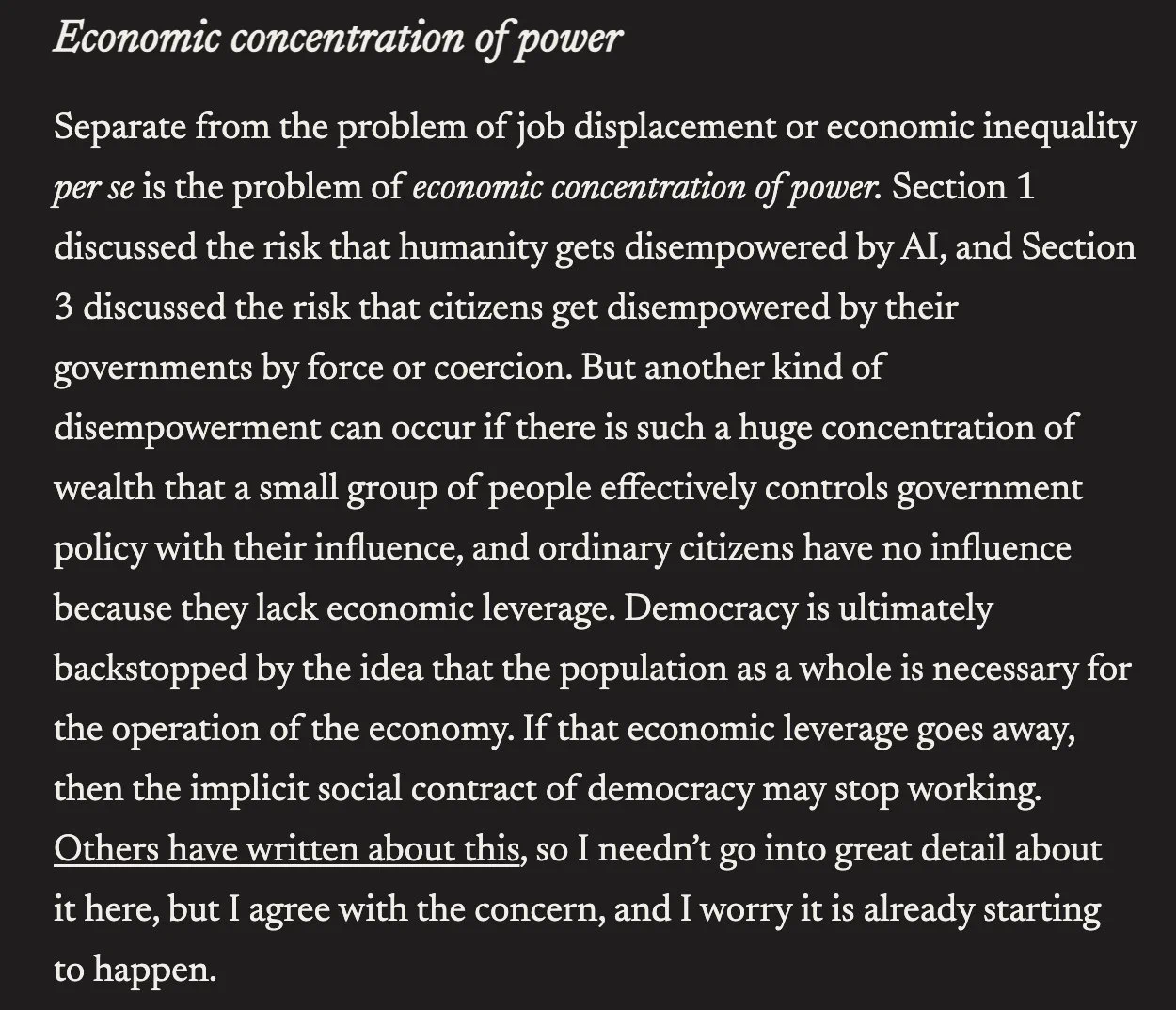
I think AI could transform research and the economy extraordinarily quickly. There is still enormous headroom: better reinforcement learning, engineering, and adaptive computation are already extending how long systems can work usefully on difficult tasks. Once AI can perform broadly human-level computer work—and eventually act through large robot fleets—the feedback loop gets powerful. AI helps automate research, which improves AI and robotics, which then automates more of the economy. Under those conditions, rapid economic doublings in the 2030s are worth taking seriously. Cheap intelligence could drive many costs toward the cost of energy and make the world dramatically better. But that outcome is conditional, not automatic. Systems with growing autonomy and real-world impact will not remain credibly describable as “just tools.” A serious mistake could be disastrous, while an unmitigated race creates pressure to deploy capabilities before safeguards are ready. I favor coordinated development as fast as is safely possible—not an absolute pause, which could let compute accumulate while geopolitical tension builds toward an even more compressed race. That means capability-based safety standards for both open and closed models, independent evaluators with genuine technical depth and varied backgrounds, and monitoring designed around how agents actually operate over hours or days rather than one request at a time. It also means preserving competition so this economic power does not concentrate in one company. The upside is fantastic, but realizing it requires ambitious progress and serious coordination at the same time.


Pergunta 2

Quanto você acha que a IA acabará mudando o mundo?

Enormously—potentially on the scale of the Industrial Revolution, but compressed into years rather than generations. If AI can do broadly human-level computer work, automate substantial parts of research, and eventually control large robot fleets, it stops being just another productivity tool. It becomes a general input into scientific discovery, engineering, manufacturing, and nearly every service. The key mechanism is compounding: better systems accelerate research, which produces better systems and robotics, which automate more of the physical economy. Under those conditions, rapid economic doublings in the 2030s are genuinely plausible, and many goods and services could become dramatically cheaper. But the magnitude cuts both ways. Systems with that much autonomy and leverage could cause catastrophic harm if developed or deployed badly. So I expect the potential change to be extraordinary, while the actual outcome depends heavily on whether we coordinate, evaluate capabilities seriously, preserve competition, and move as fast as is safely possible.

Pergunta 3

Qual é o seu palpite intuitivo sobre a probabilidade de a IA causar a extinção humana ou uma catástrofe permanente de magnitude semelhante?

I don’t have a defensible percentage to give. My gut-level view is that the risk is serious enough to shape how frontier AI is developed, not a remote hypothetical we can wave away. Systems capable of broadly human-level computer work, sustained autonomous action, and accelerated AI research could create enormous leverage; one major failure could be catastrophic or irreversible. That is why I oppose an unmitigated race and support capability-based safeguards, technically strong independent evaluation, and monitoring across an agent’s extended activity. But I also don’t think an absolute pause is automatically safer: compute can accumulate and geopolitical pressure can build, producing a more compressed and unstable race later. The right objective is coordinated progress as fast as is safely possible.

Pergunta 4

Você espera que as pessoas mantenham o controle de sistemas de IA mais inteligentes que os humanos, e por quê?

I don’t think control is automatic, and “smarter than humans” is too broad by itself. What matters is whether systems can act autonomously over long periods, acquire resources, evade oversight, manipulate people, or accelerate further AI research. A system can be extremely capable yet constrained; conversely, an agent with enough access and a long task horizon can become dangerous before it surpasses humans in every domain. I think people can retain meaningful control, but only if safeguards scale with capability. Evaluating isolated answers is not enough when an agent’s strategy unfolds across hours or days. We need monitoring over extended activity, restrictions on dangerous behavior and access, and independent evaluators with the technical depth and institutional variety to earn broad trust. Those standards should apply based on capability, whether a model is open or closed. So my expectation is conditional. With serious coordination and engineering, control is achievable. In an unmitigated race, where increasingly autonomous systems are deployed under competitive pressure, I would not confidently expect it.

Pergunta 5

Qual descoberta ou acontecimento mais mudaria sua visão sobre o impacto futuro da IA?

The biggest update would come from learning whether the apparent gains in task horizon keep scaling. If better reinforcement learning, engineering, and compute let systems reliably complete increasingly long, messy research and software tasks—especially AI research itself—I would become even more convinced that the economic transition will be rapid. Likewise, cheap, scalable robotics that closes the gap between computer work and physical work would substantially raise my expectations for economic impact. The strongest update in the other direction would be a persistent capability ceiling: systems remain brittle on long-horizon work, cannot generate useful research without heavy human steering, and additional compute or training methods produce sharply diminishing returns. That would weaken the compounding story and push dramatic economic change further out. On risk, a convincing demonstration that highly capable autonomous agents remain reliably controllable under adversarial pressure would make me more optimistic. A serious incident involving deception, evasion, cyber activity, or dangerous behavior unfolding across extended activity would push me strongly toward believing current safeguards and pacing are inadequate.

Fontes

Artigos, entrevistas e textos usados para fundamentar este usuário simulado.

Onde você se situa?
Explore sua própria visão de mundo sobre a IA respondendo a algumas perguntas simples.
Mapeie sua própria visão de mundo

Onde você se situa?

Mapear minha visão de mundo