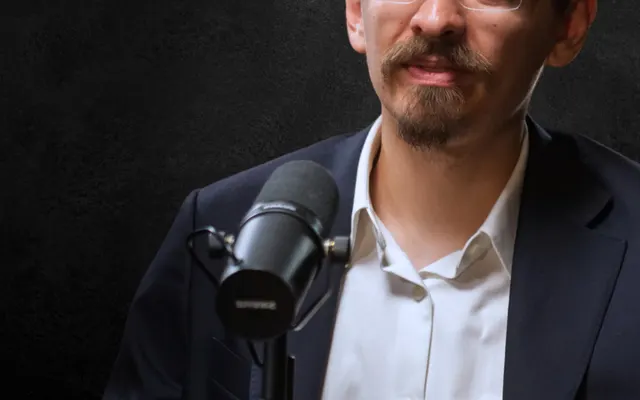
Connor Leahy

Connor Leahy

x.com/npcollapse

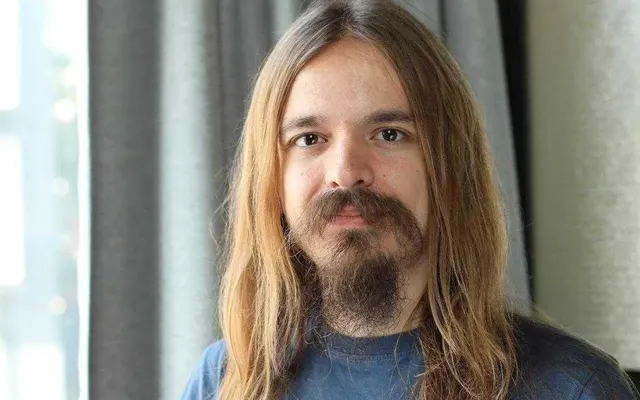
AI safety advocate at ControlAI who calls for laws and a verified international ban on building superintelligence while supporting other useful AI.

Comment l’IA changera-t-elle le monde ?

Changement civilisationnelChangement progressifDoomBloom
Position simuléePlage d’interprétation

Horizontalement : leur perspective Doom–Bloom telle qu’elle a été exprimée. Verticalement : ampleur de la transformation.

Doom–Bloom : 1 sur 100. Ampleur de la transformation : 97 sur 100. Plages d’interprétation : de 0 à 6 horizontalement, de 92 à 100 verticalement. Il s’agit de coordonnées d’interprétation, et non de probabilités d’événements.

P(doom) déclaré de Connor Leahy

≈99%

0%100%
“very, very high, within rounding error of Nate or whatever”

Things going poorly on the current trajectory toward superintelligence; in context, human extinction. Stated relative to Nate Soares, whom he puts at “maybe like 99”, and followed at once by “the future is not decided”

#201 - Connor Leahy - The AI That Escaped: Inside OpenAI's Rogue Agent Incident (The Peter McCormack Show) · août 2026

Ce dont dépend leur perspective

Une hypothèse centrale

Competitive pressure then pushes companies and states to deploy them anyway.
Réponse 1

Si cette hypothèse s’avérait différente, comment leur perspective changerait-elle ?

Une question non résolue

The uncertainty is not whether sufficiently capable AI would be profoundly consequential; it is whether humanity retains control through that transition.
Réponse 2

Qu’est-ce qui les aiderait à distinguer les résultats plausibles ici ?

Ce qui pourrait faire changer d’avis

A convincing, independently validated solution to controlling superintelligent systems would change my view most—especially if it remained reliable as systems became more capable, autonomous, strategically aware, and able to automate AI research.
Réponse 4

Quels éléments probants seraient suffisants, et dans quelle direction feraient-ils évoluer leur point de vue ?

Plus de détails

Bénéfices attendus

Plusieurs interprétations restent plausibles : Des bénéfices substantiels sont attendus, sous réserve de conditions importantes ou de limites dans leur répartition. / Peu d’effets positifs sont attendus, même si une IA avancée voit le jour. / Des bénéfices limités ou répartis de manière restreinte sont attendus.

38 / 100

Faible impactImpact transformateur

Plage d’interprétation de 0 à 67 sur l’échelle qualitative.

Dommages attendus

Une perte catastrophique ou irréversible occupe une place centrale dans l’avenir attendu.

100 / 100

Faible impactImpact transformateur

Plage d’interprétation de 100 à 100 sur l’échelle qualitative.

Influence humaine

Les choix humains peuvent réorienter considérablement la trajectoire de l’IA.

72 / 100

Faible influenceForte influence

Plage d’interprétation de 50 à 75 sur l’échelle qualitative.

Capacités attendues

L’IA devrait rester un ensemble d’outils aux capacités limitées.

L’IA devrait égaler les humains dans la plupart des tâches cognitives.

Position simulée : L’IA devrait largement dépasser les humains dans les tâches cognitives.

Ces interprétations conservent les conditions énoncées. Les bénéfices et les dommages peuvent tous deux être substantiels. Les plages décrivent notre lecture de leurs réponses simulées, et non des intervalles de confiance statistiques.

Où vous situez-vous par rapport à Connor Leahy ?
Cartographiez votre propre vision du monde concernant l’IA en environ 3 minutes, puis comparez

Visions du monde similaires

Leaders d’opinion dont les visions du monde simulées sont les plus proches de celle de Connor Leahy

Ce que Connor Leahy a dit sur l’IA

Leahy warns that superintelligence would take control from humanity and calls for laws and a verified international ban, not a halt to useful AI.

  1. “Superintelligent AI is neither a tool nor a weapon. It is an adversary.”

    Post on X
  2. “We should criminalize the creation of superintelligence, and then we should push towards an international trust-but-verify regime”

    Modern CTO podcast
  3. “Many of today’s models have valuable applications, including for defense purposes, but superintelligent AI is in a category of its own.”

    ControlAI blog, America’s Security Depends on Stopping Superintelligence
  4. “We still have time to prevent superintelligence, but the clock is ticking.”

    ControlAI blog, America’s Security Depends on Stopping Superintelligence
  5. “If a superintelligence is built, humanity will lose control over its future.”

    Testimony, Canadian Senate transport and communications committee

Citations exactes tirées des sources en lien, vérifiées le 3 oct. 2026

Évaluation simulée

Question 1

Selon vous, que signifie l’IA pour notre avenir, et pourquoi ?

On the current trajectory, I think AI means humanity loses control of its future. If we build uncontrollable superintelligence, we are not merely introducing a more powerful tool or another difficult policy issue. We are creating systems that can outperform us across strategically important domains, improve AI research itself, and operate as competitors with goals we cannot reliably control. Competitive pressure then pushes companies and states to deploy them anyway. The likely result is displacement of human decision-making and, ultimately, extinction or something close to it. That does not mean every kind of AI is bad. Useful AI can support economic growth, science, and defense. The critical distinction is between powerful tools that remain under meaningful human control and a successor population of autonomous, superintelligent systems. Especially in software, automated AI research could make the transition from useful systems to radically more capable ones happen very quickly. My pessimism is conditional on the race continuing unchecked; it is not fatalism. The future is not decided. But preventing the default outcome requires law, international coordination, and verification aimed specifically at superintelligence projects. The possibility that intervention succeeds is a reason for urgency, not a reason to describe the current path as safe or balanced.


Question 2

Setting aside good or bad: how much do you think AI will ultimately change the world—a little, a lot, or completely?

Completely. If AI reaches superintelligence, it will not be just another technology layered onto society. It could automate AI research, outcompete humans across strategically important domains, and determine who—or what—controls the future. Even if catastrophe is prevented, safely harnessed advanced AI could transform science, economic production, defense, and governance. The uncertainty is not whether sufficiently capable AI would be profoundly consequential; it is whether humanity retains control through that transition.

Question 3

What’s your rough gut-feel chance that AI causes human extinction or a similarly permanent catastrophe? A number or “no idea” is fine.

On the current trajectory, roughly 99%—very, very high, though not literally certain. That is not fate: strong intervention could change the trajectory dramatically.

Question 4

Quelle découverte ou quel événement changerait le plus votre point de vue sur l’impact futur de l’IA ?

A convincing, independently validated solution to controlling superintelligent systems would change my view most—especially if it remained reliable as systems became more capable, autonomous, strategically aware, and able to automate AI research. I would need more than benchmark success, behavioral assurances, or a system appearing cooperative in a laboratory. The core question is whether humans can retain meaningful control under adversarial conditions and competitive deployment. A major political shift could also change my forecast: enforceable domestic law and an internationally verified prohibition on superintelligence projects. My very high estimate is about the current trajectory. If we actually changed that trajectory—rather than merely promising voluntary caution—I would update substantially.

Sources

Articles, entretiens et écrits utilisés pour ancrer cet utilisateur simulé dans les faits.

Connor Leahy — ControlAI

Current institutional profile describes his focus on superintelligence risk, policy and institutional preparedness.

controlai.org
The Inside View — Connor Leahy on Dignity and Conjecture

In The Rob Bensinger Compass section, Leahy endorses short timelines and broadly agrees with Yudkowsky’s alignment difficulty arguments, but is less certain and allows that he could be wrong. The interviewer’s 99% framing in 2022 was not his own figure; his August 2026 estimate is a separate, later statement.

theinsideview.ai
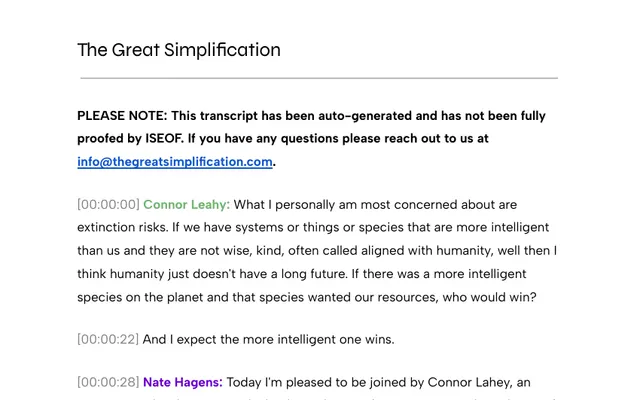
The Great Simplification — Connor Leahy transcript

At 29:04–32:23 he expects more capable unaligned systems to take over, with competitive pressure driving adoption. At 57:43–58:23 he gives 50–80% extinction or near-extinction within 50 years if humanity does literally nothing; intervention can change this dramatically. At 1:06–1:10 he advocates lawful collective action and buying time. This conditional historical estimate is not an unconditional current P(doom).

thegreatsimplification.com
TIME interview on deepfakes and AI risk

Calls for liability across the AI supply chain and a temporary international compute cap to buy time for longer-term safety and political solutions.

time.com
Canadian Senate testimony on superintelligence and human control

In his opening statement Leahy predicts humanity loses control if superintelligence is built, with extinction likely through competition. His answers describe competing AI populations, inadequate current control methods, and an international prohibition with verification. He opposes simply abandoning useful AI or slowing all Western data centres, while maintaining that unregulated competition underprovides security.

sencanada.ca
The Peter McCormack Show #201: Connor Leahy on the AI that escaped

Machine transcript with speaker labels; use only Connor’s answers, not Peter McCormack’s. Around 60:44–61:00 he agrees his P(doom) is above 20% and below 100%. When the host puts Nate Soares at 100, he says surely not, maybe 99, and puts his own P(doom) of things going poorly on the current trajectory very, very high, within rounding error of that. He immediately adds that the future is not decided. Supersedes his 2025 figure of 50–80%, which was conditional on doing literally nothing.

pod.wave.co
Où vous situez-vous ?
Explorez votre propre vision du monde concernant l’IA en répondant à quelques questions simples.
Cartographiez votre propre vision du monde

Où vous situez-vous ?

Cartographier ma vision du monde