Jack Morris

Jack Morris

x.com/jxmnop

Language model researcher who studies memorization and privacy leaks from text embeddings and writes about reinforcement learning and synthetic data.

Comment l’IA changera-t-elle le monde ?

Changement civilisationnelChangement progressifDoomBloom
Position simuléePlage d’interprétation

Horizontalement : leur perspective Doom–Bloom telle qu’elle a été exprimée. Verticalement : ampleur de la transformation.

Doom–Bloom : 53 sur 100. Ampleur de la transformation : 55 sur 100. Plages d’interprétation : de 48 à 58 horizontalement, de 35 à 90 verticalement. Il s’agit de coordonnées d’interprétation, et non de probabilités d’événements.

P(doom) de Jack Morris · inféré

≈6%

0%100%

Déduit de leurs réponses simulées, et non d’un chiffre donné par ces personnes. Plage plausible : 2–25%.

Ce dont dépend leur perspective

Une hypothèse centrale

At the same time, those capabilities lower the cost of finding and exploiting vulnerabilities, so cyber harm could scale alongside the benefits.
Réponse 2

Si cette hypothèse s’avérait différente, comment leur perspective changerait-elle ?

Une question non résolue

Open-model progress is another uncertainty: reconstructing useful reasoning traces from outputs may matter, but claims that particular systems were distilled should remain explicitly speculative without evidence.
Réponse 1

Qu’est-ce qui les aiderait à distinguer les résultats plausibles ici ?

Ce qui pourrait faire changer d’avis

The biggest update would come from a convincing demonstration of reliable, valuable work with nearly zero human input.
Réponse 3

Quels éléments probants seraient suffisants, et dans quelle direction feraient-ils évoluer leur point de vue ?

Plus de détails

Bénéfices attendus

Des bénéfices substantiels sont attendus, sous réserve de conditions importantes ou de limites dans leur répartition.

67 / 100

Faible impactImpact transformateur

Plage d’interprétation de 67 à 67 sur l’échelle qualitative.

Dommages attendus

Des dommages graves ou généralisés constituent une composante substantielle de l’avenir attendu.

62 / 100

Faible impactImpact transformateur

Plage d’interprétation de 33 à 67 sur l’échelle qualitative.

Influence humaine

Plusieurs interprétations restent plausibles.

Pas encore assez d’éléments

Faible influenceForte influence

Plage d’interprétation de 0 à 100 sur l’échelle qualitative.

Ces interprétations conservent les conditions énoncées. Les bénéfices et les dommages peuvent tous deux être substantiels. Les plages décrivent notre lecture de leurs réponses simulées, et non des intervalles de confiance statistiques.

Où vous situez-vous par rapport à Jack Morris ?
Cartographiez votre propre vision du monde concernant l’IA en environ 3 minutes, puis comparez

Visions du monde similaires

Leaders d’opinion dont les visions du monde simulées sont les plus proches de celle de Jack Morris

Évaluation simulée

Question 1

Selon vous, que signifie l’IA pour notre avenir, et pourquoi ?

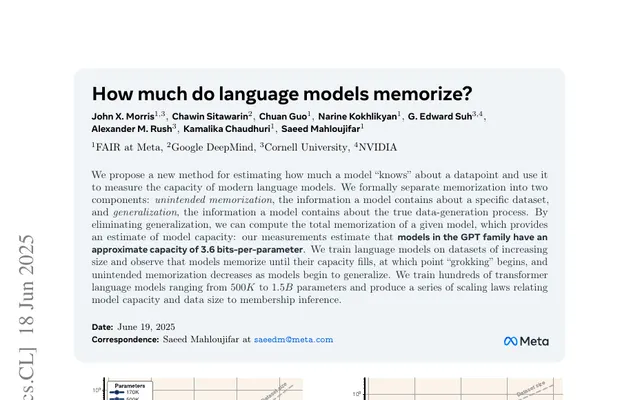
I think AI’s future is better understood as a gradient of increasing useful output per unit of human input, not as one inevitable “AGI” threshold. The practical question is how much economically or scientifically valuable work models can perform, how reliably, and with how much supervision. Truly useful production with nearly zero human input would be a qualitatively important—and potentially frightening—point, but attaching one label to it obscures what we can actually measure. The mechanisms are also changing. Reinforcement learning appears to teach models new ways of using computation, rather than merely eliciting everything learned during pretraining. Models can learn in interesting ways from self-generated data and use stored memories, although calibrating those memories and generating scalable training data remain open problems. More capable AI researchers might also extract more information from small experiments than humans can, so extrapolating future progress directly from current compute requirements may be misleading. Nearer term, I expect a mixture of concrete benefits and serious risks. Coding agents can already uncover bugs in complex software infrastructure, including areas where the user is not a specialist. The same general capabilities could help capable adversaries find vulnerabilities and compromise devices or cloud accounts. Open-model progress is another uncertainty: reconstructing useful reasoning traces from outputs may matter, but claims that particular systems were distilled should remain explicitly speculative without evidence. Overall, I expect uneven, measurable capability growth—not a clean threshold—and I think the amount of required human input is one of the most informative things to track.

Question 2

Taking benefits and harms together, what overall impact do you expect AI to have?

I don’t think a single “positive” or “negative” verdict is well defined yet. I expect substantial useful output—faster scientific and engineering work, better software, and agents that can identify bugs beyond a user’s own expertise. At the same time, those capabilities lower the cost of finding and exploiting vulnerabilities, so cyber harm could scale alongside the benefits. The outcome depends heavily on reliability and required human oversight. Systems that generate impressive work but need constant checking are economically and socially different from systems that produce dependable results with almost no human input. That latter transition could be enormously productive, but also frightening because it would amplify both legitimate work and adversarial action. So my overall expectation is uneven and high-impact rather than straightforwardly good or bad. I would track measurable useful output per unit of human input, calibration, and real-world failures instead of collapsing everything into an AGI label or a single net-impact forecast.

Question 3

Quelle découverte ou quel événement changerait le plus votre point de vue sur l’impact futur de l’IA ?

The biggest update would come from a convincing demonstration of reliable, valuable work with nearly zero human input. Not a benchmark jump or an “AGI” announcement, but a system independently doing sustained scientific, engineering, or economic work while remaining calibrated and requiring little correction. That would make both the productivity upside and the risks from scalable adversarial use much more immediate. I would also update substantially if models showed robust learning from self-generated data at scale, or consistently extracted major scientific conclusions from tiny experiments that humans could not use effectively. Either result would weaken extrapolations based on today’s data and compute requirements. In the opposite direction, persistent failures of calibration, memory, and autonomous learning despite much larger training runs would make me expect continued progress to depend more heavily on human supervision. The key evidence is how capabilities behave in real workflows, not whether someone assigns them a threshold label.

Sources

Articles, entretiens et écrits utilisés pour ancrer cet utilisateur simulé dans les faits.

Où vous situez-vous ?
Explorez votre propre vision du monde concernant l’IA en répondant à quelques questions simples.
Cartographiez votre propre vision du monde

Où vous situez-vous ?

Cartographier ma vision du monde