Jensen Huang

Jensen Huang

x.com/JensenHuang

Nvidia CEO who argues for broad AI adoption, open models and more infrastructure, and against slowdowns based on risk forecasts he calls unscientific.

¿Cómo cambiará la IA el mundo?

Cambio civilizatorioCambio incrementalDoomBloom
Posición simuladaRango de interpretación

Horizontal: su perspectiva Doom–Bloom expresada. Vertical: escala de la transformación.

Doom–Bloom: 97 de 100. Escala de la transformación: 68 de 100. Rangos de interpretación: de 92 a 100 en horizontal y de 50 a 75 en vertical. Son coordenadas de interpretación, no probabilidades de eventos.

P(doom) declarado de Jensen Huang

0% by 2030

0%100%
“There is 0% chance that's going to be the end of the world”

AI bringing about “the end of the world”, in answer to claims that AI could kill everyone by the end of the decade · By 2030

Nvidia's Jensen Huang rejects AI extinction warnings as "doomsday narratives" · sept 2026

Cronología de hitos de Jensen Huang
  1. Ciencia y vida cotidiana

    By 2030, I expect AI to be embedded across nearly every industry: writing and reviewing software, operating useful agents continuously, accelerating design and discovery, improving factories through simulation, strengthening cyber defense, and helping people interact with computers by specifying outcomes rather than mastering every technical detail.

    Respuesta 4

Agrupados por hito, sin espaciarlos ni ordenarlos por fechas inferidas. La IA general y la IA sobrehumana conservan sus definiciones.

De qué depende su perspectiva

Un supuesto central

Claims of recursive self-improvement do not magically eliminate engineering, testing, deployment constraints or the physical infrastructure AI depends on.
Respuesta 1

Si este supuesto resultara distinto, ¿cómo cambiaría su perspectiva?

Más detalles

Beneficio esperado

Se esperan beneficios transformadores y de gran valor para muchos.

98 / 100

Poco impactoImpacto transformador

Rango de interpretación de 100 a 100 en la escala cualitativa.

Daño esperado

Se espera poco impacto adverso significativo.

8 / 100

Poco impactoImpacto transformador

Rango de interpretación de 0 a 33 en la escala cualitativa.

Influencia humana

Una estimación provisional a partir de tus respuestas; el rango más amplio muestra otras lecturas plausibles.

61 / 100

Poca influenciaInfluencia fuerte

Rango de interpretación de 21 a 100 en la escala cualitativa.

Ritmo de desarrollo

Detener o frenar considerablemente el desarrollo de IA más capaz.

Posición simulada: Continuar el desarrollo con las salvaguardas indicadas.

Acelerar el desarrollo de IA más capaz.

Reglas para usar la IA

Restringir los usos de la IA mencionados hasta que existan protecciones o permisos previos.

Posición simulada: Permitir los usos de la IA mencionados con rendición de cuentas y protecciones específicas.

Reducir al mínimo las restricciones a los usos de la IA mencionados.

Acceso a la IA

Restringir el acceso a la IA potente.

Permitir el acceso con restricciones de capacidad o de uso.

Posición simulada: Favorecer un acceso amplio o abierto a la IA potente.

Estas interpretaciones conservan las condiciones que se indicaron. Los beneficios y los daños pueden ser considerables a la vez. Los rangos describen cómo leemos sus respuestas simuladas, no intervalos de confianza estadísticos.

¿Dónde te ubicas frente a Jensen Huang?
Mapea tu propia visión de la IA en unos 3 minutos y luego compárala

Visiones similares

Líderes de opinión cuyas visiones simuladas son las más cercanas a la de Jensen Huang

Lo que Jensen Huang ha dicho sobre la IA

Huang argues for broad AI adoption, open models and more infrastructure, and says alarming people about AI risk is irresponsible.

  1. “Scaring people is unnecessary. It is irresponsible.”

    CBS News interview
  2. “Our company’s success is directly connected to the safe deployment of products and services”

    CBS News interview
  3. “Open source is fundamentally necessary for many industries to join the AI revolution.”

    Lex Fridman Podcast
  4. “Every college student should graduate and be an expert in AI.”

    Lex Fridman Podcast
  5. “The choices we make now, how fast we build, how broadly we participate and how responsibly we deploy it, will shape what this era becomes.”

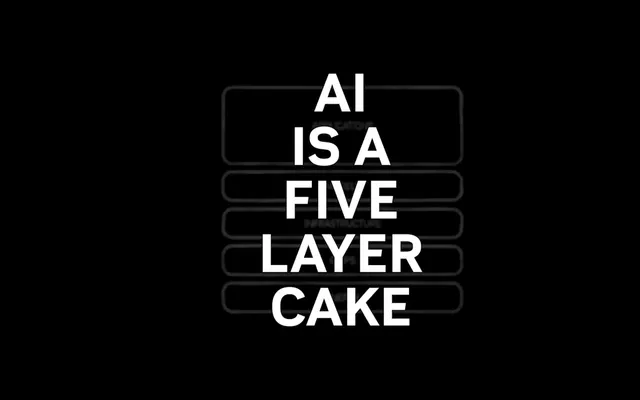
    Essay, AI Is a 5-Layer Cake

Citas textuales de las fuentes enlazadas, comprobadas el 3 oct 2026

Evaluación simulada

Pregunta 1

¿Qué crees que significa la IA para nuestro futuro y por qué?

AI means a new layer of infrastructure—energy, chips, computing systems, models and applications—that will amplify human productivity across essentially every industry. Companies and countries will build specialized systems; more people will program by describing what they want; factories, vehicles and robots will improve through simulation; useful agents will run continuously. That requires more computing, more energy and more investment—not paralysis. And I reject the doomer narrative. People invent extinction percentages, call them scientific forecasts, and then demand that everyone slow down. Based on what? Look at the record: radiologists were supposed to disappear, coding was supposed to disappear, whole professions were supposedly about to vanish. Why should repeatedly wrong forecasters dictate industrial policy now? Claims of recursive self-improvement do not magically eliminate engineering, testing, deployment constraints or the physical infrastructure AI depends on. Of course products must be safe. When a laboratory has an incident, fix the engineering, controls and testing. That is not evidence that civilization must stop building. Open models also let companies and nations develop their own AI, compete and strengthen cyber defense instead of depending on a handful of closed systems. The future will belong to those who adopt this technology, build the infrastructure and use it—not those frightened into surrender by made-up doomsday forecasts.

Pregunta 2

Setting aside good or bad: how much do you think AI will ultimately change the world—a little, a lot, or completely?

A lot—profoundly. AI will become infrastructure for nearly every industry, like electricity or computing, changing how we design products, write software, operate factories, discover medicines and run businesses. It will automate many tasks, but that is not the same as eliminating the purpose of every profession. “Completely” is too theatrical if it means the physical world, engineering constraints and human goals somehow vanish. AI still depends on energy, chips, data centers, models, applications and people deploying it. So I expect enormous transformation—not magic, and certainly not the doomsday fantasy.

Pregunta 3

What’s your rough gut-feel chance that AI causes human extinction or a similarly permanent catastrophe? A number or “no idea” is fine.

For the period through 2030: 0%. These extinction percentages are made up, not scientific forecasts.

Pregunta 4

¿Qué esperas que la IA sea capaz de hacer para 2030?

By 2030, I expect AI to be embedded across nearly every industry: writing and reviewing software, operating useful agents continuously, accelerating design and discovery, improving factories through simulation, strengthening cyber defense, and helping people interact with computers by specifying outcomes rather than mastering every technical detail. I also expect far more physical AI—robots, autonomous machines and vehicles—but deployed through engineering, simulation, testing and real-world validation. Not a magical intelligence that wakes up, recursively improves without constraint and suddenly escapes the need for chips, energy, data centers, product development and human organizations. The important distinction is tasks versus professions. AI will automate and transform many tasks. That does not mean every profession disappears or human purpose becomes obsolete. We heard those dramatic predictions about radiologists and programmers already. Why should the same forecasters now be treated as prophets? By 2030, AI will be extremely capable and economically important. It will not be the end of the world.

Fuentes

Artículos, entrevistas y textos usados para fundamentar a este usuario simulado.

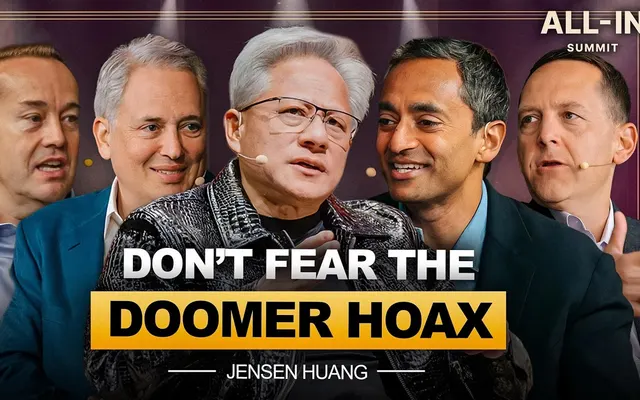
All-In Summit: doomer critique and Trump call

At 04:46–06:33 Huang dismisses extinction estimates and attacks earlier predictions. At 15:25 he rejects runaway self-improvement. At 23:48–29:29 he praises Trump’s rejection of doomerism and opposes slowdown. Transcript mirror: https://sozai.app/transcript/jensen-huang-doomer-hoax-superintelligence-ai-future/ . The literal hoax declaration during the call is Trump’s; Huang endorses the framing.

youtube.com
Reporting corroborating Huang’s response during the call

Reports Huang affirming Trump’s rejection of AI doomsayers. Used to check speaker attribution in the automated transcript, not as evidence that Trump’s exact words were Huang’s.

pcgamer.com
Axios interview: Jensen Huang is AI’s anti-doom evangelist

In Axios’s interview, he rejects doomer forecasts as policy guidance and argues overreaction would delay adoption and weaken American competitiveness.

axios.com
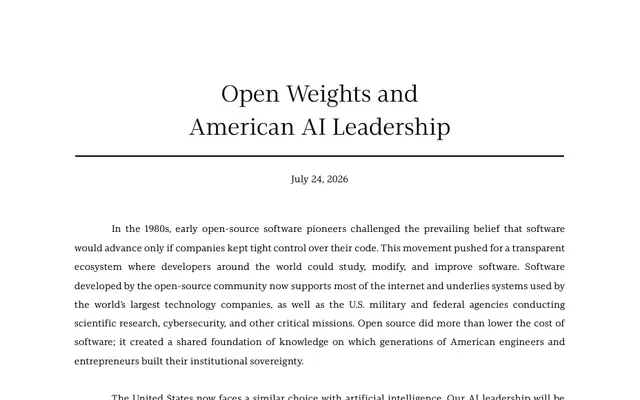
Open Weights and American AI Leadership

Coalition letter promoted by Huang defending open weights as essential for competition, sovereignty and security. Argues that defenders need access to strong models and favors targeted protections over broad restrictions. This is a shared policy position, not his sole-authored essay or proof that all open releases are safe.

images.nvidia.com
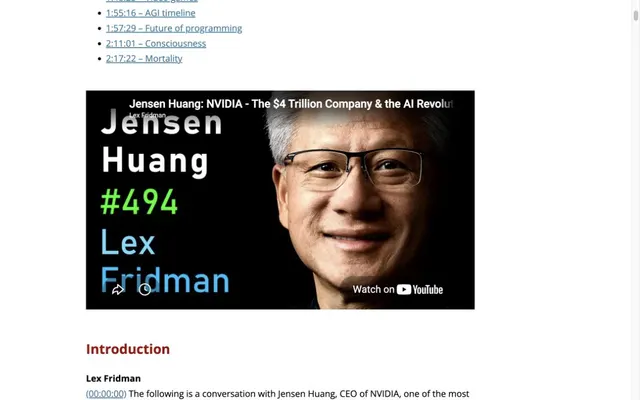
Lex Fridman: Jensen Huang on NVIDIA and the AI revolution

Distinguishes automating tasks from eliminating the purpose of a profession, predicts more people can program through specifications, and urges broad adoption. Separates functional intelligence from humanity. His provocative AGI claim answers a particular short-lived billion-dollar-company definition; it is not a claim that agents could already recreate NVIDIA.

lexfridman.com
AI Is a 5-Layer Cake

Huang’s own essay treats AI as infrastructure built from energy, chips, computing infrastructure, models and applications. Grounds his build-and-deploy position in physical capacity and economic coordination, with adoption across companies and countries. This is his infrastructure thesis, not independent validation of every growth claim.

blogs.nvidia.com
NVIDIA Q2 FY2027 earnings call: Huang on open models and agents

In his own answers, Huang argues that open models enable proprietary enterprise AI and distributed cyber defense, while continuously running agents expand compute demand. He dismisses some AGI milestones as less useful than productive work. Profitability and demand claims are commercially interested executive statements, not independently established economics.

investor.nvidia.com
CES 2026: open models and physical AI

NVIDIA’s official recap quotes Huang on open models across industries, simulation before real-world deployment, autonomous vehicles and manufacturing. Adds concrete mechanisms for the transformation he expects beyond chatbots. Announcements and demonstrations describe his company’s plans and claims, not proof of general autonomous competence.

blogs.nvidia.com
Nvidia’s Jensen Huang rejects AI extinction warnings as “doomsday narratives”

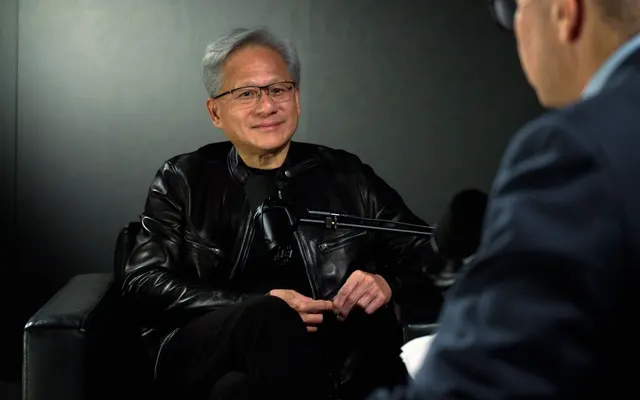
CBS News write-up of Jo Ling Kent’s interview, recorded September 18, quoting him directly. Responding to claims that AI developers believe it could kill everyone by the end of the decade, he says 2030 is not going to be the end of the world, that there is a 0% chance of that, that scaring people is unnecessary and irresponsible, and that such warnings are “doomsday narratives”. A categorical dismissal for the period to 2030, not a calculated long-run estimate.

cbsnews.com
¿Dónde te ubicas?
Explora tu propia visión de la IA respondiendo unas pocas preguntas sencillas.
Mapea tu propia visión de la IA

¿Dónde te ubicas?

Mapear mi visión de la IA