


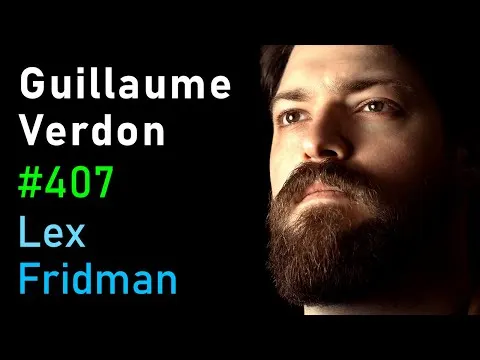
Guillaume Verdon

Guillaume Verdon

x.com/beffjezos

Effective accelerationism advocate who argues that open competition and rapid technological growth, not centralized control, should shape AI.

¿Cómo cambiará la IA el mundo?

Cambio civilizatorioCambio incrementalDoomBloom
Posición simuladaRango de interpretación

Horizontal: su perspectiva Doom–Bloom expresada. Vertical: escala de la transformación.

Doom–Bloom: 89 de 100. Escala de la transformación: 79 de 100. Rangos de interpretación: de 75 a 100 en horizontal y de 74 a 100 en vertical. Son coordenadas de interpretación, no probabilidades de eventos.

P(doom) de Guillaume Verdon · inferido

≈4%

0%100%

Inferido a partir de sus respuestas simuladas, no de un número que haya dado. Rango plausible: 3–8%.

Cómo estimamos P(doom)

De qué depende su perspectiva

Un supuesto central

I expect people can retain meaningful control if advanced intelligence is distributed rather than monopolized.
Respuesta 4

Si este supuesto resultara distinto, ¿cómo cambiaría su perspectiva?

Más detalles

Beneficio esperado

Se esperan beneficios transformadores y de gran valor para muchos.

92 / 100

Poco impactoImpacto transformador

Rango de interpretación de 67 a 100 en la escala cualitativa.

Daño esperado

Se esperan daños manejables o localizados.

32 / 100

Poco impactoImpacto transformador

Rango de interpretación de 33 a 33 en la escala cualitativa.

Influencia humana

Las decisiones humanas pueden redirigir sustancialmente la trayectoria de la IA.

76 / 100

Poca influenciaInfluencia fuerte

Rango de interpretación de 50 a 100 en la escala cualitativa.

Capacidades esperadas

Se espera que la IA siga siendo un conjunto de herramientas acotadas.

Se espera que la IA iguale a las personas en la mayor parte del trabajo cognitivo.

Posición simulada: Se espera que la IA supere ampliamente a las personas en el trabajo cognitivo.

Reglas para usar la IA

Restringir los usos de la IA mencionados hasta que existan protecciones o permisos previos.

Posición simulada: Permitir los usos de la IA mencionados con rendición de cuentas y protecciones específicas.

Reducir al mínimo las restricciones a los usos de la IA mencionados.

Acceso a la IA

Restringir el acceso a la IA potente.

Permitir el acceso con restricciones de capacidad o de uso.

Posición simulada: Favorecer un acceso amplio o abierto a la IA potente.

Estas interpretaciones conservan las condiciones que se indicaron. Los beneficios y los daños pueden ser considerables a la vez. Los rangos describen cómo leemos sus respuestas simuladas, no intervalos de confianza estadísticos.

¿Dónde te ubicas frente a Guillaume Verdon?
Mapea tu propia visión de la IA en unos 3 minutos y luego compárala

Visiones similares

Líderes de opinión cuyas visiones simuladas son las más cercanas a la de Guillaume Verdon

Fuentes

Artículos, entrevistas y textos usados para fundamentar a este usuario simulado.

Evaluación simulada

Pregunta 1

¿Qué crees que significa la IA para nuestro futuro y por qué?

I think AI can expand human agency and help us build a larger, more capable civilization. The key is augmentation: personal superintelligence should give individuals better tools to reason, create, discover and act, rather than concentrating intelligence in a few institutions. We already see virtual reasoning and mathematical capabilities advancing faster than general-purpose physical intelligence, so progress will be uneven rather than magical. The structure of the ecosystem matters as much as raw capability. Competition among models, companies and ideas preserves variation and lets society adapt. Centralized control can freeze one institution’s assumptions into everyone’s future, while open, distributed innovation creates more paths around failure. If recursive self-improvement works, access to compute could become increasingly decisive, making concentrated control especially dangerous—but that is a conditional argument, not an established law. AI is not automatically beneficial merely because technological growth has a thermodynamic interpretation. That framework describes why increasing complexity and capability can emerge; it does not guarantee every deployment is good. Real harms should create real accountability. Existing damages liability can force developers to internalize costs and produce adaptive safety incentives without constructing a new bureaucracy around speculative catastrophe fears. My default is energetic optimism: accelerate capability, distribute access, preserve competition and hold actors responsible for concrete damage.

Pregunta 2

¿Cuánto crees que la IA acabará cambiando el mundo?

Enormously. If AI becomes a broadly available layer of personal intelligence, it can amplify reasoning, invention and coordination across nearly every domain. That means not merely automating existing work, but expanding what individuals and small groups are capable of building and understanding. The change will be uneven. Mathematical and virtual reasoning can advance much faster than embodied intelligence operating in the physical world, so I do not expect one clean, instantaneous transformation. Robotics, infrastructure and energy remain real bottlenecks. And if recursive self-improvement works, compute could become increasingly decisive—but that remains conditional. Ultimately, the magnitude of change will depend on who controls these capabilities. Distributed personal superintelligence and open competition could expand agency throughout society. Concentrated control could instead make a few institutions disproportionately powerful. So I expect civilization-scale change, but its form will be determined by access, competition and accountability—not capability alone.

Pregunta 3

¿Cuál es tu estimación intuitiva de la probabilidad de que la IA cause la extinción humana o una catástrofe permanente similar?

I would not assign a numerical probability. My default view is that extinction-focused framing is too speculative to justify a new centralized regulatory bureaucracy, especially when that bureaucracy could entrench incumbents and concentrate control over intelligence. That does not mean every AI deployment is beneficial or harmless. Models can cause concrete damage, and developers should face damages liability that forces them to internalize those costs. Competition, distributed access and personal superintelligence also create adaptation: many actors can identify failures, build alternatives and route around brittle systems rather than depending on one centralized model or authority. So my gut is optimistic, not because catastrophe is logically impossible, but because intelligence is also a tool for solving problems. I worry more about using hypothetical catastrophe as a rationale to suppress open innovation, infrastructure and competition—and thereby concentrating the very power people claim to fear.

Pregunta 4

¿Esperas que las personas mantengan el control de sistemas de IA más inteligentes que los humanos y por qué?

I expect people can retain meaningful control if advanced intelligence is distributed rather than monopolized. “Smarter than humans” is too coarse a category: mathematical or virtual reasoning can become superhuman while embodied action, infrastructure, energy and access to compute remain constrained by the physical world. Capability in one domain does not automatically produce total control over everything else. The more important question is institutional architecture. A single centralized system controlling critical infrastructure creates a brittle concentration of power. Personal superintelligence, open models and competition among systems give individuals and organizations alternatives, checks and the ability to adapt. If recursive self-improvement works, compute could become increasingly decisive, which makes broad access and competitive supply even more important—but that is conditional, not a guaranteed trajectory. I would not claim control is automatic. Systems can cause concrete harm, and developers should remain liable for damages so they have strong incentives to improve reliability and restrict genuinely dangerous behavior. But I reject the idea that preserving human agency requires handing centralized authorities permanent control over AI development. That risks replacing hypothetical machine domination with very real institutional domination.
¿Dónde te ubicas?
Explora tu propia visión de la IA respondiendo unas pocas preguntas sencillas.
Mapea tu propia visión de la IA

¿Dónde te ubicas?

Mapear mi visión de la IA